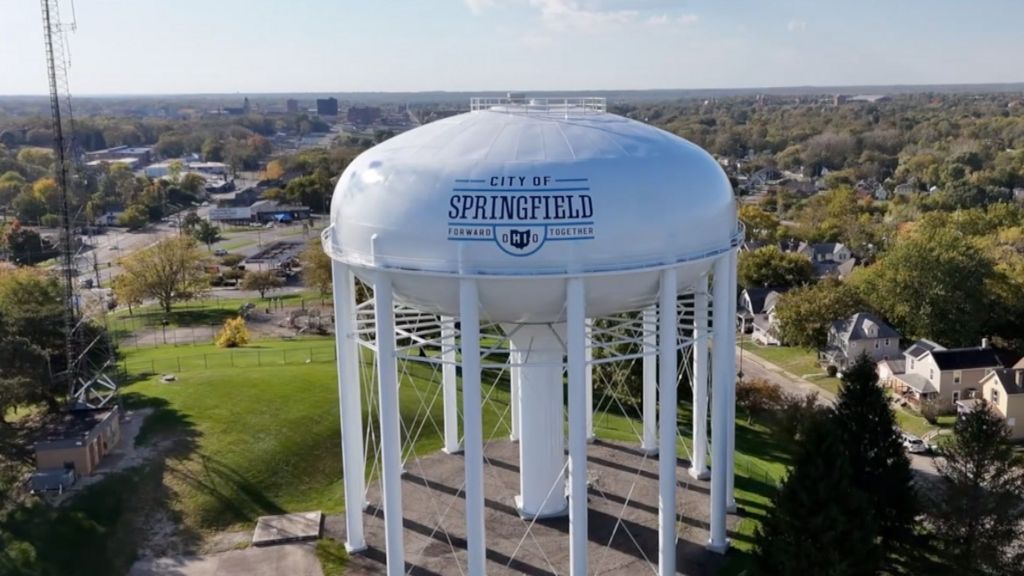
Nestled in the southwest corner of Ohio, the small industrial town of Springfield has been catapulted to the center of America’s bitter national debate over immigration ahead of the 2026 midterm elections — a flashpoint that has come to embody two starkly different visions of the country’s present and future, depending on who describes it.
For former and current President Donald Trump, Springfield is the perfect illustration of everything that has gone wrong with decades of lax U.S. immigration policy. It was here in 2024 that he amplified a widely debunked, false conspiracy theory claiming Haitian immigrants were stealing and eating local residents’ pets. Today, Trump points to his aggressive mass deportation campaign as proof he is delivering on his promise to give long-time residents “their town back.”
For critics and analysts, however, Springfield represents a far more familiar, tragic cycle of modern American life: decades of decline for traditional manufacturing industries, followed by a wave of new immigration drawn by affordable housing and a surplus of low-wage jobs that native-born workers often leave unfilled. This pattern has repeated itself across hundreds of small former industrial towns across the U.S. What is unfolding in Springfield is anything but unique.
The human cost of Trump’s immigration crackdown came to a devastating head this summer with the death of 20-year-old Pierre Damas Bel, a Haitian migrant who built a promising life in Springfield only to lose everything after the Supreme Court upheld the Trump administration’s decision to end Temporary Protected Status (TPS) for more than 350,000 Haitian migrants living legally in the U.S.
Bel arrived in Springfield earlier in 2024 to reunite with his father and stepmother, fleeing the brutal gang violence and total political collapse that has convulsed his native Haiti. He entered the U.S. legally through a now-terminated Biden-era program that allowed vulnerable migrants waiting in Mexico to enter the country to pursue their asylum claims. After arriving, he was granted TPS, a humanitarian protection program that allows vetted people from crisis-stricken countries to live and work legally in the U.S. for 18-month periods, which are routinely extended as long as dangerous conditions persist in the migrant’s home country.
By all accounts, Bel threw himself into building a new life in America. A family friend told the BBC he was an honors student, a gifted athlete, and a cadet in a high school program that trains students to become commissioned officers in the U.S. Armed Forces. But after the Supreme Court’s June ruling, Bel was ordered to report to a U.S. Immigration and Customs Enforcement (ICE) field office, where he was fitted with a GPS ankle monitor to track him as he awaited deportation.
Bel documented his despair on social media, writing that the monitor left him feeling overwhelming “shame and humiliation.” On August 31, he parked his car on the side of a highway outside Springfield, walked into oncoming traffic, and was killed instantly. His family has explicitly tied his death to the psychological toll of being forced to wear the tracking device.
Neither the Department of Homeland Security (DHS) nor ICE has directly responded to BBC inquiries about Bel’s case, but ICE has previously pushed back against any effort to hold the agency responsible for his death. Earlier this year, a spokesperson told U.S. media: “Remaining in the country illegally, while fighting removal, is a choice. Leaving with a free flight home and $2,600 is also a choice.”
Viles Dorsainvil, co-founder of a local Springfield support center for Haitian migrants facing deportation, told the BBC Bel had done everything possible to keep his legal status intact, and had twice visited ICE facilities to beg officials to remove the ankle monitor before he filed a formal legal motion to have it taken off. “He went twice to the ICE facilities… begging them to remove the ankle monitor,” Dorsainvil said. “He did everything right to be here until they put the tag on him.”
Bel’s death is just one outcome of a far broader policy shift: the Trump administration has already ended TPS protections for more than one million immigrants from 13 different countries, pushing hundreds of thousands of people who lived and worked legally in the U.S. for years into undocumented status overnight. For the 2026 midterm election campaign, Trump has centered his platform on border security and mass deportation of undocumented migrants. While the policy remains deeply popular with Republican base voters, polling shows overall public support for his harsh enforcement approach has declined over the past year.
Ohio has emerged as one of the most critical swing states in this year’s midterm elections, where one of two Republican-held U.S. Senate seats is up for grabs. Trump has visited the state twice this campaign season to rally his base and reverse a recent slide in his approval ratings. During an early October rally in Youngstown, he returned again to his talking point on Springfield, telling cheering supporters: “You have a little town, beautiful little town in Ohio where they dropped about 35,000 Haitians. Well, they’re being taken out and they’re almost going to be gone and we’re giving their town back.”
The Trump administration first announced it would end TPS for Haitians in June 2025, and a two-year legal battle ended this summer when the Supreme Court ruled in the administration’s favor. After the ruling, DHS General Counsel James Percival defended the decision, arguing: “The T in TPS stands for TEMPORARY, yet many of these designations became de facto amnesty. This is a win for the rule of law and common sense.”
In an August social media post that drew widespread criticism, DHS released a video showing Haitian migrants in chains and white uniforms being led onto a deportation flight, paired with upbeat, jaunty music and a text message ordering Haitians with expired TPS to “LEAVE IMMEDIATELY.” The administration has justified its crackdown by claiming Haiti is now safe enough for migrants to return — a claim that directly contradicts the U.S. State Department’s official travel advisory, which lists Haiti as a Level 4 “Do Not Travel” destination, the highest possible warning for dangerous countries.
Decades of economic decline are still visible across Springfield’s landscape, in the form of shuttered factory lots and boarded-up, abandoned homes. Like much of the American Midwest, the town was gutted by late 20th century deindustrialization, which left thousands out of work and prompted many native-born residents to move to coastal cities or warmer southern states in search of new opportunities.
Over the past five years, an estimated 20,000 Haitian migrants have settled in Springfield. The first wave arrived after the devastating 2010 Haiti earthquake, while a larger group came after the 2021 assassination of Haitian President Jovenel Moïse, which plunged the country into the ongoing wave of gang violence that persists today. The influx caused Springfield’s population to grow rapidly, and with TPS protecting their right to work, most Haitian migrants took low-wage jobs in local factories and distribution centers that went unfilled by native-born workers.
For many long-time Springfield residents, the rapid influx of new arrivals has sparked unease that aligns with Trump’s hardline approach. Rick Johnson, a lifelong Springfield resident and retired Marine whose porch is lined with American and service branch flags, is a vocal supporter of ICE’s deportation campaign. “We love America, we love Americans – any kind of Americans, but you kind of have to be American,” he said. Johnson noted that after decades of industrial decline, most of his old neighbors have moved away, and his only current neighbors are a Haitian family that moved in four years ago, who he says do not bother him personally. His concern, he says, is purely about the scale and speed of the change. “Really it’s the amount of them,” he said. “If you come here you [should] come here legally. The Temporary Protected Status is done… it’s time to go.”
Many local residents share a common perception that traffic safety has worsened since the Haitian community arrived, a concern amplified by a 2023 crash that killed 11-year-old Aiden Clark when his school bus overturned after a collision with a minivan driven by a Haitian migrant who did not have a valid U.S. driver’s license. The driver was sentenced to jail, but in a surprising rebuke to anti-immigrant politicians, Aiden’s father Nathan Clark spoke out at a city commission meeting to denounce leaders who used his son’s accidental death as a “political tool” to stoke anti-immigrant sentiment.
For Haitian residents of Springfield who have lost TPS, daily life has become defined by fear and uncertainty. At a local grocery store run by Paschur Castelly, a Haitian migrant who arrived in the U.S. 20 years ago, most shelves sit empty. Business has collapsed as migrants avoid leaving their homes or spending money over fears of ICE raids. “I can’t purchase new merchandise because I don’t have people coming in,” Castelly said. He added that most Haitian migrants in Springfield are hardworking people who fled chaos to build a better life: “our communities, we have doctors, we have engineers… we came here to get a better life, to help our family in Haiti, you know? Our country doesn’t offer us security.”
During a 20-minute interview with the BBC, only one customer entered the store. The customer, a warehouse worker who asked to remain anonymous for his own safety, pulled up his right pant leg to reveal the large ankle monitor ICE ordered him to wear. Like thousands of other Haitians in Springfield, he was given a stark choice: wear the monitor and check in with ICE every two weeks, or sign his own deportation order immediately. As the interview ended, Castelly locked the store’s front door — a routine precaution now that neighbors regularly fear unexpected ICE raids. When a local woman spotted the BBC crew, she shouted across the street to check that Castelly was safe, a small reflection of the pervasive anxiety that hangs over the town’s Haitian community.
Weeks before Americans head to the polls to decide control of Congress for the final two years of Trump’s second term, Springfield remains what it became when Trump first threw it into the national spotlight: a symbol of two irreconcilable visions of America, split along the lines of immigration, identity, and who gets to call this country home.