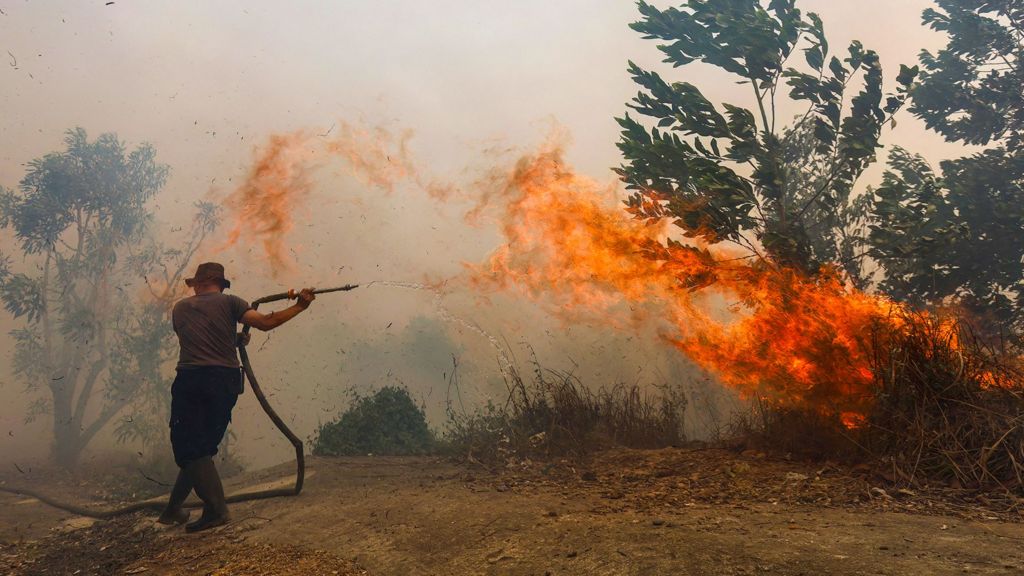
When sunlight filters through the thick toxic smog that cloaks Indonesian Borneo, every structure – from passing cars to residential homes to city streets – fades in and out of a dull, rust-colored fog. The scene has been widely described as nothing short of apocalyptic, but for local residents like Dianyra Eka Nastiti, a mother of three living in Palangkaraya, the terror peaks after dark.
“Sometimes at night my baby’s chest makes a rattling sound,” Nastiti shared. “She was hospitalized for bronchopneumonia when she was just a month and a half old, and every single night I lie awake worrying: Will my child wake up coughing tomorrow? These thoughts haunt me every night.”
Nastiti’s home sits on the frontline of a months-long environmental disaster that has choked large swathes of Southeast Asia in dangerous pollution. Data from open-access satellite platform Nusantara Atlas shows that roughly 1.9 million hectares of land across Indonesia – an area roughly equivalent to the entire U.S. state of New Jersey, or the whole nation of Fiji – have been burned by wildfires since January 2024 alone. One million of those hectares were lost just in September.
The harmful impact of the fires extends far beyond the burned areas. Smouldering forest, swamp, and peatland releases a thick mix of microparticles and carbon monoxide, forming a massive toxic cloud that has engulfed most of Indonesia and drifted as far as neighboring Singapore, Malaysia, and the Philippines.
As of mid-October, Indonesia’s Ministry of Health has documented more than 277,000 cases of chronic cough and acute respiratory infection linked to the haze, over 62,000 of which affect infants and toddlers under the age of five. Twenty-two-year-old Natari Victoria, who was admitted to a Palangkaraya health center after suffering from a persistent cough for more than a week, says the public health crisis has touched every corner of the community. “The forest fires have had a huge impact, especially on everyone’s health,” she explained. “I have young cousins, including babies, who are coughing too. It’s really taking a toll on them.”
Smoke from peat fires carries a complex mix of pollutants that pose severe, long-term risks to human health. Tiny particulate matter can penetrate deep into lung tissue, and in severe cases enter the bloodstream, triggering inflammation, chronic respiratory illness, and raising the risk of premature death. The fires also release massive volumes of toxic greenhouse gases into the atmosphere, worsening global climate change.
“Here in Central Kalimantan, especially in Palangkaraya, the sky has turned yellow and hazy,” said Riduan, head of the Palangkaraya Health Office. “What are residents actually breathing in? It’s not fresh oxygen – it’s carbon dioxide and pollutants. As a result, the body, specifically the brain, doesn’t get enough oxygen.”
Children, elderly people, and pregnant women are uniquely vulnerable to the haze, with health impacts worsening over prolonged exposure. Official guidance urges residents to stay indoors to limit exposure, but for many low-income communities, this advice is completely unworkable. “I still need to buy vegetables, stock up on food, purchase school supplies, and take care of other necessities,” Nastiti said. “It’s simply not possible to stay locked inside 24/7, and I feel like the people who say that have no idea what is actually happening here.”
Nastiti’s top priority is protecting her children’s health, so she forces them inside whenever the haze grows particularly thick. “With conditions being so unsafe, I have no choice,” she explained. “Our young children should be at the park, playing with their friends and going to school. Instead, they are locked inside the house.”
Thirty-seven-year-old Lola Macitri, who lives in the rural village of Ramang 50 kilometers north of Palangkaraya, has been similarly confined to her home as the smog has deepened from dusty grey to amber yellow to a murky burnt orange over recent weeks. Her children, like most students in the worst-affected regions of Indonesia, have shifted to remote online classes, while she and other local adults can only manage half a day of work outside before falling ill from the toxic air.
Countless farmers, daily-wage laborers, and small street vendors face an impossible choice: risk their health to earn a living, or stay safe and watch their livelihoods collapse. With few evacuation options available to low-income communities, most have no choice but to wait out the crisis. “If you ask whether we are afraid of the health risks, of course we are,” Macitri said. “But where else can we go? We just have to endure and stay strong through this situation, because there is simply no other option.”
Indonesian authorities are facing growing public anger over what many residents describe as a woefully insufficient response to the crisis. Officials say they have rolled out a range of fire suppression measures, from aerial waterbombing to experimental weather modification. Last week, the government announced it had deployed more than 60,000 personnel to carry out a coordinated land operation, claiming an 80% success rate in extinguishing new ignitions.
“At this point, I think we need to use every safe and effective option available to suppress the fires,” said Dr. Nisa Novita, a forestry and peatland researcher with Indonesian conservation NGO Yayasan Konservasi Alam Nusantara (YKAN). “It’s a bit like trying to save a sinking ship: we need to act urgently, use whatever tools can help, and prevent further damage while we still can.”
Even so, resources for frontline responders are rapidly running out. Firefighter Juni has been battling the blazes for more than 100 days, and says the fires often mask their persistence: while flames may die down on the surface, deep underground, smouldering blazes continue to eat through thick layers of carbon, vegetation, and peat. “It is truly exhausting,” he said, describing the chronic shortness of breath, persistent cough, and constant eye pain he has developed from working in the haze. When asked what he needs most to continue the fight, his answer was simple: “air. The haze makes it hard to breathe. We are just hoping for heavy rain.”
Juni’s wish is shared by millions of people across Indonesia and neighboring Southeast Asian nations. While seasonal wildfires are a recurring event in Indonesia, this year’s Super El Niño has amplified drought conditions and delayed the heavy seasonal rains that are the most effective tool for extinguishing stubborn peat fires. This has turned a routine seasonal event into an unprecedented catastrophe for frontline firefighters and local residents alike.
Dr. Novita noted that prolonged drought has also depleted local water reserves, making it even harder to bring the blazes under control. Fellow Palangkaraya firefighter Fauzi Rahman echoed this frustration, explaining that peatland fires require far more time and resources to extinguish than typical wildfires. “Peatland fires are hard to put out because they require a lot of water and a long time,” he said. “On regular land we can clear 20 hectares in a single day, especially with a large team… On peatland, it can take months. We really have to inject water deep down, all the way to the bottom, which requires a huge amount of water. And right now, water is hard to find.”
Most concerning of all, Dr. Novita says her team has documented fires spreading into previously unaffected areas, expanding the scope of the disaster beyond the usual high-risk zones. “So we’re not only dealing with fires in the usual hotspots but also seeing them emerge in new areas,” she said.
In Palangkaraya, residents are growing increasingly desperate for an end to the crisis. But for most, relief will only come when the much-awaited rains finally arrive. “Hopefully, with all the extraordinary efforts from the community, the military, and the police working together, the fires can be put out,” Riduan told reporters. “However, as of right now, the fires are still burning. So what can we hope for? Our greatest hope is that Almighty God will bring us rain soon.”