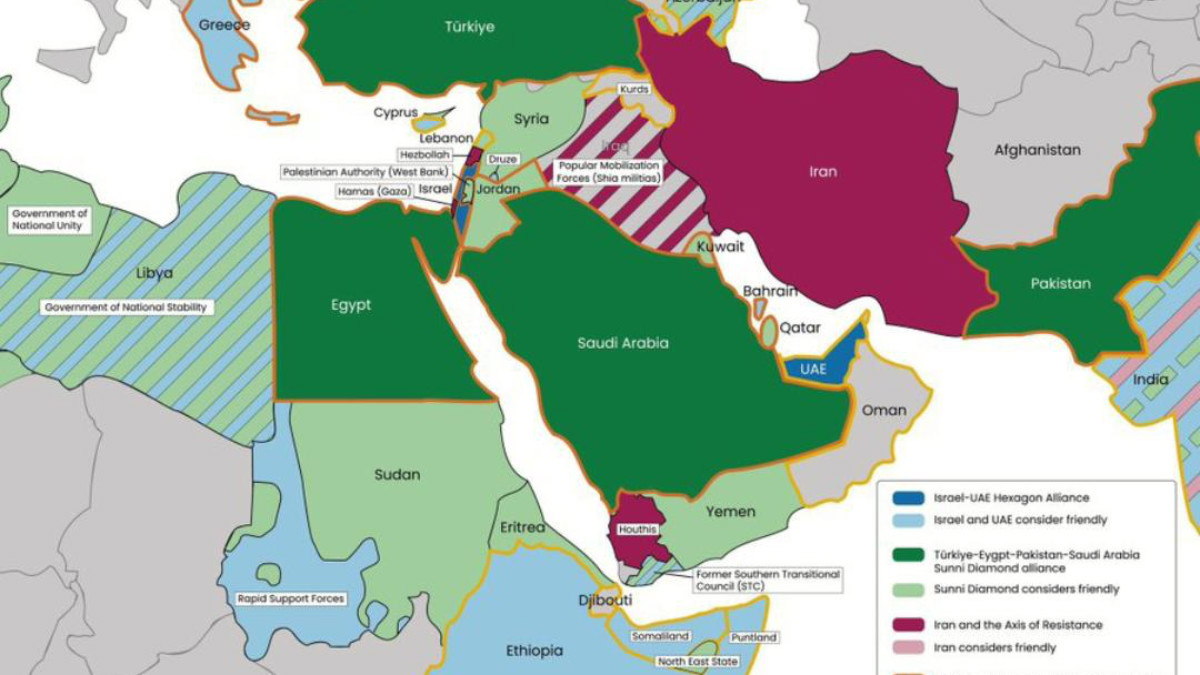
In a high-profile Sunday address where Israeli Prime Minister Benjamin Netanyahu introduced a sweeping updated national security doctrine, a publicly displayed regional alignment map has quickly become the center of diplomatic backlash and regional scrutiny, laying bare the unspoken power dynamics reshaping modern Middle Eastern geopolitics.
The core shift in Netanyahu’s new security framework, as outlined in an official statement from his office, responds to what the Israeli government frames as the shifting threat landscape after what it terms the “War of Redemption.” The doctrine explicitly reorients Israeli strategy away from traditional defensive and containment approaches, prioritizing pre-emptive offensive strikes to neutralize emerging threats, shoring up domestic civil defense against evolving risks, and formalizing Israel’s self-positioning as a leading regional power. It also emphasizes that shifting regional currents have opened new doors for Israel to build cross-border partnerships both within and beyond the Middle East, the statement added.
The map presented alongside the doctrine identifies a bloc called the “Hexagon Alliance” anchored by Israel and the United Arab Emirates, with Greece, Ethiopia, and sections of India also listed as aligned parties. What has drawn the most outrage and scrutiny, however, is the map’s classification of Sudan’s southwestern region—currently under full control of the Rapid Support Forces (RSF)—as aligned with the Israeli-UAE bloc. The RSF, led by former Janjaweed commander Mohamed Hamdan Dagalo, has been widely accused of perpetrating genocide in Darfur amid Sudan’s ongoing civil conflict. Multiple United Nations expert investigations and independent media reports, including on-the-ground work from Middle East Eye, have documented consistent Emirati military and logistical support for the paramilitary, a claim the UAE has repeatedly denied in official statements.
Further, the map frames a range of separatist and breakaway factions across the broader Middle East and North Africa as friendly to the Israeli-UAE bloc. In Libya, the eastern Libyan administration led by strongman Khalifa Haftar is marked as aligned with Israel. In Yemen, the UAE-backed Southern Transitional Council— which reorganized into the Transitional Council of South Arabia earlier this year after a brief dissolution—is listed as sympathetic to the alliance. Most recently, Israel made global headlines when it became the first United Nations member state to formally recognize Somaliland, a breakaway region that unilaterally declared independence from Somalia in 1991. Multiple reports have documented expanding Israeli and Emirati military footprints in the territory, which is also marked as aligned on Netanyahu’s map.
Notably, the map deviates from longstanding formal Israeli diplomatic arrangements by excluding two of Israel’s earliest Arab peace partners from its core alliance bloc. Egypt, which signed a historic peace treaty with Israel in 1979, is categorized as part of a separate “Sunni diamond alliance” alongside Pakistan, Turkey, and Saudi Arabia. Jordan, which has maintained a formal peace agreement with Israel since 1994, is only marked as “friendly” to the Israeli-led bloc, rather than a core aligned member.
The map also retains longstanding Israeli framing of the Tehran-led network of armed groups and allied states as the “Axis of Resistance,” grouping Iran, Lebanon’s Hezbollah, and Yemen’s Houthi movement in the opposing bloc. It additionally notes that Ethiopia, which is currently at heightened risk of full-scale war with neighboring Eritrea, is counted as a friendly state. Prior reporting from Middle East Eye has documented that Israel has long sought to establish a permanent Red Sea military base in Eritrea.
While regional geopolitical analysts note that the alignments laid out in the map do not come as a major surprise to seasoned Middle East watchers, the public release of the document is expected to create significant diplomatic discomfort for many of Israel’s existing regional partners and harden long-held suspicions among Arab states about Israeli expansionist and interventionist goals across the region. Critics have already raised alarms that the map’s explicit recognition of separatist factions amounts to open Israeli support for partitioning already fragile conflict-affected states, a move that could further destabilize already volatile regions across the Horn of Africa and North Africa.