As Russia’s full-scale invasion continues to pummel Ukraine’s industrial backbone, the leader of one of the nation’s largest steel producers is sounding the alarm over new European Union trade rules, saying the bloc’s sweeping import curbs unfairly lump a war-ravaged Ukraine in with global steel giants exporting cheap goods.
Yuriy Ryzhenkov, chief executive officer of Metinvest, made the case in an exclusive interview with the BBC, arguing that the EU’s recently enacted protective tariffs and import quotas fail to account for the extraordinary crisis Ukraine’s steel sector is currently navigating. He is calling for at least a targeted carve-out that would allow Ukrainian steel to enter the bloc’s market without the new restrictions, warning that continued access to the EU is a matter of survival for Ukraine’s vital steel industry.
In a bid to shield domestic steel manufacturers from cut-price competition primarily from China and Turkey, the EU rolled out new trade protections that cap total annual duty-free steel imports at 18.3 million tonnes. That marks a sharp 47% reduction from the quota levels in place in 2024. While the policy includes country-specific quotas and a longstanding free trade agreement between the EU and Ukraine remains in effect, that deal does not override the bloc’s right to implement independent trade protection measures. As a result, Ukraine is bound by the new caps – a outcome Ryzhenkov calls fundamentally unfair.
“Ukraine has been bundled together into those measures without any consideration for the situation Ukraine is in,” Ryzhenkov said, referencing the ongoing full-scale war with Russia. “Access to the European market is crucial for survival. The restrictive measures that have been put in place by the authorities in the European Union, they don’t help. I think it’s unfair that Ukraine has been treated in the same way as all of the other importers into the European Union.”
Ukraine’s domestic steel industry projects that under the new rules, annual exports to the EU could plummet by between 50% and 60%. For a nation that has relied on steel exports as a core pillar of its economy for decades, that drop could be catastrophic. Before Russia launched its full invasion in 2022, metallurgy and mining made up roughly 10% of Ukraine’s total gross domestic product and accounted for a full third of the country’s total export revenue. The European Union has long been the largest single customer for Ukrainian steel, and Ryzhenkov emphasized that years of war have destroyed alternative logistics routes, leaving the EU as the only accessible major market for the country’s output.
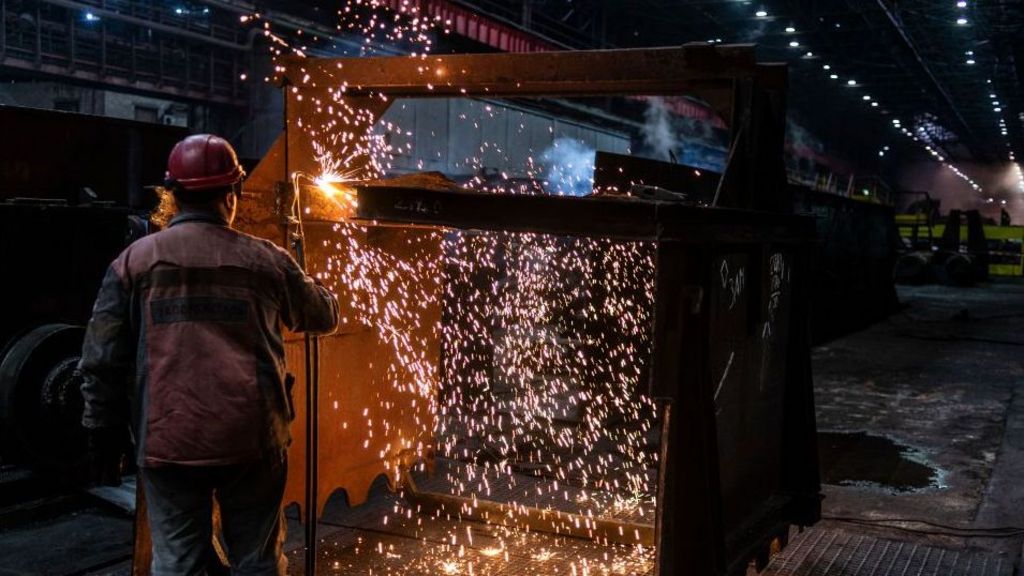
The war has already gutted Ukraine’s steel production capacity. Every one of the country’s operating steel mills has sustained damage from Russian bombardment, and Ryzhenkov noted that strikes on industrial infrastructure have “intensified significantly” in recent months. In September 2024, the country recorded its first month with zero domestic steel production – a first in more than 150 years of Ukrainian steel-making. Since the invasion began, nearly 800 Metinvest employees have been killed in attacks and ongoing conflict. The company has expanded bomb shelter coverage at mill sites and implemented strict safety protocols to protect workers during air raids, but Ryzhenkov acknowledged that large-scale industrial facilities cannot be fully protected from persistent attack.
Looking ahead to the coming winter, Ryzhenkov predicted the season will be “one of the hardest in our history” for the sector. “We are in a dire situation when we don’t have logistics to access any other market apart from the EU and cutting our available market by 60%, that doesn’t help for the industry to survive,” he added.
In response to the criticism, a European Commission spokesperson pushed back on claims that the bloc ignored Ukraine’s crisis when drafting the new policy, saying officials “took into account the difficult situation” of Ukraine during policy negotiations. The EU maintains that its framework sets a specific quota for Ukrainian steel that guarantees the country can continue exporting to the bloc, even if that quota is set at “a level lower than in the past years.” The spokesperson added that the EU has “offered compensations” to its largest steel suppliers, which includes Ukraine, to offset the impact of the reduced quotas.