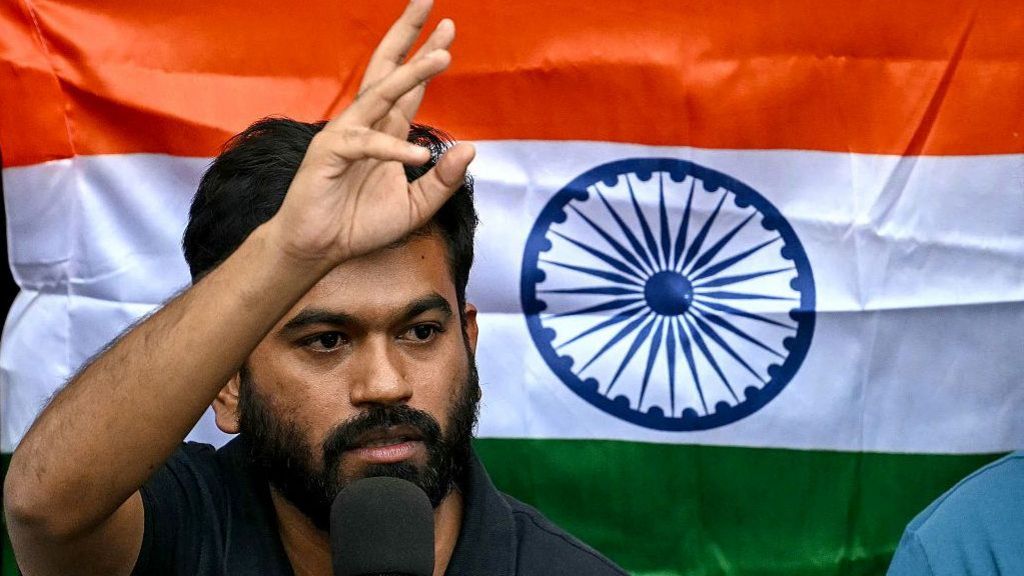
In just five months, a youth-led grassroots movement in India has grown from a sarcastic online reclamation of an insult into a formidable force challenging the country’s top election leadership, forcing authorities to deploy thousands of security personnel across New Delhi to crack down on planned demonstrations. On Friday, just hours before the Cockroach Janta Party (CJP) was set to rally in central Delhi’s bustling Connaught Place commercial district, police detained movement founder Abhijeet Dipke, marking the second time in less than a week that the youth leader had been taken into custody.
The CJP, which draws its unusual name from an offhand comment by India’s chief justice who compared unemployed young people to cockroaches earlier this year, has turned the derogatory label into a unifying rallying cry. Dipke and his supporters embraced the insult, building a movement that first gained national attention in July when thousands of young protesters marched toward India’s Parliament over a leaked examination paper scandal. The demonstration ended in clashes with police, and the widespread public unrest ultimately forced the resignation of India’s education minister, cementing the CJP’s status as a major voice for disaffected youth.
Today, the movement’s core demand is the resignation of Chief Election Commissioner Gyanesh Kumar, over widespread allegations of widespread voter list manipulation that the CJP claims benefits Prime Minister Narendra Modi’s ruling Bharatiya Janata Party (BJP). At the center of the dispute is the Election Commission’s Special Intensive Revision, a sweeping overhaul of national electoral rolls that critics argue has removed more than 130 million eligible voters from the rolls, disproportionately disenfranchising voters who are likely to support opposition parties. Both the Election Commission and the Modi government have repeatedly denied all allegations of bias or manipulation.
Friday’s planned rally was organized partly as a show of solidarity with two senior CJP leaders, Saurav Das and Ashutosh Ranka, who were jailed for five days earlier this month after entering the iconic protest site Jantar Mantar. The site, which has served as India’s most prominent venue for public dissent near Parliament for decades, was recently declared off-limits to protests by Delhi police, a move the CJP says is intended to push demonstrations out of sight of the country’s centers of power. The two leaders were detained after breaching the new restriction, just days after they were released from custody following a mass crackdown on an earlier CJP protest last Saturday.
In the lead-up to Friday’s march, Delhi authorities took extensive measures to prevent the gathering from going forward: police served Dipke a formal notice banning the unpermitted rally, closed central Delhi’s Central Park for 48 hours citing administrative reasons, and deployed thousands of police and paramilitary personnel across the city to block access to the planned protest site. Police even offered to allow a small, limited group of CJP supporters to gather at an alternate location to wave the Indian national flag and sing the national anthem, an offer the movement rejected.
In response to the ban, CJP organizers adjusted their strategy, urging supporters to travel to Connaught Place in small groups of fewer than five people, unfurl the tricolor Indian flag (known locally as Tiranga), take a photo, and disperse. In a social media statement, the movement emphasized: “Waving the Tiranga is not a crime,” and encouraged supporters to share their photos online to show broad support for the movement’s demands.
The BBC witnessed Dipke’s detention firsthand, as plainclothes officers surrounded the youth leader just moments after he left his residence, where he had been staying with opposition politician Anish Gawande, and forced him into a waiting police car. Several CJP supporters attempted to block the police vehicle from leaving, but were pushed back by officers. Gawande questioned the legality of the detention, telling reporters: “Detaining a lone man walking with the national flag in his hand is bit of a joke.” Delhi police have not yet publicly confirmed the formal grounds for Dipke’s detention.
By the time the protest was scheduled to begin, between 200 and 300 supporters had gathered near the closed Central Park, and although the turnout was smaller than at previous CJP rallies, the crowd was steadily growing when police began dispersing and detaining participants. The BBC counted dozens of detentions throughout the day, including prominent student activist Neha Bora, a leader of the All India Students’ Association who has emerged as one of the most visible faces of the recent protest wave, and multiple working journalists who were covering the demonstration. Footage captured by on-site reporters shows police dragging protesters across sidewalks and forcing them into waiting detention buses, and the BBC filmed one officer slapping a detained protester inside a police vehicle. Delhi police have not responded to requests for comment on allegations of excessive force against demonstrators.
The CJP’s campaign against the Election Commission has dovetailed with a broader wave of protest from India’s national opposition parties, which have also leveled allegations of voter list manipulation to benefit the BJP. Last week, opposition leader Rahul Gandhi and dozens of opposition lawmakers attempted to march to the Election Commission’s headquarters in Delhi, but were stopped and detained by police. The opposition has since brought their grievances to President Droupadi Murmu and marched to India’s Supreme Court to challenge the electoral roll revision. While the CJP, student groups and opposition parties have organized separate protests, their demands have converged, and Gandhi has publicly condemned the detention of CJP organizers and called for Jantar Mantar to be reopened to peaceful protest.
In a pre-protest video message released Thursday, Dipke acknowledged that he was likely to be detained or jailed again, but urged supporters to continue the movement. “I also may be jailed after this, but I am not worried,” he said. “Tricolour is my pride and I will raise it.” He called on supporters who could not travel to Delhi to wave the flag in their own towns and cities, a call that has been echoed by other CJP leaders who have insisted the movement will continue regardless of government crackdowns. Delhi police have defended their measures as necessary to maintain public order, stating that unpermitted large gatherings would disrupt traffic, harm local business activity and block access for emergency response vehicles. Home Minister Amit Shah has also pushed back against opposition criticism, accusing critics of spreading false information about the electoral roll revision and defending the Election Commission’s institutional independence.