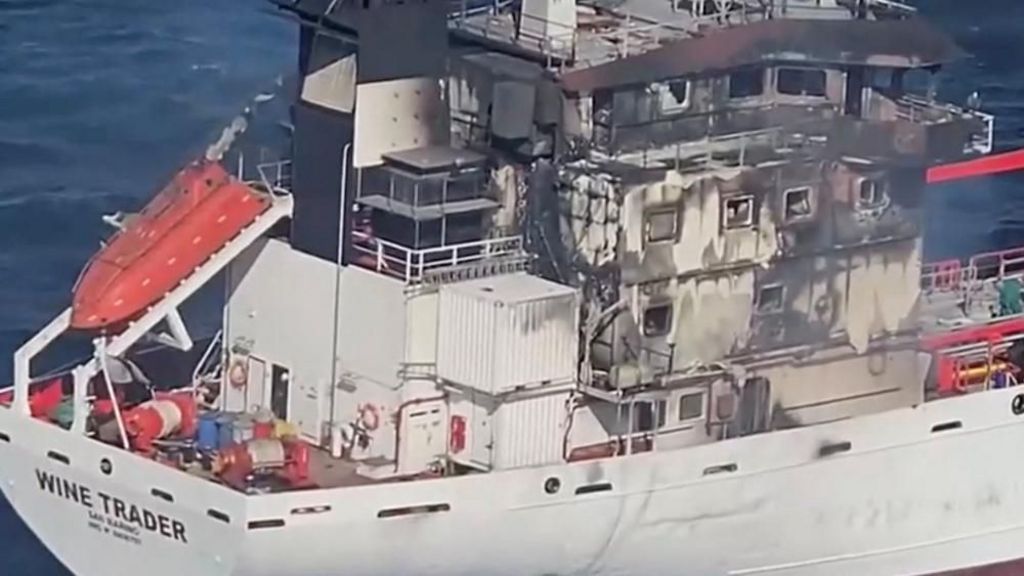
A major search and rescue mission is ongoing in treacherous, high-wave conditions off Romania’s Black Sea coast after a pair of drone attacks on commercial chemical tankers left seven crew members unaccounted for, marking the latest escalation in a growing wave of maritime violence targeting shipping in the strategic waterway.
Early Thursday morning, at approximately 07:00 local time, the San Marino-flagged tanker *Wine Trader* — which was traveling empty from Tunisia to Romania, positioned 13 nautical miles east of the Danube River’s Sulina mouth — reported multiple explosions and an out-of-control fire onboard. Naval officials confirmed five crew members have been accounted for, seven remain missing, and four of those recovered are confirmed alive, with rescuers working against dangerous sea conditions to reach them.
Romanian President Nicușor Dan confirmed a second tanker, the *Yara J* flying the flag of the Comoros, was also hit by a drone late Wednesday in the same general area. All crew members aboard the *Yara J* escaped unharmed and managed to extinguish the fire that broke out after the strike, the Romanian government confirmed.
The attacks come on the heels of a similar drone strike targeting merchant shipping further south along neighboring Bulgaria’s Black Sea coast earlier this week. That strike sank one vessel and left 11 crew members missing, prompting Bulgaria to summon Russia’s top diplomatic envoy over the incident, which Bulgarian officials blame Moscow for orchestrating.
Overnight ahead of Thursday’s attack, Romanian defense officials detected a large swarm of Russian drones operating near Ukraine’s Snake Island, just a short distance from the strike site. Russia has publicly acknowledged targeting two cargo vessels carrying what it calls military cargo bound for Ukraine’s Odesa port, though it did not name the ships hit off Romania’s coast.
Moscow has repeatedly stated its campaign of maritime strikes in the Black Sea targets vessels delivering weapons and dual-use military goods to Ukraine, which has been the target of a full-scale Russian invasion since 2022. However, Kyiv and Western allies say Russia is deliberately targeting civilian merchant ships, including vessels carrying grain and other essential humanitarian cargo through the Black Sea, a historically critical global trade route for food exports.
In response to the escalating attacks on NATO allied territory in the Black Sea region, Romanian and Bulgarian leaders are set to discuss whether to trigger Article 4 of the North Atlantic Treaty, which allows any alliance member to call for emergency consultations with fellow allies when it believes its territorial integrity or national security is under threat. Dan is scheduled to meet NATO Secretary General Mark Rutte in Brussels alongside Bulgarian Prime Minister Rumen Radev in the coming days to discuss growing security risks in the region, with talks expected to center on requests for additional defensive equipment to protect civilian shipping transiting the area.
“We want to have all the information about what happened, but there will be a response from the Romanian state,” Dan said in comments to reporters following the attack.
European Commission President Ursula von der Leyen has already condemned the escalating maritime violence, saying earlier this week that the Black Sea has become “another front of escalation of the Russian war in Ukraine. This is unacceptable.”
The recent surge in attacks began last week, when two more ships were struck off Bulgaria’s coast. On the same day, Ukraine struck a Russian oil tanker anchored in the Black Sea port of Sochi. Turkey, which has acted as a mediator in the conflict, has called on both Russia and Ukraine to implement a ceasefire in the Black Sea to protect civilian shipping. Moscow has rejected repeated calls from the United States and European Union for a naval truce, blaming Ukraine for starting the cycle of attacks on commercial vessels in the region. Currently, Russian forces occupy approximately 18 percent of Ukraine’s internationally recognized territory, more than two years after Putin launched the full-scale invasion.