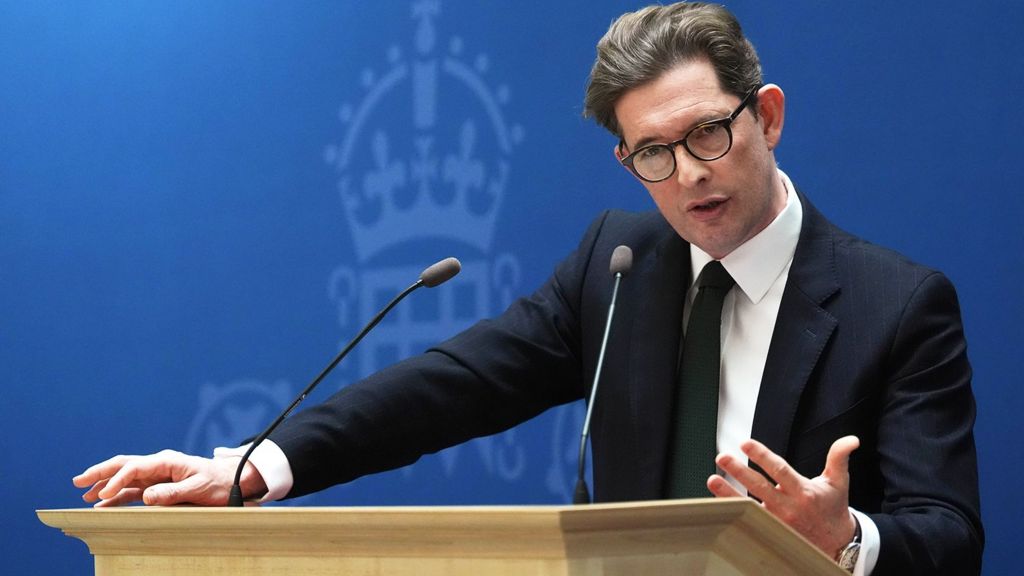
In a landmark annual address delivered at MI5’s London headquarters, domestic intelligence service director general Sir Ken McCallum has laid out a stark assessment of the UK’s evolving national security landscape, revealing that the agency now allocates more resources to countering state-sponsored threats than it did at the height of the Cold War.
Sir Ken opened his speech by naming Russia the UK’s top aggressor, noting that overall foreign state threats have grown fourfold over the past 10 years. This dramatic surge has left MI5 balancing counterterrorism and state threat operations at roughly equal scale, a shift unseen in modern UK intelligence history.
Turning to Moscow’s ongoing global activities, Sir Ken outlined that Russia is waging a deliberate campaign of hybrid warfare designed to avoid triggering a collective NATO response, a red line the Kremlin would be strategically foolish to cross. With its full-scale invasion of Ukraine yielding minimal territorial gains at horrific human and military cost, Russia has instead focused on destabilizing European democratic societies. Thanks to coordinated global action that has seen nearly 1,000 Russian intelligence operatives expelled from countries worldwide since the invasion began, the Kremlin’s traditional covert network in the UK has been gutted. This has forced Moscow to rely on hiring criminal proxies to carry out attack plots on its behalf, a shift Sir Ken described as a clear sign of Russian strategic weakness, not strength. “These are not the actions of a great power with the strategic upper hand,” he emphasized.
Beyond Russia, Sir Ken warned that Iran is rapidly expanding its own hybrid campaign of aggression within UK borders. Over the past 12 months alone, UK authorities have made 50 arrests linked to Iranian state-backed activities, which have disproportionately targeted British Jewish communities while also plotting attacks against harder military infrastructure targets. While he declined to comment directly on the recent alleged plot at RAF Fairford – which Prime Minister Keir Starmer linked to Iran’s Islamic Revolutionary Guard Corps – Sir Ken stressed that any actors seeking to sow chaos on UK soil, whether local hired attackers or their overseas paymasters, will face an unyielding law enforcement response. He added that the 2023 National Security Act, a landmark piece of legislation designed to counter foreign interference, is already being heavily deployed to address threats from Russia, Iran, and China alike.
A core focus of the address was the emerging, rapidly evolving risk of bad actors exploiting artificial intelligence for malicious purposes. Sir Ken confirmed that MI5 has already intercepted terror groups attempting to integrate AI into their attack planning, including pairing AI-enhanced autonomous drones with new reconnaissance methodologies that lower the barrier for successful attacks. AI is also being used to generate hyper-personalized propaganda and radicalization content, supercharging the ongoing cybersecurity arms race between attackers and defenders.
Most concerning, Sir Ken argued, is the risk of extremist groups leveraging AI to develop novel or more dangerous bioweapons. While this threat has not yet been fully realized, he warned that AI has the potential to fundamentally reshape the risks posed by both existing and emerging bioweapons. “Human history has given us no experience of facing an actor which is smarter than we are,” he noted, referencing the unprecedented uncertainty surrounding advanced AI development. To address this gap, Sir Ken announced the launch of MI5’s new AI Threat Assessment Centre, tasked with separating exaggerated speculation from tangible risks and coordinating national responses to AI-enabled threats. The agency is already collaborating closely with GCHQ, MI6, and the UK’s world-leading AI Security Institute to mitigate these emerging hazards.
On the topic of domestic terrorism, Sir Ken contextualized the April 2024 decision to raise the UK’s terror threat level to “severe” – the first such increase in five years, meaning an attack is deemed highly likely. While long-standing threats from Islamist groups including Al Qaeda and the Islamic State continue to motivate and direct attacks, Sir Ken highlighted extreme right-wing terrorism as a key driver of the elevated risk. Over the past year, the service has recorded a sharp rise in cases where extremist anti-immigration and anti-Muslim narratives have escalated into concrete terror planning. Unlike many other terror threats, extreme right-wing radicalization disproportionately skews young, fueled by unregulated online extremist spaces. Sir Ken revealed that MI5 had recently investigated a radicalized 13-year-old extreme right-wing extremist in the UK, and intelligence from that investigation allowed an international partner to stop a lethal attack on their territory.
In closing, Sir Ken reaffirmed MI5’s commitment to adapting to the changing threat landscape, noting that the service’s expanded resourcing and new initiatives like the AI Threat Assessment Centre position it to meet the challenges of an increasingly volatile global security environment.