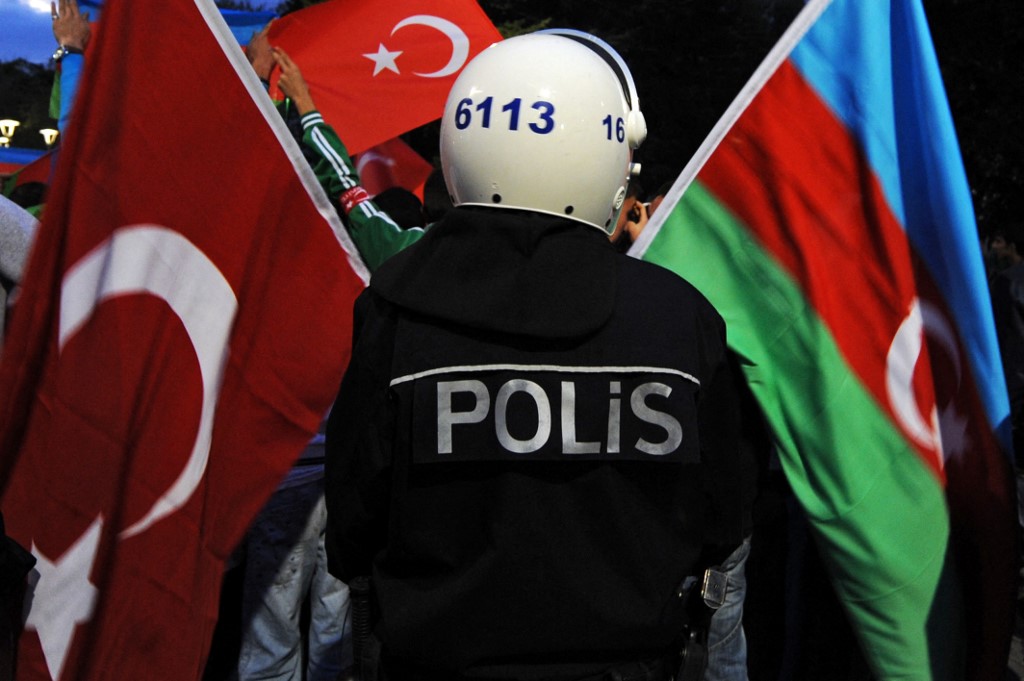
On Tuesday, a sharp public rift emerged between two historically close regional allies, as Azerbaijan’s ruling New Azerbaijan Party (YAP), led by President Ilham Aliyev, publicly accused Turkey of fueling artificial tensions over Baku’s newly implemented headscarf ban in primary and secondary schools. The Azerbaijani ruling party specifically called out senior Turkish officials, including Oktay Saral, a top chief presidential adviser from Turkey’s ruling Justice and Development Party (AKP), over critical social media posts opposing the newly enforced policy.
The controversy erupted after Azerbaijan rolled out updated dress code regulations for schools, adopted on September 21 for students and October 6 for teaching staff, that bar headscarves on campus. Viral footage circulated widely on Turkish social media showing distraught Azerbaijani female students removed from classrooms in tears after being denied entry for wearing hijabs, triggering public outcry across Turkey and forcing Turkish officials to respond. Saral publicly stated on Monday that barring hijab-wearing students from access to education was unacceptable, and called on Baku to reverse the ban.
In response to the criticism, YAP issued a strongly worded statement accusing AKP-aligned Turkish media outlets of publishing factually distorted reports about Azerbaijan, and issued a formal warning that the escalating rhetoric could cause lasting harm to longstanding bilateral ties. On the same day Saral made his comments, Azerbaijani security forces arrested at least 37 people who participated in public protests against the ban, on charges of violating public order regulations. Local internet connectivity was also restricted that day, with access to major social platforms including X, TikTok, and Instagram throttled to limit the spread of protest content.
Beyond the immediate dispute over the headscarf policy, the row has brought underlying tensions over Azerbaijan’s foreign policy to the surface. Many Turkish social media users have heavily criticized Baku’s close diplomatic and economic ties to Israel, sparked by Azerbaijan’s decision to remain in the United Nations General Assembly chamber during Israeli Prime Minister Benjamin Netanyahu’s address last September—a choice that triggered a wave of negative commentary from Turkish audiences.
In its official statement, YAP pushed back against this criticism, clarifying that Azerbaijan’s relationship with Israel is rooted in mutual interests and compliance with international law. The party reaffirmed Azerbaijan’s longstanding support for the Palestinian people, noting that Baku has provided consistent financial and humanitarian aid to Palestine, including full funding for the operations of the Palestinian Embassy in Baku. It also reiterated that President Aliyev has repeatedly endorsed a two-state solution to the Israeli-Palestinian conflict, with East Jerusalem as the capital of an independent Palestinian state.
Addressing Turkish criticism of the headscarf ban directly, the Azerbaijani ruling party emphasized that no Muslim-majority nation has the right to dictate policy to another, interfere in its domestic governance, or claim moral or political superiority over fellow Muslim states. In a remark widely interpreted as a direct rebuke of Turkish President Recep Tayyip Erdoğan, the statement added that any claim to advance Muslim world unity must be rooted in equal cooperation and mutual respect, not “hegemonic tendencies” toward allied states.
The party also underscored that Azerbaijan is constitutionally a secular state, and argued that framing the headscarf issue as a political weapon to sow division harms both Turkish national unity and broader Muslim solidarity. “Using issues of this kind as a means of political pressure against Azerbaijan is particularly unacceptable,” the statement read. “We call on the AKP government to refrain from this harmful policy.”
The longstanding partnership between Turkey and Azerbaijan is built on deep shared linguistic, ethnic, and cultural bonds, and Turkey was Baku’s most critical military backer during the 2020 Second Nagorno-Karabakh War, providing drones, heavy arms, and deploying fighter jets and special operations forces to support Azerbaijan’s successful campaign to reclaim territory from Armenian control. In its statement, YAP recalled the iconic “One nation, two states” principle coined by former Azerbaijani President Heydar Aliyev to frame the bilateral relationship, but stressed that this principle does not erase the sovereignty of either state.
“It refers precisely to one nation and two independent states,” the statement clarified. “Under no circumstances does this principle provide grounds for one state to interfere in the internal affairs of the other or impose its own political and ideological approaches upon it.” The party concluded with a clear warning that continued unprompted criticism from Turkish officials would cause irreversible damage to bilateral ties.
Thus far, Ankara has opted for de-escalation rather than public retaliation. A senior anonymous Turkish official told Middle East Eye last week, following Aliyev’s earlier sharp rebuke of Turkish commentary, that Ankara has no intention of interfering in Azerbaijan’s domestic affairs, and framed the row as a simple misunderstanding. The official added that Turkey had conveyed this reassurance to Baku at the highest diplomatic levels, and multiple Turkish officials have confirmed Ankara will not respond directly to the indirect criticism from YAP, and will instead prioritize diplomatic outreach to ease tensions.
The senior Turkish official described Azerbaijan as a close “kin country,” highlighting the deep shared strategic cooperation between the two states across energy, transportation, and military infrastructure projects that have been jointly developed over decades. Downplaying the public dispute, the official noted that previous disagreements between the two allies have always been resolved through quiet engagement, and expressed confidence that further dialogue will resolve the current tensions.