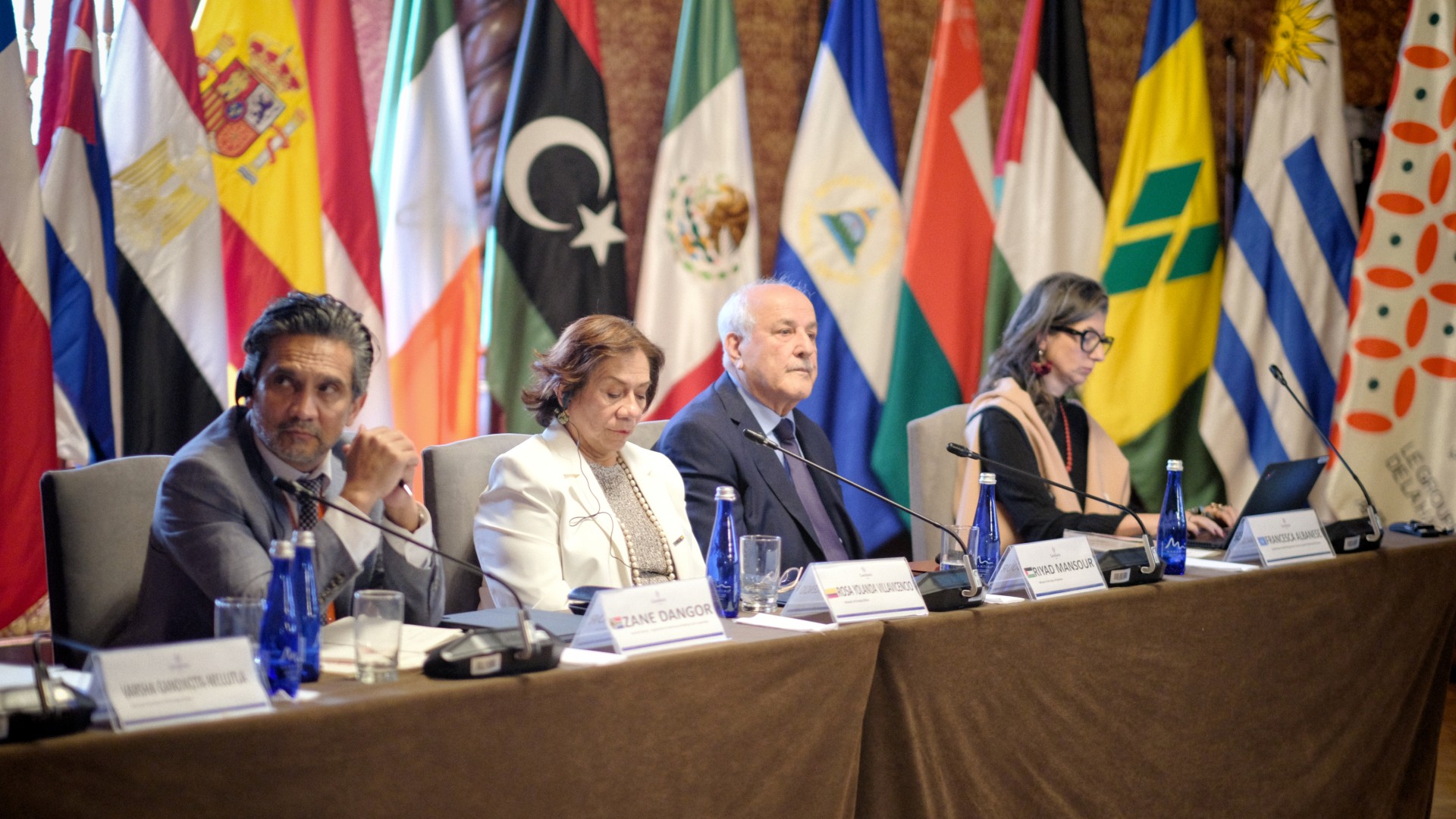
Launched in early 2025 by a coalition of seven nations seeking to hold Israel accountable for alleged violations of international law in Gaza, The Hague Group now finds itself navigating deep internal rifts and political backlash, as a wave of right-wing electoral wins across Latin America has stripped the bloc of three of its four founding members in just six months.
The most recent departure came in August 2026, when Colombia — once a co-chair of the coalition — formally exited the group, just two months after right-wing populist Abelardo de la Espriella defeated former pro-Palestinian president Gustavo Petro. Under Petro, Colombia had taken bold action to cut ties with Israel over its military campaign in Gaza: the former president issued a national ban on coal exports to Israel, even calling on Indigenous Wayuu communities in La Guajira to block transport lines after bureaucratic and diplomatic efforts stalled. He also joined South Africa’s landmark genocide case against Israel at the International Court of Justice (ICJ).
De la Espriella has reversed nearly all of these policies in his first months in office. Within weeks of taking power, he signed a decree resuming coal exports to Israel, recognized Israel’s illegal claim to the Golan Heights, lifted visa requirements for Israeli citizens, restored the suspended Colombia-Israel free trade agreement, and pulled Colombia’s support from the ICJ genocide case. He also withdrew the nomination of prominent pro-Palestinian Colombian lawyer Carolina Olarte-Bacares for a seat on the International Criminal Court (ICC), eliminating any possibility of Latin American and Caribbean representation on the court despite the region holding 8.2% of the global population.
Colombia’s exit follows the departures of two other Latin American founding members earlier this year: Bolivia and Honduras, both of which withdrew shortly after right-wing candidates won presidential elections in March. Honduran President Nasry Asfura has already moved to deepen bilateral ties with Israel, extending an open invitation to Prime Minister Benjamin Netanyahu — who faces an ICC arrest warrant for alleged crimes against humanity — even before his inauguration. Today, only South Africa remains as the bloc’s co-chair, steering the coalition alone.
Founded to fill a global gap in enforcing international law amid widespread inaction on the Gaza crisis, The Hague Group operates as a coordination platform rather than a lawmaking body, bringing member states together to align diplomatic and legal action against Israel. Guillaume Long, the group’s diplomatic advisor, explains that the coalition was formed specifically to counter a coordinated push by the U.S. and its allies to weaken the global legal and humanitarian order that has long held states accountable for atrocities.
“The Hague Group was born to advance international law in an era of impunity, not only for the people of Gaza but for the future of a world where justice prevails over impunity,” South African Minister of International Relations Ronald Lamola told members at a recent gathering. At the 81st UN General Assembly session this month, 40 aligned nations met to discuss how to turn rhetorical support for international law into tangible, enforced action, with accountability for atrocities in Gaza at the top of the agenda.
Yet the coalition faces not only external pressure from great power politics but internal contradictions that have undermined its core mission. Most notably, South Africa — the group’s standard-bearer in the ICJ case — has been accused of hypocrisy after allowing Anglo-Swiss mining giant Glencore, which for decades supplied Colombian coal to Israel, to relocate its export operations to South Africa’s Richards Bay after Colombia’s original ban. Critics note that the South African government holds full regulatory authority to block these exports under existing dangerous goods trade rules, but has failed to act, in large part due to deep ties between the country’s ruling elite and the extractive industry.
South African President Cyril Ramaphosa, who has repeatedly called for accountability for Palestinian civilians at global forums including the BRICS summit, was forced to divest personal mining interests linked to Glencore when he took office, but his family still retains close ties to the industry. His brother-in-law, billionaire Patrice Motsepe, co-runs ARM Coal in a joint venture with Glencore that holds operational rights to export infrastructure at Richards Bay. “The South African government talks ‘left’ by going to The Hague and walks ‘right’ by ignoring the sources of profit and trade,” said Patrick Bond, director of the Centre for Social Change at the University of Johannesburg, calling the continued coal exports “the most extreme form of hypocrisy” that directly fuels Israel’s military campaign.
Not all member states have failed to deliver on their commitments, however. Earlier this year, Malaysian authorities seized two separate shipments of strategic cargo bound for Israel at the Port of Tanjung Pelepas, in a move Prime Minister Anwar Ibrahim said aligned with the country’s Hague Group obligations to avoid becoming a trade conduit for Israeli atrocities. “This action demonstrates Malaysia’s firm stance to ensure that our country will never serve as a conduit for trade that could support or contribute to the Israeli regime’s atrocities against the Palestinian people,” Ibrahim said.
Long argues that the coalition’s purpose is not to demand uniform perfect action from all members, but to create space for coordinated progress toward shared goals, noting that member states already face severe repercussions for joining the bloc. South Africa lost hundreds of millions in U.S. aid after launching the ICJ case, while Petro had his U.S. visa revoked after speaking out against Israel’s campaign. “It is because of the fact that states are not all in compliance with their third-state obligations that The Hague Group was created,” Long said. “Our role … is to try and consolidate coordinated state action.”
Observers and insiders say the coalition’s future depends on adapting to shifting political landscapes by expanding partnerships beyond national governments. Former Colombian deputy foreign minister Mauricio Jaramillo Jassir, who served under Petro, argues that the bloc can strengthen its position by opening channels to civil society and making membership more flexible to include a broader range of actors. He added that de la Espriella’s policy reversal may not be legal under international law, noting that the 1948 Genocide Convention binds all third-party states to take action to prevent and punish genocide, regardless of changes in government.
In Colombia, civil society groups have already continued the fight to block coal exports to Israel, even after the government reversed course. The NGO Resist Glencore, which organizes in solidarity with Indigenous communities displaced and harmed by Glencore’s massive El Cerrejon coal mine in La Guajira, worked closely with the Petro administration to tighten export bans, cutting Colombian coal supplies to Israel from 34% to just 6% in months. The group is now working with former Petro administration officials to push an energy embargo bill through Colombia’s Congress, where Petro’s Historic Pact remains the largest bloc.
A representative for Resist Glencore noted that the same coal that powers Israel’s infrastructure in Gaza is also destroying the local environment in La Guajira, driving disproportionate child mortality among Indigenous communities that have lived on the land for generations. “These things are completely connected,” they said.
As Israeli military operations continue in Gaza and ethnic cleansing accelerates in the West Bank, The Hague Group faces steep challenges to uphold its founding mission. Proponents of the coalition argue that despite its setbacks and contradictions, it fills a critical role in a global order where powerful states face little accountability for mass atrocities. “There is a growing consensus that these attacks to destroy the institutions of international justice are completely outrageous,” Long said.