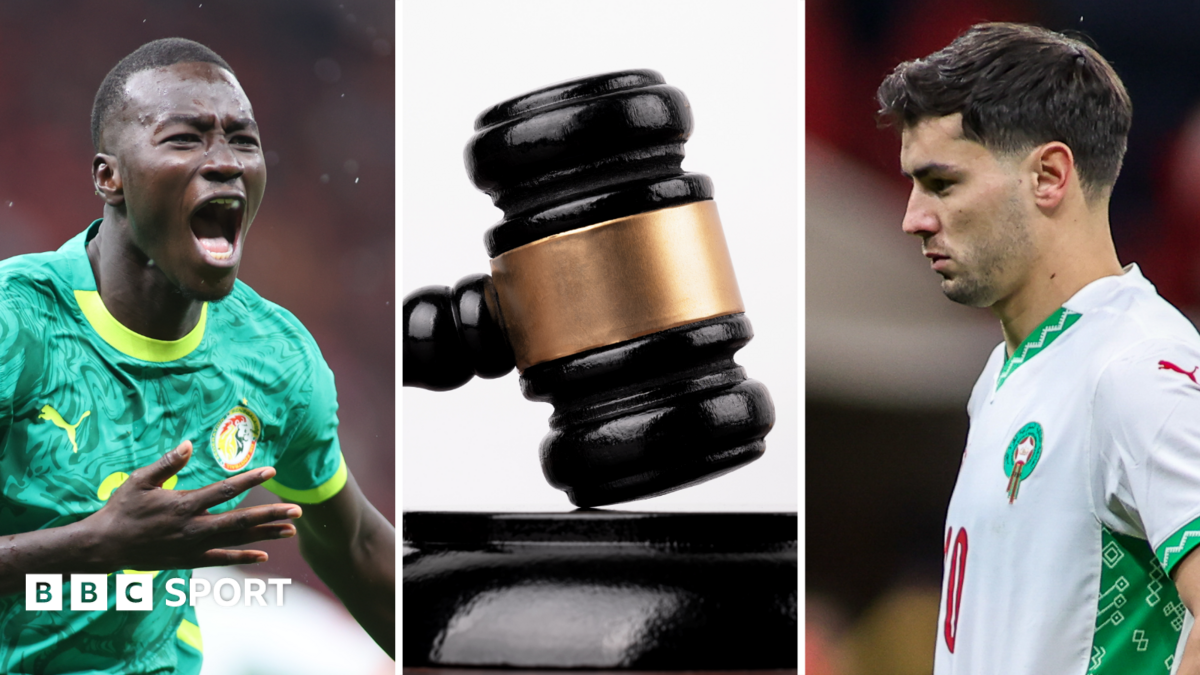
What was meant to be a 90-minute battle for continental football supremacy has stretched into a nine-month legal saga, and the long-awaited final chapter of the 2025 Africa Cup of Nations (Afcon) is finally set to begin this week. Instead of being decided by penalties or a last-minute strike on Rabat’s Prince Moulay Abdellah Stadium pitch, the 2025 Afcon title will be settled by the Court of Arbitration for Sport (CAS), sport’s highest global legal body, which will hear Senegal’s appeal against the controversial decision to strip the West African side of the championship they celebrated lifting in January. Fans hoping for an immediate resolution have already been told a final ruling will not come on the day of Thursday’s hearing, leaving both nations and the global football community waiting longer for closure.
The chaos that sparked this unprecedented legal fight began on a charged night in the Moroccan capital, where 66,000 raucous home fans packed the stadium to watch their team chase a first Afcon title in nearly 50 years. With the final deadlocked at 0-0 deep into stoppage time, Senegal thought they had secured a dramatic late winner through Ismaila Sarr, only for referee Jean Jacques Ndala to disallow the goal after blowing his whistle for a Moroccan free kick moments before Sarr’s shot. Controversy escalated minutes later when a VAR review led Ndala to award Morocco a penalty. Tensions boiled over completely: Senegal head coach Pape Thiaw led a number of his players and staff off the pitch and into the tunnel, while clashes broke out between supporters and stadium security that briefly left the venue without order.
Play eventually resumed after the unrest, and in the 124th minute of extra time, Morocco missed a golden chance to claim the title when Real Madrid forward Brahim Diaz saw his Panenka penalty saved by Senegal goalkeeper Edouard Mendy. Shortly after, Pape Gueye scored the decisive strike to give Senegal a 1-0 win, and the side lifted their second Afcon trophy in front of the world. Or so they thought.
Within days of the final, the Royal Moroccan Football Federation (FMRF) filed an official complaint with the Confederation of African Football (CAF), citing tournament regulations that punish teams that leave the pitch without referee approval. Article 82 of CAF’s competition rules, found under the chapter covering match withdrawals, states that any team that exits the playing field before a match concludes without the referee’s explicit authorization will be considered the losing side and eliminated from the competition. In March, a CAF appeals board upheld Morocco’s complaint, ruled that Senegal had forfeited the match, and awarded Morocco a 3-0 default victory and the 2025 Afcon title.
The ruling divided football observers across the continent. While CAF has a history of overturning results in Afcon and World Cup qualifying matches, some critics — including a former senior CAF official — have argued that only the match referee has the authority to officially abandon a game in the event of a team walk-off. Senegal’s national football federation (FSF) dismissed the ruling as “unfair, unprecedented and unacceptable” and immediately launched an appeal to CAS, the independent Lausanne-based legal body that serves as the final arbitrator for disputes in international sport.
Founded in 1984 to handle the growing number of commercial and regulatory disputes as global football grew into a multi-billion-dollar industry, CAS handles more than 900 cases annually across more than 50 sports, covering everything from doping violations and transfer disputes to corruption claims and tournament organization conflicts. Senegal’s appeal will be heard by a three-arbitrator panel led by 76-year-old French legal scholar Gerald Simon, founder of the University of Burgundy’s Sports Law Laboratory and a CAS member for more than two decades. If the panel cannot reach a unanimous decision, Simon will cast the deciding vote.
While the closed-door hearing — requested by both federations — is scheduled to conclude Thursday afternoon, CAS has already confirmed that no ruling will be issued that day. Under CAS rules, final appeal verdicts must be issued no later than four months after a hearing, with an informal target of three months, though high-profile cases have moved faster: in 2020, Manchester City’s appeal against a UEFA European ban over financial fair play violations saw a verdict issued just five weeks after the hearing.
A ruling overturning CAF’s original decision would deal another significant blow to the governing body’s reputation, which has already faced widespread criticism for the retrospective title handover. CAF president Patrice Motsepe has already stated the organization will accept and respect any ruling CAS issues, and a ruling in Senegal’s favor could force amendments to CAF’s official tournament regulations. Already, the chaotic events of the January final have driven a global rule change: the International Football Association Board (IFAB), football’s global lawmaking body, updated its rules in April to state that any player leaving the pitch in protest of a referee’s decision can be sanctioned with a red card, and any team official that incites a mass walk-off faces similar punishment, with teams responsible for match abandonment expected to forfeit by default.
The fallout from the final has already cost two head coaches their jobs: Thiaw was fired by Senegal following the team’s 2026 World Cup round of 16 exit, while Morocco’s Walid Regragui was dismissed in March. For both federations, however, the stakes remain far higher than just the title: Morocco invested heavily in hosting its first Afcon since 1988, and senior FMRF officials argue Senegal’s walk-off permanently tarnished the tournament’s global image. For Senegal, the dispute has amplified long-held frustrations across parts of African football over what the FSF and Senegalese government describe as disproportionate Moroccan influence within CAF; tensions were already high before the walk-off over incidents including laser pointers directed at Senegal players and a scuffle that saw reserve goalkeeper Yehvann Diouf tackled by three Moroccan ball boys when he intervened to stop them moving starting goalkeeper Edouard Mendy’s towel.
With the 2027 Afcon set to kick off in less than a year, fans have already begun speculating about a potential on-pitch rematch between two of Africa’s top national sides. But regardless of where the final verdict lands, there is widespread agreement across the global football community: the winner of a major continental title should be settled on the grass, not in a Swiss courtroom.