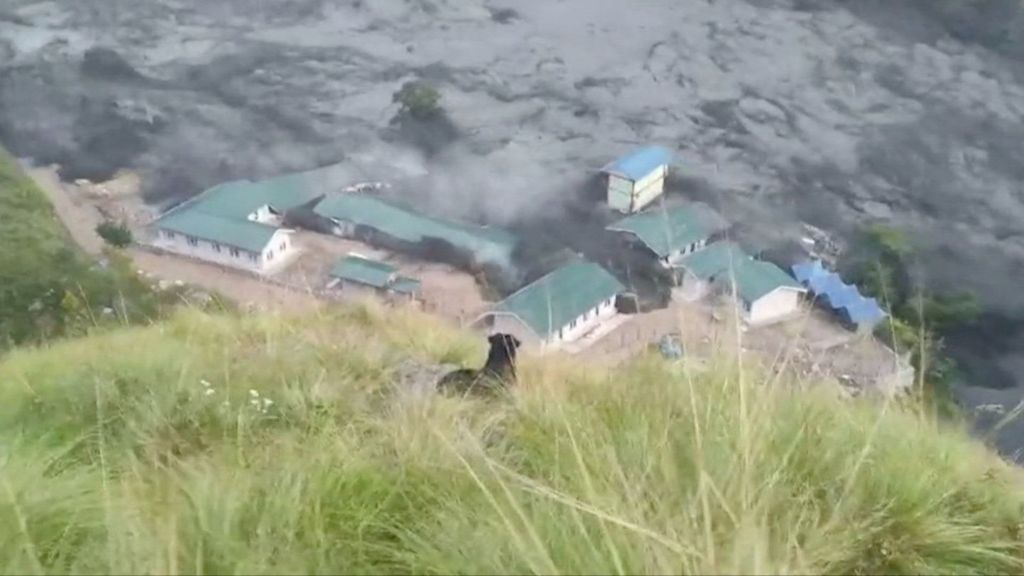
Nepal’s Himalayan landscape, long a source of natural beauty but also recurring risk, has been hit by a new flash disaster: a sudden surge of the Budhi Gandaki River in central Gorkha district that has washed away entire residential complexes, destroyed critical infrastructure, and displaced hundreds, just two months after the Himalayan nation faced one of its worst flood events in recent history.
According to Nepal’s Disaster Risk Reduction and Management Authority, Sunday’s flood, which struck as local communities gathered to mark the first day of Dashain, the country’s most important cultural holiday, damaged over 200 homes, disrupted the lives of more than 650 people, swept away roughly a dozen residential structures and multiple suspension bridges, and inflicted significant damage to an under-construction hydropower project, carrying off key construction equipment.
In a dramatic captured video of the event, raging brown floodwaters surge down a narrow valley, pulling the entire multi-building complex into the current within seconds. In just a few hours, water levels at one monitoring point rose from 2 meters to nearly 8.5 meters, before hydrological monitoring infrastructure on the river was itself swept away – cutting off official data flow from the site, according to Binod Parajuli, a government-employed meteorologist.
As of the latest updates, official teams have rescued 95 people stranded along the riverbank, including nine foreign nationals. While no fatalities have been confirmed, five people remain unaccounted for, and multiple remote settlements have been completely cut off from road access, leaving air travel as the only way to reach affected areas. Nepal’s Army has mobilized four helicopters to support search and rescue operations for the missing and deliver emergency aid to isolated communities.
For local residents, the sudden disaster has upended holiday plans and left widespread fear and uncertainty. Ganesh Karki, a resident of the Gorkha district’s Jagatbagar settlement, recalled waking to an early morning flood warning and fleeing with neighbors to higher ground in a nearby forest 500 meters uphill. “We never imagined a flood of this size,” Karki said. “The water surged for about 15 minutes and then stopped repeatedly throughout the morning. We are afraid to return home at night.” Hundreds of displaced families are now in urgent need of safe shelter and access to basic food, water and medical supplies, with no clear timeline for when they can return to their land.
The root cause of the latest flash flood remains under investigation. The most widely discussed hypotheses point to either a temporary landslide blockage of the Budhi Gandaki or one of its upstream tributaries that eventually burst, or a small ice avalanche in the upper Himalayan reaches of the river basin, which some local residents have reported witnessing. Experts have noted that while this flood’s debris flow is smaller and slower-moving than the devastating August event that killed more than 1,400 people and left thousands missing along Nepal’s northern border with Tibet, it adds another layer of trauma for communities that have barely begun to recover from the earlier catastrophe.
The August disaster was triggered by a rock and ice avalanche near Nepal’s 7,234-meter Lantang Lirung mountain peak, which sent a catastrophic flood surging down the river system connected to the Budhi Gandaki. Save the Children, which has deployed an emergency response team to the Gorkha district, warned that repeated disasters have pushed already vulnerable children into severe distress. “Children’s lives have been ripped apart in an instant yet again,” said Tara Chettry, the charity’s Nepal country director. “We are yet to see the full scale of the damage, but they may have lost their homes, schools and communities. Many children in Gorkha will still be in shock and distress after the mega floods in August, barely having a chance to get back on their feet.”
Nepal’s position in the seismically active, glaciated Himalayas makes it inherently prone to natural disasters ranging from earthquakes to landslides and seasonal floods. But a growing body of research and expert analysis points to climate change as a key amplifying factor: rising global temperatures are accelerating glacial melt in the Himalayas, increasing the frequency of glacial lake outbursts, ice avalanches, and unexpected flash floods that catch communities off guard, leaving low-altitude settlements increasingly vulnerable to repeated, catastrophic events. In response to the latest disaster, Nepali authorities have maintained a nationwide high alert for further flood and landslide events as the country enters its post-monsoon season.