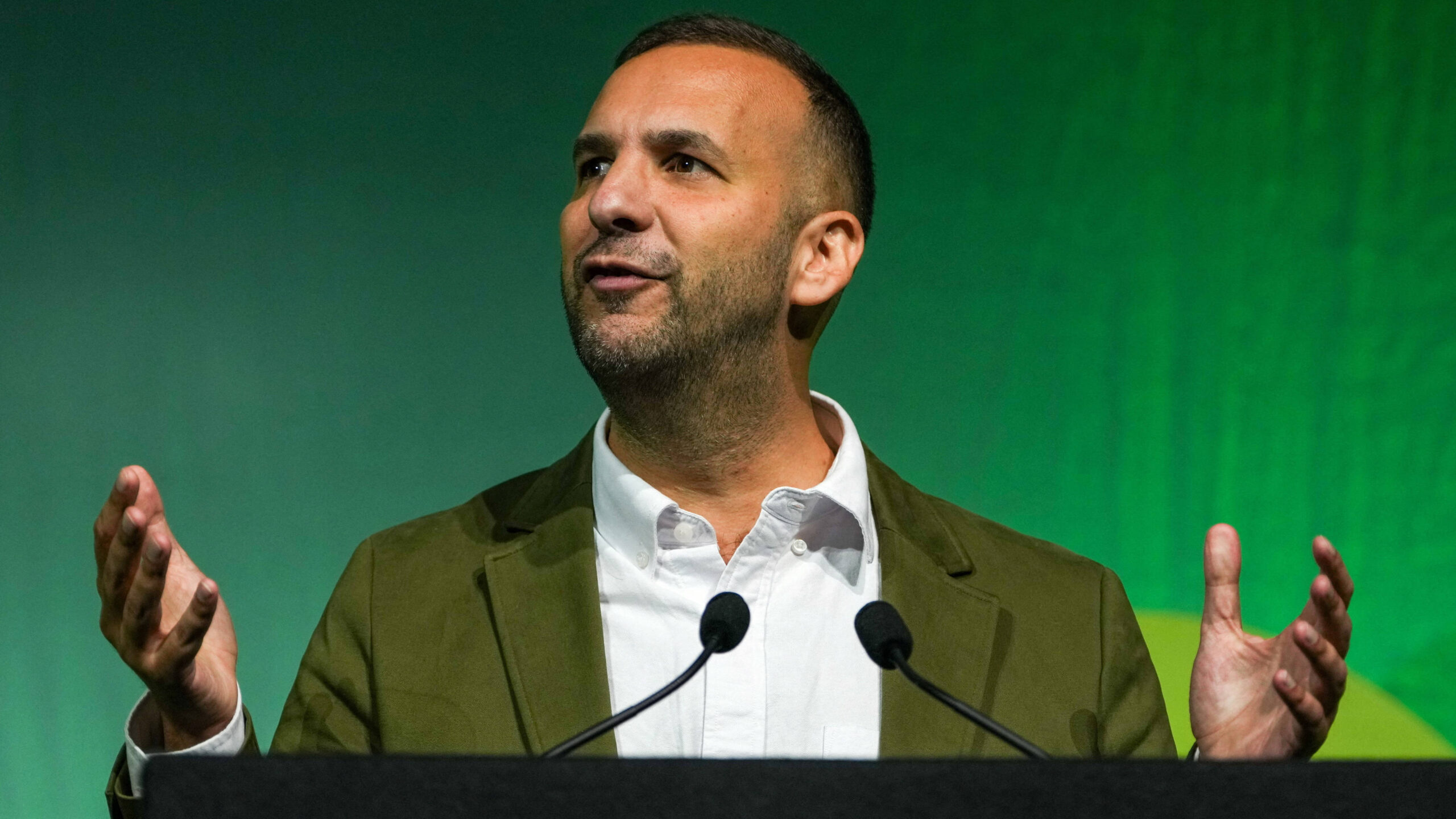
A contentious vote by the Green Party of England and Wales has ignited international backlash and reignited a decades-old global debate over the definition of Zionism, marking the first time a major UK political party has formally categorized the movement as a form of racism.
At the party’s annual conference held in Brighton over the weekend, members passed the motion on Sunday, which not only framed Zionism as racism but also endorsed the creation of a single democratic Palestinian state guaranteeing equal rights for all ethnic and religious communities, rejecting the long-proposed two-state solution to the Israeli-Palestinian conflict.
International responses were swift and condemnatory. The Israeli government immediately implemented a travel ban on Green Party leader Zack Polanski – who is Jewish himself – accusing the entire party of promoting antisemitism. The United States announced it would raise formal objections with the British government, warning the vote amounted to antisemitic rhetoric. Even the European Green Party moved quickly to separate itself from the decision, issuing an unequivocal rejection of the motion and reaffirming its longstanding commitment to a two-state solution.
Domestically, the Green Party has faced widespread criticism from rival political groups. More than a dozen Labour Members of Parliament have filed official reports against the party with UK police over the new policy, while Reform UK Deputy Leader Richard Tice openly labeled the Green Party as a whole antisemitic.
Internal divisions have also fractured the Green Party’s own ranks over the vote. Co-Deputy Leader Mothin Ali spoke openly in favor of the motion in an interview with Middle East Eye, arguing that as framed in the resolution, Zionism functions as an ethno-nationalist project that has enabled ethnic cleansing and advances a belief in the superiority of one group over another. Ali expressed confidence the vote would reshape long-term political discourse around the issue in the UK. His position stands in direct opposition to three senior Green parliamentarians – MPs Ellie Chowns, Carla Denyer and Adrian Ramsay – who have publicly criticized the motion.
Jewish groups have also been split in their responses. Yashad, a progressive Jewish organization that is openly critical of Israeli Prime Minister Benjamin Netanyahu’s right-wing government, nevertheless condemned the motion. The group noted that while the meaning of Zionism is widely debated, for the majority of British Jews, the core idea of Zionism – the right of Jewish people to collective self-determination and peoplehood – is central to their Jewish identity.
“Telling Jews they are acceptable only if they give up that understanding of collective Jewish identity, is not, as some have sought to explain it away, an attack on a political ideology. It is an attack on Jewish identity,” the group said in a statement. The motion won endorsement from prominent Holocaust survivor and activist Stephen Kapos, while Jewish Greens, an internal caucus of Jewish Green Party members, opted not to take an official position, confirming its own membership was evenly divided on the issue.
Amid the flurry of breaking coverage and public outrage, a critical chapter of 20th century international history has largely been overlooked: this is not the first time the global community has formally debated framing Zionism as racism. The debate stretches back 50 years, when the United Nations General Assembly adopted a binding resolution with exactly that framing in 1975, a position that enjoyed the support of a majority of UN member states at the time. Though that resolution was later revoked, declassified records show the British government quietly lobbied the United States to abandon its campaign to overturn the original resolution in the years between its passage and its repeal.
The 1975 resolution drew on a series of preceding international declarations that linked Zionism to racist governance. A 1973 UN General Assembly resolution had already condemned what it called the “unholy alliance between South African racism and zionism,” referencing the close political and military ties between Israel and the apartheid regime in South Africa. Months before the 1975 UN vote, the Organization of African Unity’s Assembly of Heads of State and Government adopted a resolution arguing that “the racist regime in occupied Palestine and the racist regime in Zimbabwe and South Africa have a common imperialist origin, forming a whole and having the same racist structure and being organically linked in their policy aimed at repression of the dignity and integrity of the human being.” That same year, the Non-Aligned Movement – a bloc of 120 states that remained neutral during the Cold War – passed a resolution labeling Zionism as a direct threat to global peace and security.
The 1975 UN resolution was jointly introduced to the General Assembly by the Palestine Liberation Organization (PLO) and Cuba, after a push by several Arab countries to expel Israel entirely from the United Nations failed to gain enough support. Ahead of the November 10 vote at the UN General Assembly session in New York, Belgium’s lead delegate Edouard Longerstaey launched a last-minute effort to delay the vote until the following year, but member states rejected the delay by a margin of 67 votes to 55, with 15 abstentions. Four and a half hours of heated debate preceded the final vote.
Kuwait’s representative Fayez Abdallah Sayegh told the assembly that Arab nations held deep reverence for Judaism, and noted that many Jewish people around the world also opposed Zionist policy. “We reject the equation between anti-Zionism and antisemitism,” he told delegates. But Israel’s permanent representative to the UN, Chaim Herzog – who would later go on to serve as Israel’s president – delivered a fiery response, dramatically tearing up a copy of the resolution text mid-speech. “I do not come to this rostrum to defend the moral and historical values of the Jewish people,” Herzog proclaimed. “To question the Jewish people’s right to national existence and freedom is not only to deny to the Jewish people the right accorded to every other people on this globe, but it is also to deny the central precepts of the United Nations.”
US permanent representative Daniel Patrick Moynihan doubled down on the condemnation, telling the assembly that the United States would never recognize or accept the resolution. “It does not acknowledge, it will not abide by, it will never acquiesce in, this infamous act,” Moynihan said. “A great evil has been loosed upon the world. The abomination of antisemitism has been given the appearance of international sanction.”
When the final vote was held that evening, the resolution passed by a vote of 72 in favor to 35 against, with 32 abstentions. Support for the resolution came largely from recently independent former colonies, the Soviet Union and its communist bloc allies, and all Arab and Muslim-majority nations. Many African states and non-aligned powers including India also backed the measure. Opponents included the United States, Canada, Australia, New Zealand, most Western European countries, several Latin American nations, and four African countries. The United Kingdom voted against the 1975 resolution, but declassified diplomatic records reveal British officials privately lobbied Washington against launching a campaign to repeal it.
It was not until 1989 that US Vice President Dan Quayle launched a formal campaign to revoke the 1975 resolution. According to declassified documents from the period, British UN diplomats privately dismissed Quayle’s campaign as “naked political opportunism”, arguing it was crafted to appeal to pro-Zionist voters and aligned with the priorities of the Republican Party’s right wing. Crispin Tickell, then head of the British mission to the UN, warned that revoking the resolution would give hardline Arab actors an opening to create diplomatic disruption and would draw unwanted global attention to racially discriminatory policies pursued by the Israeli government. Tickell advised the British government to communicate Britain’s “deep misgivings about the political damage that any campaign on this issue could do to the UN and to the peace process generally” to senior US officials. Then Conservative Foreign Secretary Douglas Hurd followed that advice, directing his staff to communicate the UK’s “firm wish that no action will be taken in the near future” to Washington.
Despite British lobbying, the 1975 resolution was ultimately revoked just two years later in 1991. By that time, the Cold War had ended, and Israel made the repeal of the resolution a non-negotiable precondition for its participation in the historic Madrid Peace Conference, the first formal negotiation between Israeli and PLO representatives. Some 111 UN member states voted in favor of revocation, while 25 opposed it and 13 abstained. All Arab states voted against the repeal, though seven – including Egypt and Kuwait – were absent for the vote.
Fifty years on from that landmark 1975 vote, the question of framing Zionism as racism has once again sparked a global firestorm, with the Israeli and U.S. governments once again leading widespread condemnation. The key difference this time is that the controversial position has been adopted not by a global intergovernmental body, but by a small left-wing opposition party in the United Kingdom, turning a niche domestic political decision into an international diplomatic incident.