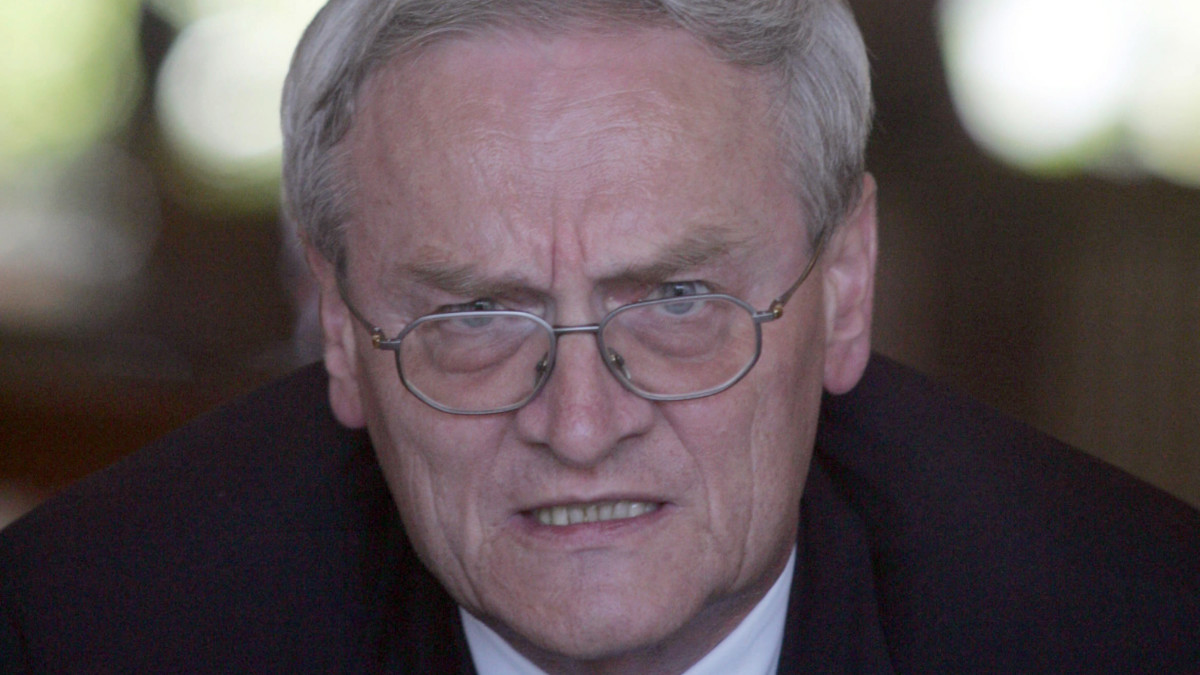
On Tuesday, German law enforcement authorities took one of the nation’s most senior former intelligence officials into custody, opening what is already being called the most severe espionage scandal to hit Europe since the end of the Cold War. The suspect, 80-year-old August Hanning, led Germany’s Federal Intelligence Service (BND), the country’s equivalent to the U.S. Central Intelligence Agency, between 1996 and 2005. Federal prosecutors have formally charged Hanning with espionage, treason, and operating on behalf of unidentified foreign intelligence agencies.
The arrest grew out of an unrelated high-profile investigation that first put Hanning under law enforcement scrutiny. In September 2025, authorities searched Hanning’s private residence in Hamburg as part of a child custody dispute involving Christina Block, a German multi-millionaire who is the heir to a popular domestic steakhouse chain. According to reports from leading German outlets Bild and Der Spiegel, Hanning exploited his long-standing close ties to senior Israeli intelligence figures to orchestrate an attempted kidnapping of Block’s two children from their home in Denmark, where they lived with Block’s ex-husband.
Allegations outline that Hanning reached out to Jacob Perry, former head of Israel’s domestic Shin Bet security service and current leader of Tel Aviv-based private intelligence firm CGI Group, to assist with the plot. During the attempted abduction, kidnappers physically assaulted Block’s ex-husband before forcing the 10-year-old boy and 13-year-old girl into a vehicle. German media reports confirm the children had their mouths sealed with duct tape and were threatened with death if they attempted to scream for help. One Israeli suspect linked to the kidnapping was arrested in Cyprus and later extradited to Germany, Israeli outlet Haaretz confirmed. Prosecutors allege Hanning and a retired German police officer accepted a payout of more than $112,000 from Block in exchange for carrying out the kidnapping. Hanning has repeatedly denied all allegations tied to the custody case, claiming he never contacted Perry to discuss any such plot.
As investigators dug deeper into Hanning’s activities connected to the kidnapping, they uncovered evidence of the far more serious alleged espionage activity. Alongside Hanning, Manfred D., Hanning’s former chief of staff who still held a position at the BND under subsequent agency leadership, was also arrested on charges of aiding treason. Prosecutors allege Manfred D. exploited his ongoing access to classified BND materials to pull secret information and pass it to Hanning, who then sold or distributed the intelligence through his post-retirement private consulting work. Investigators have confirmed Hanning passed sensitive materials to at least one foreign spy and an agent of an overseas intelligence service, though they have not publicly named the country in question. The Financial Times reports that investigators have already ruled out Russia, which Berlin currently identifies as its primary geopolitical adversary amid the ongoing war in Ukraine. During his tenure leading the BND, Hanning built deep professional connections with senior intelligence and business leaders across the globe, including in China and Israel, leaving open multiple lines of inquiry for investigators.
The arrest has sent shockwaves through Germany’s political and intelligence establishment. In an official statement to Agence France-Presse, Marc Henrichmann, chair of the German parliament’s intelligence oversight committee, emphasized that the country has zero tolerance for betrayal of state secrets. “Whoever allies themselves with the enemies of our liberal democracy will be found out,” Henrichmann said, adding that Hanning’s alleged actions amount to “trampling his official duties underfoot.” The case continues to unfold, with investigators working to map the full extent of the alleged espionage network and identify all foreign actors involved, in what is shaping up to be a defining test of Germany’s national security infrastructure in the 21st century.