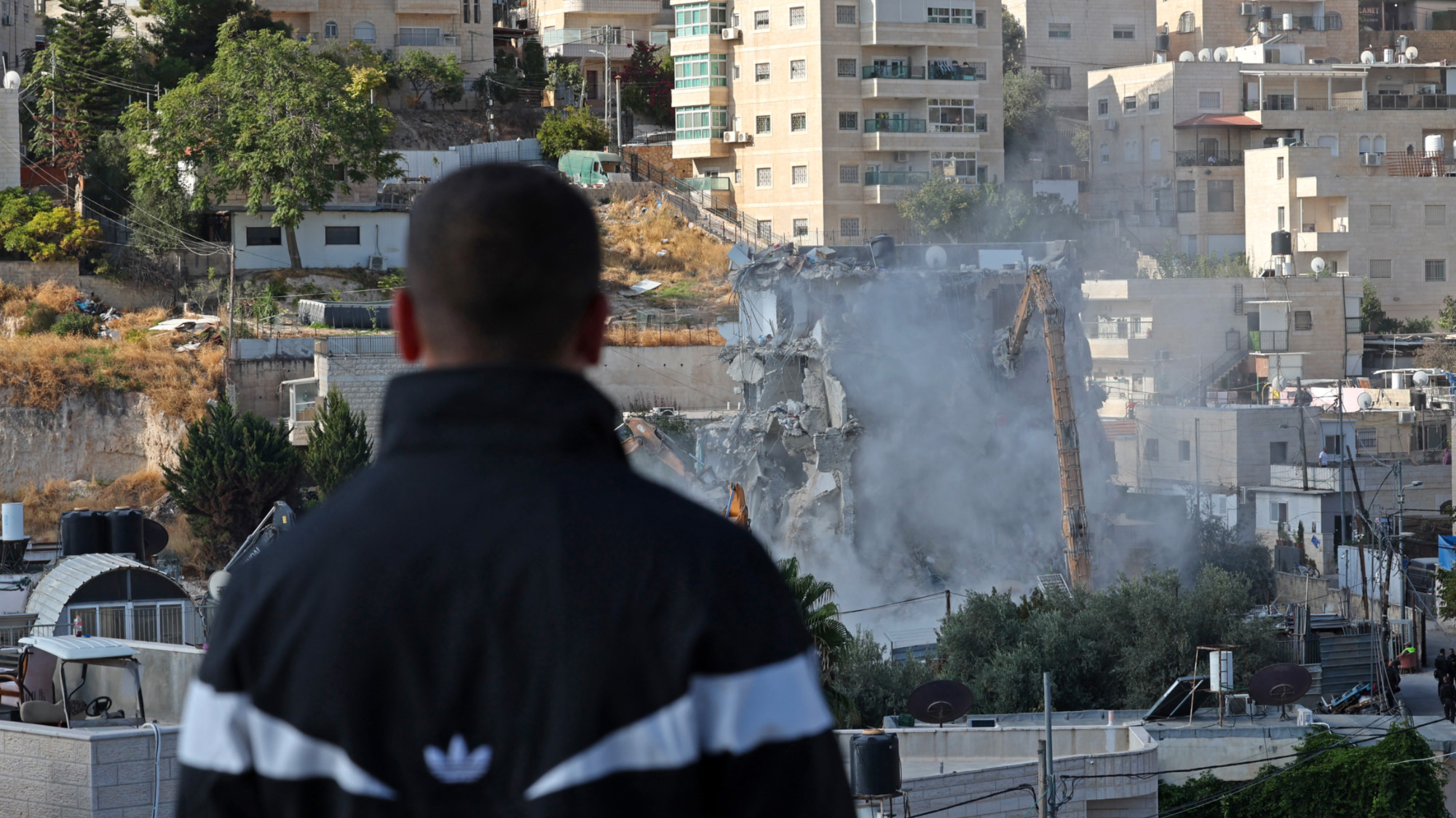
On a pre-dawn Tuesday in the al-Tur neighborhood of occupied East Jerusalem, one kilometer east of Jerusalem’s Old City on the Mount of Olives, a five-story residential building owned by Palestinian families was completely razed to the ground. The operation, personally overseen by hardline Israeli National Security Minister Itamar Ben Gvir, left approximately 70 people – most of them women and children – without shelter, just weeks ahead of Israel’s upcoming national elections.
Residents told reporters they were taken completely by surprise when Israeli bulldozers and armed forces encircled the building at 3 a.m. Heavily armed soldiers stormed individual apartments without warning, breaking down doors and forcibly evicting all residents while barring them from returning to retrieve personal possessions. Fayez Khalfawi, a longtime resident of the building, described the chaotic, terrifying scene to Middle East Eye: sleeping women and children were jolted awake by the raid, with some women fleeing into the streets disoriented and without their head coverings, while young children screamed and cried uncontrollably throughout the forced evacuation. By the end of the operation, the entire structure had been flattened, and all belongings inside the 10 apartments were destroyed. Displaced residents now sift through the rubble in a desperate search for any salvageable clothing or personal items.
Shortly after participating in the operation – which included climbing into a bulldozer to film a campaign-style video at the site – Ben Gvir posted a message to his X account celebrating the demolition. “The bulldozers of governance never rest for a moment,” he wrote. “This morning in the al-Tur neighborhood of East Jerusalem! That’s the only way it works.” The minister added that he had attended the site personally to verify that his policy was being implemented on the ground, and claimed that over the past 18 months, Israeli authorities have demolished 10,000 “illegal structures” and reclaimed an area of land equal to the combined size of Tel Aviv and Givatayim.
The demolition marks the end of a 15-year legal battle for the displaced families. The first demolition order was issued back in 2011, on the grounds that the building was constructed without the required Israeli permits. Human rights and policy analysts have long documented that Israeli governing authorities in East Jerusalem make it nearly impossible for Palestinian residents to obtain legal building permits, a pattern that leaves thousands of Palestinian families at constant risk of displacement. Despite submitting permit applications more than four times over the years and challenging the demolition order in Israeli courts, the families’ appeals were rejected. In addition to facing denial of permits, the families were also forced to pay tens of thousands of dollars annually in fines, penalties and property taxes over the course of the dispute, receiving only a final 24-hour eviction notice on Monday, one day before the demolition.
The Palestinian Authority’s Jerusalem Governorate issued a sharp condemnation of the demolition and Ben Gvir’s personal involvement, framing the action as “official incitement” against Palestinian residents and cynical election campaigning conducted at the expense of basic Palestinian human rights. The Governorate argued that the home demolition is part of a broader, systematic policy of forced displacement designed to alter the demographic and urban character of occupied East Jerusalem. Israel’s 1967 occupation and subsequent unilateral annexation of East Jerusalem has never received recognition under international law, and the Fourth Geneva Convention explicitly prohibits occupying powers from implementing permanent changes to occupied territory unless such changes are required for explicit military necessity or for the benefit of the local civilian population.
This demolition comes amid a dramatic escalation in the rate of Palestinian home demolitions across Jerusalem. Data from the Jerusalem Governorate shows that Israeli authorities carried out 427 demolitions in the city between January and the end of September this year. A recent report from the United Nations Office for the Coordination of Humanitarian Affairs (Ocha) released last month added broader context: between September 15 and 21 alone, Israeli authorities demolished 86 Palestinian-owned structures across the West Bank, including East Jerusalem, displacing 147 Palestinians – 73 of them children – 13 of whom were displaced in East Jerusalem.
Amjad Shihab, a political science professor at Al-Quds University, explained that the escalating demolition campaign reflects a shrinking set of constraints on Israeli policy toward Palestinians in East Jerusalem. “The situation marks the start of a period in which Palestinians face increasingly few ‘red lines’,” Shihab said. He described the demolitions and tight building restrictions as an organized displacement campaign, noting that more than 70 percent of Palestinian residents of Jerusalem live below the poverty line. High taxes, strict construction bans, and ongoing Israeli settlement expansion have combined to make daily life unsustainable for many Palestinian families. “Any attempt to build without a permit results in immediate demolition,” Shihab explained. “There is insufficient work, life is unstable, prospects are bleak, and the land is being eroded by settlement projects.” The ultimate message to Palestinian residents, he added, is unambiguous: “You have no future here, so leave.”