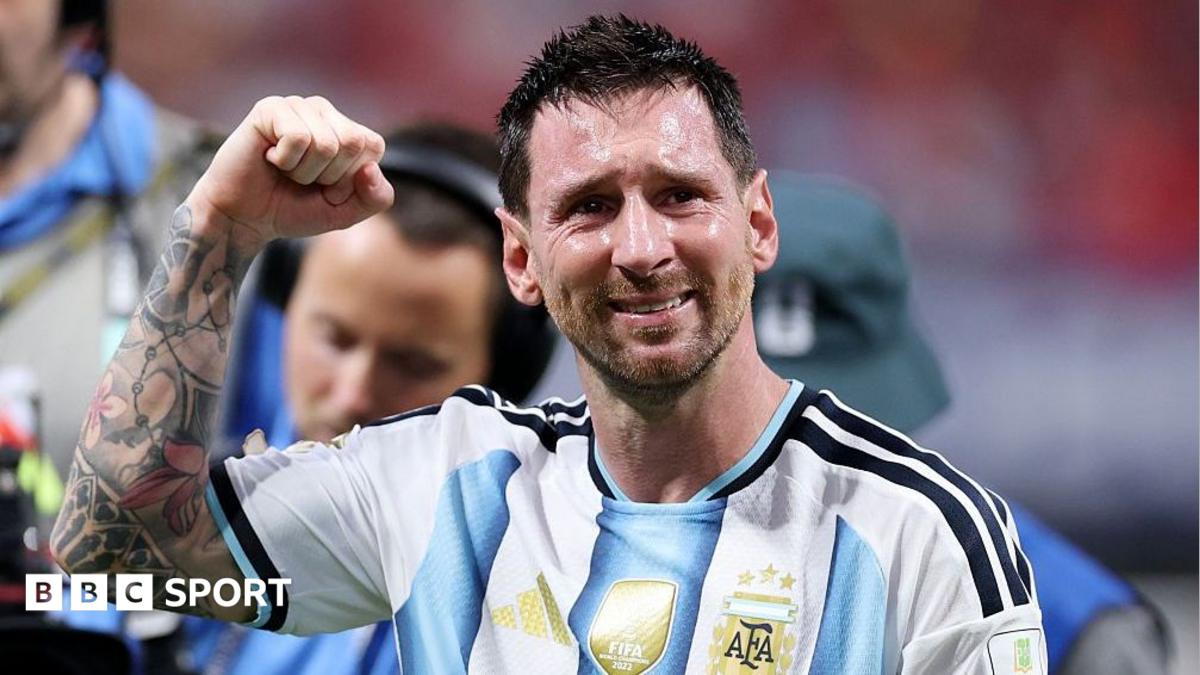
As the curtain prepares to fall on Lionel Messi’s legendary 17-year career with Argentina’s men’s national football team, the 38-time capped captain is gearing up for an emotional goodbye at Buenos Aires’ iconic Monumental stadium, where he will feature in an international friendly against Benin in his 208th and final appearance for the Albiceleste.
Widely regarded as the greatest player to ever pull on Argentina’s sky blue and white stripes, with only the late Diego Maradona mentioned in the same breath, Messi first announced his retirement from international duty back on August 31, six weeks after Argentina’s unexpected 2026 World Cup final defeat to Spain. At the time of the announcement, the 2022 World Cup-winning captain said he had “nothing more to give” to the national side, closing what appears to be the final chapter of his international career despite current Argentina coach Lionel Scaloni leaving the door open for a potential change of heart.
While Messi’s international run is drawing to a close, his club career at Major League Soccer’s Inter Miami remains ongoing. His current contract with the MLS side runs through the end of the 2028 season, with annual performance reviews built into the agreement. Sources close to Messi note he has no intention of stepping away before his contract expires, and a further extension remains on the table if he continues to feel mentally sharp and physically fit to compete week in and week out. True to his career-long approach, Messi has never made long-term plans beyond his next fixture, but the outline of his post-playing life is already taking shape across football and global business.
Those who know him make clear Messi will never step away from football entirely—he has said he would struggle to imagine a life outside the sport. But his ambitions stretch far beyond the pitch, and he has already begun building a growing portfolio of football club ownership across Europe and South America. When asked in recent months whether he would prefer to work as a club head coach or an owner, Messi made his choice clear: he wants to own clubs. The daily pressure of match results, player management and non-stop media attention that comes with coaching does not fit Messi’s lifestyle, he has said, while ownership lets him shape a club’s long-term direction from a slightly removed position—though he has no interest in being a hands-off owner, and plans to be involved in all key decisions.
The foundation of his football ownership network is already being built in Spain, his long-time second home. In April, Messi purchased UE Cornella, a fifth-tier club located on the outskirts of Barcelona that operates as a youth development academy for emerging talent. Just last month, on October 1, second-tier Spanish side CD Eldense confirmed Messi as its new majority owner, with the deal currently awaiting final authorization from Spain’s national sports council, the CSD. Eldense will serve as the flagship club for Messi’s football operations, and the club moved quickly to appoint former Villarreal manager Javi Calleja to stabilize the side and avoid relegation this season. For now, the two clubs are being run by trusted associates who act as a liaison between Messi and day-to-day operations, but he already follows every Eldense match closely remotely. After the club’s recent 4-1 victory over Real Oviedo, Messi shared his first public message as owner on Instagram, writing simply: “Aupa Deportivo.”
Messi’s world-famous brand has already had a tangible impact on Eldense: roughly a dozen new sponsorship deals have been signed in the days since his purchase was announced, including deals from brands that had been in talks with the previous ownership without reaching an agreement, and existing partners who already work with Messi on other projects. In May 2025, Messi joined long-time friend and former teammate Luis Suarez to launch Deportivo LSM in Uruguay, and the new club earned promotion to Uruguay’s third tier in its very first competitive season. Early talks of expanding the network to more clubs have been put on hold, as the upfront investment required to lift smaller clubs up the divisions proved larger than initially projected. For now, Messi’s primary focus is cementing Eldense’s position in Spain’s second tier and eventually pushing for promotion to La Liga.
His connection to Inter Miami also extends beyond his playing contract: as part of his current agreement, he will earn an ownership stake in the club once he retires from playing, though he has no current plans to launch his own MLS expansion franchise. Speculation has lingered that Messi could eventually return to Newell’s Old Boys, the Rosario-based club where he began his youth career, or even to Barcelona, where he spent the majority of his playing career, or a post-playing role at Maradona’s beloved Napoli. But sources close to the player say none of these moves have been formally discussed, and no one close to him expects a return to play for his boyhood club. The Messi family is currently planning to settle permanently in Castelldefels, a coastal town just outside Barcelona, and his business and football interests are already centered on Europe and Miami. Newell’s remains close to his heart, however: the club is one of 16 youth academies participating in the 2026 edition of the Messi Cup, the under-16 youth tournament Messi founded to develop emerging young talent.
Youth development is a core passion for Messi outside of club ownership. He is already a regular presence at his son’s youth football matches, and has poured both time and money into the Messi Cup, which launched in 2025 with just eight participating academies. Last year, organizers only expected Messi to attend one or two matches, most likely the tournament final, but he surprised everyone by staying for every single match across the entire event. This year, the tournament has doubled in size to 16 teams, and will be held starting October 25 at Inter Miami’s training facilities in Florida, with youth sides from top European clubs including Atletico Madrid, Chelsea, Barcelona, Inter Milan, and Arsenal all participating.
Beyond football, Messi has built a diversified business portfolio that has pushed his net worth to an estimated $1.1 billion, according to Forbes June 2026 rankings, with roughly $140 million in combined annual earnings from football and business ventures. His most high-profile partnership is the lifetime endorsement deal he signed with sportswear giant Adidas back in 2017. His most visible consumer business is MiM Hotels, a collection of six boutique hotels spanning from Ibiza to Andorra that has been operated under a rental agreement by Spanish hotel group Melia since November 1, 2025. The brand name draws from Messi’s initials and the Majestic hotel group, and the properties are classified as part of Melia’s luxury Melia Collection line.
In his native Rosario, Messi’s family investment firm is behind Carrasco M, a luxury residential development of 24 homes along the Parana River, with sales handled by a property agency co-founded by fellow Argentine international Ángel Di María. He is also a partner in El Club de la Milanesa, a popular restaurant chain that is planning to open five new locations across Catalonia, starting with the first branch in Castelldefels. He has also collaborated with drinkware brand Stanley on a signature line of mate containers, marking the first multi-year endorsement deal the brand has ever signed with an individual athlete, and Messi was directly involved in selecting materials and color palettes for the collection.
Messi’s business ventures grew out of the foundation built by his father Jorge, who managed his son’s commercial affairs from the very start of his career until his passing in August at the age of 68. Early in their time in Spain, some of Jorge’s financial decisions led to high-profile tax disputes with Spanish authorities, but the family’s business operations grew steadily over decades, expanding into television production, marketing, media, and commercial partnerships, all of which were well established before Jorge’s terminal illness. Today, Messi relies on a small core of trusted associates, many of whom have worked with him since his early days at Barcelona, to manage his portfolio, and only pursues projects that align with his personal interests. Speaking at the America Business Forum in Miami last November, Messi said: “Business is something that interests me. I would like to keep learning because I know nothing and I am just starting out.” Even as he continues to prioritize active football for the coming years, the empire he is building off the pitch is already well on its way to becoming the next chapter of his legendary career.