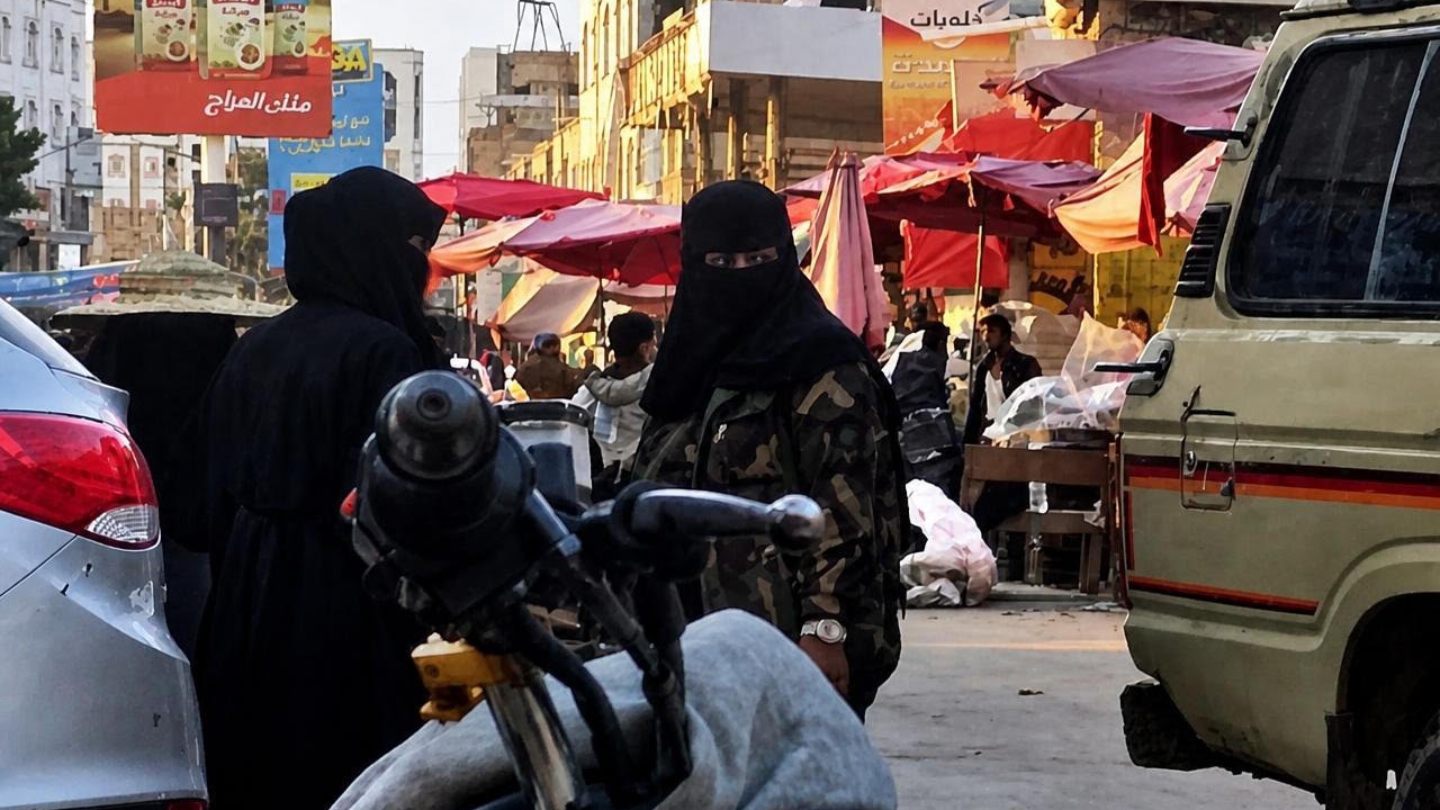
In the war-torn Yemeni city of Taiz, 36-year-old female security officer Tahani patrols local markets in her uniform, unarmed by conventional military standards, but carrying the weight of a historic shift in Yemeni society. Her daily work represents one of the most visible changes to Yemen’s security landscape in the decade since the 2015 outbreak of war: the rapid expansion of women’s roles in the country’s security apparatus.
Before the war, female soldiers were virtually absent from public security roles in Yemen. Today, women serve across every corner of the national security sector, from police stations and prosecution offices to frontline military checkpoints and high-stakes security raids. Tahani is one of thousands of women who joined Yemen’s expanding women’s police force in 2022, a move that transformed her life and opened a new path for Yemeni women seeking economic independence and public service.
A divorcee from a poor rural background who previously worked as a housewife struggling to support her only child, Tahani describes the recruitment drive for Taiz’s women’s police as the chance to fulfill a long-held dream. “Yemen needs female soldiers just as it needs female teachers,” she told Middle East Eye in an exclusive interview. On a typical day, Tahani rises early to cook breakfast for her son and get him ready for school before heading to the station, where she works alongside both male and female colleagues.
Her role fills a critical gap in Yemeni security, shaped by the country’s conservative social norms. Many Yemeni women prefer to interact with female officers when filing reports, undergoing searches, or providing testimony, and Tahani and her colleagues specialize in supporting these women. One of her most dangerous and essential duties is participating in home raids targeting criminal suspects. Per Yemeni tradition, male security personnel cannot enter a home where women are present, so female officers must lead the entry into these properties. “This is one of the most dangerous tasks. We must be cautious and have our weapons drawn, and we never raid a home without a plan,” Tahani explains. While she has received full tactical training, she has never had to fire on a suspect, as male colleagues provide overwatch from behind during these operations.
Today, amid a new wave of military escalation across Yemen, the work of female security officers has become even more critical. The numbers tell the story of the force’s rapid growth: back in 2014, there were just 2,868 female police officers across the entire country. Over the past decade, both the Yemeni government and Houthi authorities have ramped up recruitment of female soldiers, growing the force exponentially. Last year, the United Nations Development Programme supported capacity-building training for 69 female officers in Aden Governorate, equipping them with professional skills to carry out their duties. As security inspections have doubled and raids on suspected cells have intensified with the recent escalation, female officers have been stretched thinner than ever.
“This is the most serious situation since I started my job in 2022, as there are more home raids requiring female soldiers to be present,” Tahani says. “My colleagues at checkpoints have also doubled their efforts, because, during war, weapons can be smuggled and sleeper cells can spread among residents, so we must stay vigilant.”
Her more experienced colleague, 43-year-old Sali, who joined the force in 2016 and has served at checkpoints and stations across Taiz, echoes that sentiment. Sali explains that during periods of military escalation, security work becomes a 24/7 responsibility, extending even into personal time and daily commutes. “Security awareness must be high in such situations. We have to monitor all activity and people around us to prevent crime before it occurs,” she says. Sali adds that officers are also working to raise public awareness about the risks of sharing sensitive information about military and security developments on social media, noting that such posts can inadvertently provide intelligence to enemy forces.
Yemeni army Captain Muamer Abdulmonem, a 20-year veteran of the force, says that while female soldiers play a key role in routine security, their contribution becomes irreplaceable during periods of escalation. “During the recent escalation, there has been a dire need not only for female soldiers, but also for female volunteers. Many have been supporting the army and security forces, particularly by monitoring sleeper cells and unfamiliar individuals arriving in communities,” Abdulmonem explains. He notes that sleeper cells often hide in plain sight, operating under the guise of displaced families, street vendors, or beggars, making community-based surveillance by female security personnel especially critical. The captain also points out that female officers are the only ones who can lawfully and culturally search female travelers, a key task given that criminal networks often exploit women to smuggle weapons and contraband in a society where male officers cannot search them.
While Yemen’s women’s police force was first established in 2000, it remained a small, marginalized institution for nearly 15 years. It is only over the past decade that the force has grown significantly and won broader acceptance across Yemeni society. Tahani’s brother, 31-year-old Thaker, says his family was initially hesitant to allow Tahani to join the force, but their opposition softened once they saw that she would be working exclusively with other women on cases involving female civilians. “Tahani works with women and deals with women, so she is like any other woman working in the civil sector, and the family has accepted that,” Thaker says. “A respected woman can work anywhere to serve her country. Women are entering all kinds of professions and that society must accept female soldiers, as it is society itself that needs them to interact with women.”
That growing acceptance is visible among the Yemeni public as well. Amni Qaheri, a Taiz resident who has interacted with female officers while reporting a stolen phone and undergone searches at city checkpoints, says she appreciates the presence of female soldiers. “It was a good experience to see that there are female soldiers we can deal with. I hope their numbers increase, or even that a women’s police station is established where all the staff are women, so we can have an even higher level of freedom,” Qaheri says. She adds that searches carried out by female officers make her feel far more comfortable, and that “they do their job perfectly.”
Yemeni sociologist Hail Saeed says that while social acceptance of women in security roles is growing across the country, it remains uneven across different regions and demographic groups. “Some families and communities still harbour reservations due to the nature of security work, particularly regarding field operations or night shifts,” Saeed explains. Even so, he notes that female soldiers fill a uniquely critical role in a conservative society, especially when working with women and minors. “Having women in the police helps ensure greater privacy and comfort for female citizens during searches, interrogations, or when filing complaints,” Saeed says. “It also facilitates access to information that some women might hesitate to share with a male officer due to social customs in a conservative society.”
Saeed predicts that public acceptance will continue to grow in coming years, as long as female security personnel continue to demonstrate competence, discipline, and a commitment to public service that respects local cultural norms. “Community acceptance may expand gradually if the work of female soldiers is linked to competence, discipline, and community service, while taking cultural and social sensitivities into account,” he says.
(Note: The names of female police officials have been changed at their request to protect their privacy.)