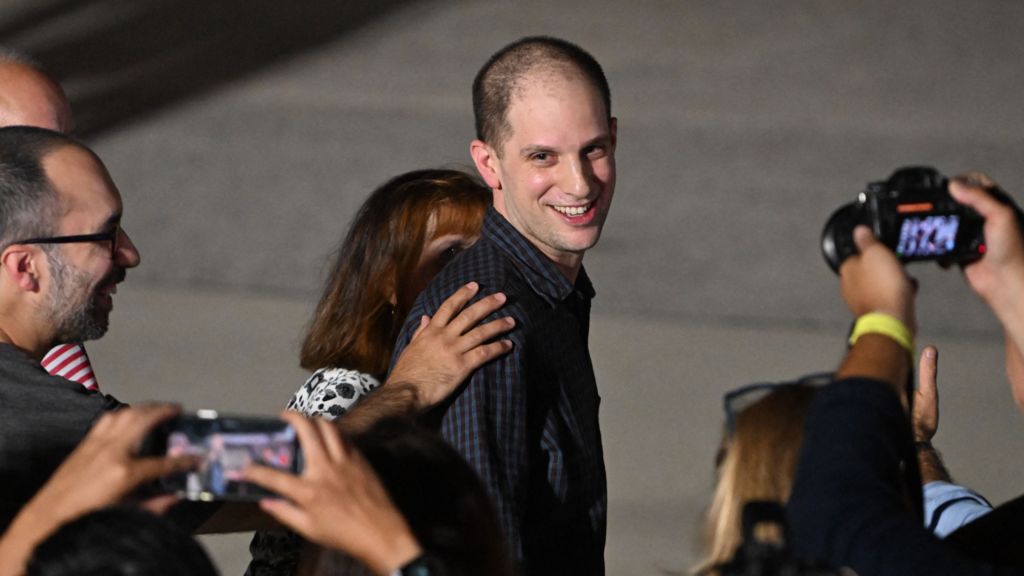
In a revealing new interview with BBC Radio 4’s *Today* program, former Wall Street Journal Moscow correspondent Evan Gershkovich has opened up for the first time about the details of his 2023 arrest by Russia’s Federal Security Service (FSB), his 16 months in Russian custody, and the aftermath of his release in a high-profile international prisoner swap last August.
Gershkovich, 34, who had been living and working in Russia since 2017, described the fateful day of his arrest in Yekaterinburg, 1,000 miles east of Moscow. He had arranged to meet a source for a story at a local restaurant, when six masked men entered the dining hall and approached their table with the unusual line that they had reserved the table. The comment, Gershkovich recalled, was deliberately designed to catch him off guard and freeze him in place. When he and his contact stood up, the FSB informed him he was under arrest on charges of espionage — and he watched as the man he had been meeting disappeared into the crowd.
It was in that moment, Gershkovich said, that he realized he had been lured into a pre-planned trap. What surprised him most, however, was that he was never interrogated or tortured, tactics that the FSB commonly uses against those accused of spying. This absence of aggressive questioning led Gershkovich to an unexpected realization that brought him a strange sense of relief: he had not been caught as a spy, but intentionally set up to be a political hostage, a bargaining chip in a larger geopolitical game. This understanding, he said, helped him maintain mental stability through his time in prison.
“They’ve set me up and fabricated this case so that I can be a valuable hostage — a pawn in a greater game,” he explained. “That means it will take a while, but I won’t be here for 12-20 years.” He correctly predicted that his high-profile status as a Western journalist would spark international outcry and eventually lead to a prisoner exchange. His case drew global media attention, with his image displayed on a Times Square billboard and then-U.S. President Joe Biden stating that bringing Gershkovich home was one of his administration’s top priorities.
Gershkovich was ultimately held in Moscow’s notorious Lefortovo Prison, a facility with a long history of detaining high-profile political prisoners and dissidents dating back to Stalin’s Great Terror, where torture and executions were widespread. He described his time there as a deeply isolating experience in a tiny cell that took a psychological toll, but noted that his treatment was better than that of many other detainees. He deliberately smiled for cameras during his public court appearances, he said, as an act of defiance against the Russian government’s fabricated case against him, refusing to let Moscow control the narrative.
Gershkovich stressed that his relatively mild treatment was not the norm for prisoners in Russia, pointing to the case of Ukrainian journalist Viktoriia Roshchyna, who died in Russian captivity in 2024 at age 27. When her body was returned months later, it showed evidence of torture and organ removal. “Some people… get tortured. They get broken as human beings, deprived of food, of hot water for showers, told that they’re never going to see their families again,” he said. “I was treated completely differently.”
As Gershkovich predicted, his detention ended in a prisoner swap 16 months after his arrest, when he was sentenced to 16 years in prison then immediately released in exchange for Vadim Krasikov, a Russian assassin serving a life sentence in Germany for a targeted killing. Gershkovich noted that Moscow achieved its goal in the exchange without facing additional sanctions, calling the Russian plan strategically cynical but effective.
Gershkovich learned of the impending swap three weeks before it was finalized, a period he described as excruciating, with each day dragging on endlessly. When his release finally came on August 1, 2024, he said it was a moment of pure joy, but in the weeks and months that followed, he faced the difficult challenge of readjusting to normal life. He experienced sleep issues, panic attacks in crowded spaces, and unexplained outbursts of anger as he processed the trauma of his detention. He has since worked with PTSD specialists and found that writing a book about his experience has helped him cope.
Today, Gershkovich is based in Berlin, and he and the Wall Street Journal have always maintained that the espionage charges against him were entirely fabricated. While he has deep personal ties to Russia — his parents emigrated from the Soviet Union to the U.S. in the 1970s, he speaks Russian fluently, and he built a life and friendships there over seven years — he says he does not know if he will ever be able to return. “I would hope to get back one day, but I guess we’ll have to see what comes after [Russian President Vladimir] Putin,” he said. “And it’s not completely clear that the next government will be any better.”