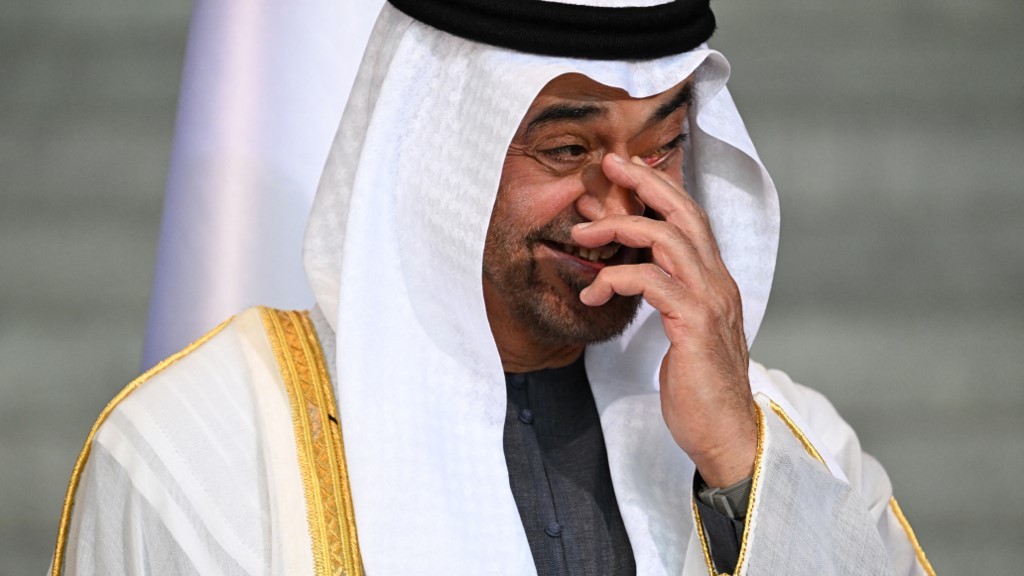
In a landmark step following the 2020 normalization of ties between the United Arab Emirates and Israel, Abu Dhabi has formally confirmed that Israeli Prime Minister Benjamin Netanyahu traveled to the country on Sunday for high-level talks with UAE President Mohammed bin Zayed Al Nahyan, marking the first official public acknowledgment of a Netanyahu visit to the Gulf state since relations were established.
The official confirmation came via a terse statement released Monday evening by the Emirates News Agency (WAM), which only noted that the two leaders “discussed … bilateral relations between the two countries and ways to strengthen and develop them.” No official imagery of the closed-door meeting was released by UAE authorities, and the statement deliberately omitted any reference to the multiple ongoing regional conflicts that involve both nations, spanning occupied Palestine, Lebanon, Syria, Iran, Yemen, and Sudan.
Unnamed UAE sources cited by Israeli newspaper Haaretz have added context that President Mohammed bin Zayed personally greeted Netanyahu upon his arrival at the airport. The meeting also earned front-page placement in two of the UAE’s leading state-run daily newspapers, Al-Bayan and Al-Ittihad, which only reprinted the exact text of the official government statement without additional commentary or analysis.
This official visit marks a sharp reversal from an earlier controversy this year, when Netanyahu’s office caught UAE leaders off guard by unilaterally revealing a secret unannounced trip the Israeli prime minister had taken to the Emirates during the height of Israeli-U.S. military strikes on Iran. The UAE foreign ministry pushed back forcefully against that unapproved disclosure, emphasizing that its bilateral ties with Israel are conducted openly, and that “any claims regarding unannounced visits or undisclosed arrangements are entirely unfounded unless officially announced by the relevant authorities in the UAE.”
The latest summit also comes on the heels of a contentious Haaretz report published earlier this month that claimed Mohammed bin Zayed had provided Netanyahu with advance warning of an impending large-scale attack by Hamas roughly 10 days before the October 7, 2023 assault that triggered the ongoing Israel-Gaza war. According to the Israeli outlet’s reporting, the warning was delivered during a 45-minute private phone call between the two leaders.
The revelation has landed amid a period of extreme political peril for Netanyahu, who is locked in a battle to retain his political future ahead of Israel’s upcoming national elections. He is also currently facing high-profile corruption charges in Israeli courts, with a conviction carrying the potential of a prison sentence. Multiple regional and Israeli media outlets have reported that a key request Netanyahu brought to the Sunday meeting was for Mohammed bin Zayed to publicly refute the advance warning report and extend public “moral” support for the Israeli prime amid his domestic political struggles.
Israeli Prime Minister’s Office has echoed the UAE’s confirmation of the visit, noting that Netanyahu and his wife Sara traveled to Abu Dhabi at the formal invitation of President Mohammed bin Zayed. “The visit focused on strengthening relations between the two countries and on regional challenges,” the Israeli statement read, confirming that a high-powered delegation of senior Israeli security and foreign policy officials accompanied Netanyahu, including the head of the National Security Council, Mossad director David Barnea (identified in earlier regional reports as Roman Goffman), the military secretary to the prime minister, and Netanyahu’s top foreign policy advisor.
Multiple Israeli media outlets have also reported that senior representatives from five additional regional states — Saudi Arabia, Jordan, Libya, Qatar, and Morocco — were in attendance at the meeting. Israeli news outlet Ynet has reported that the gathering was arranged by Mossad leadership at the request of Saudi Arabia, which is seeking Israeli intelligence and operational support to counter ongoing Houthi militant attacks on commercial shipping in the Red Sea basin.
The report was originally published by Middle East Eye, a media outlet that provides independent, in-depth coverage of political and social developments across the Middle East, North Africa, and surrounding regions.