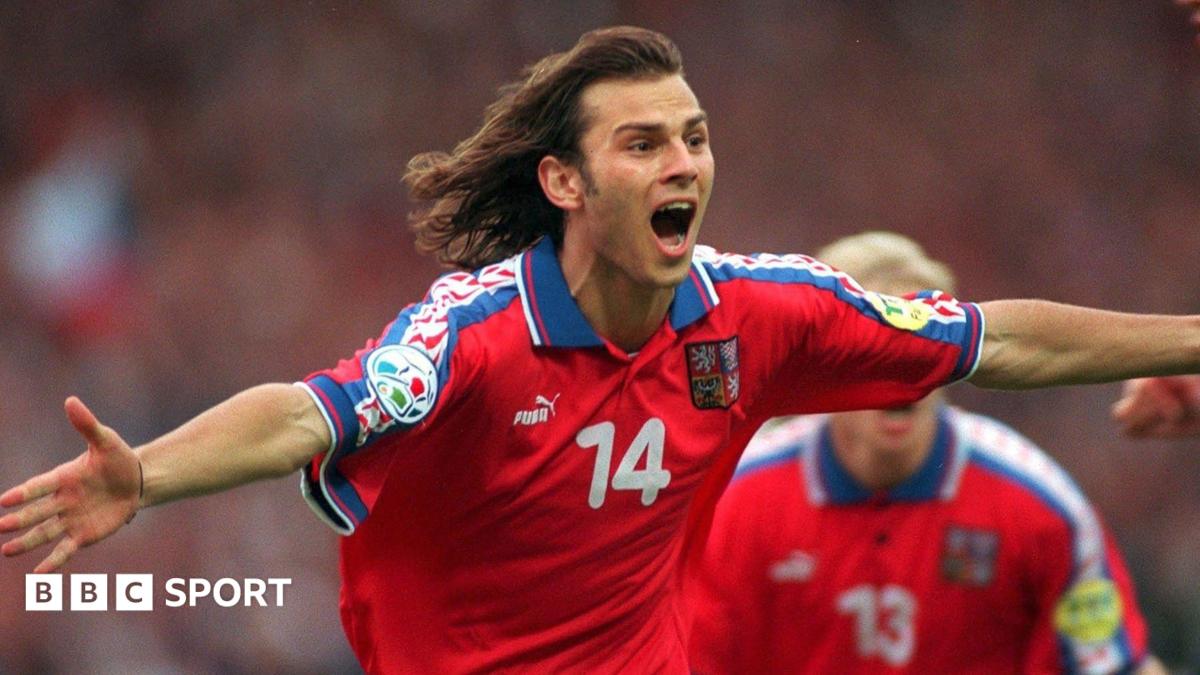
Thirty years after one of the most remarkable underdog runs in European Championship history ended in final heartbreak at the original Wembley Stadium, the Czech Republic national football team is set to return to the iconic north London venue for a new round of Nations League fixtures against England.
This international break brings two consecutive matchups between the two sides: the first kicks off in Prague on Tuesday at 19:45 BST, with the return leg scheduled at the redeveloped Wembley on October 6. While the Czechs have visited the new stadium multiple times since their 1996 final defeat to Germany, this trip marks three decades since that unforgettable summer tournament hosted across England.
Euro ’96 holds a unique place in Czech football history: it was the nation’s first major tournament after the peaceful dissolution of Czechoslovakia, which split the former country into the Czech Republic and Slovakia. Even within the Czech squad, few expected the unfancied team to make any deep run. Ranked as major tournament outsiders with most of their roster still playing domestically, many players had already booked post-group-stage holidays. Star winger Vladimir Smicer even had a wedding scheduled immediately after the opening round of matches.
In a revealing interview with the BBC’s *Sporting Witness* podcast earlier this year, former midfielder Patrik Berger recalled how even his own Borussia Dortmund teammate Jurgen Kohler – who was part of Germany’s 1996 Euro squad – had no idea the Czechs had qualified for the tournament. “He was asking me what my plans were for the summer. I said ‘I’m going to the Euros’ and he said ‘to watch games?’ I said ‘no, we’re playing you guys the first game of the group stages and then we will play in the final’ – and he was laughing,” Berger said.
The Czechs got off to a rocky start, falling 2-0 to Germany in their opening group match at Old Trafford. But a 2-1 upset victory over Italy at Anfield turned their fortunes around, followed by a dramatic 3-3 draw with Russia at the same ground. Smicer scored a late equalizer to secure the point, and when Italy played out a goalless draw with Germany, the Czechs snuck into the quarter-finals – a result the team only learned of several minutes after their own final group match ended. “One minute we’re not qualifying, the next it was we qualified, so we didn’t really know,” Berger explained.
What followed was a fairy tale run that still defines Czech football. In the quarter-finals at Villa Park, Karel Poborsky scored one of the most iconic goals in European Championship history, a perfectly executed lob over Portugal goalkeeper Vitor Baia that secured a 1-0 win and a spot in the semi-finals. Against France at Old Trafford, a 0-0 draw forced a penalty shootout, where the Czechs edged out the hosts 6-5. Future Ballon d’Or winner Pavel Nedved, Berger, and Poborsky – who would sign for Manchester United just weeks later – all converted their penalties. “If someone says they want to take a penalty in a shootout, they’re lying. Nobody wants that pressure,” Berger said. “We couldn’t believe we had beaten France. We were living the dream. To get to the final was kind of like a miracle for everyone.”
In one of the most memorable subplots of the run, Smicer flew back to Prague just two days before the final to tie the knot, with thousands of adoring Czech fans packing the city centre to celebrate the occasion before he returned to England the same day.
The 1996 final at Wembley brought the underdogs within touching distance of the title. In the 59th minute, the Czechs were awarded a penalty, and when no other player stepped up to take it, Berger stepped in. He drilled the spot kick into the back of the net to give the Czechs a surprise lead. “The only thing in my mind was hit it as hard as possible on target,” he recalled. For 73 minutes, the Czechs held on, until Oliver Bierhoff equalized for Germany in the 73rd minute. Extra time brought another historic first: Bierhoff scored the first ever golden goal in a major men’s tournament final, ending Czech hopes of a miracle win.
Berger, however, says he holds no regrets over the silver medal finish. “It wasn’t meant to be. I’d love to be European champion, but silver for us was like a gold because it opened doors to so many of us. And it opened doors to the generation after us,” he said. For Berger personally, the tournament also changed his career: his standout performances on English soil caught the attention of Liverpool, who signed him shortly after. When the team returned to Prague, 100,000 fans turned out to celebrate the underdogs, a reception that made the silver medal feel like a championship win.
This run at Euro ’96 remains the only time the independent Czech Republic has reached a major tournament final, though the golden generation of Czech football notched other notable achievements. They reached the semi-finals of Euro 2004, and quarter-finals in both 2012 and 2021. Prague-based football journalist Ondrej Zlamal argues the 2004 squad – which mixed 1996 veterans like Smicer and Berger with young stars such as Petr Cech, Milan Baros and Tomas Rosicky – actually played better football than the 1996 side. “This generation with Nedved and others culminated in 2004 and we had a feeling we should have won the Euros. It was the second highlight of the golden generation,” he said. That run ended with a defeat to eventual champions Greece in the semi-finals.
Since that era, Czech football has struggled to reach the same heights. The nation has only qualified for two World Cups, in 2006 and 2026, and exited both at the group stage. Zlamal called the 2026 World Cup performance “really disappointing”, and put the decline down to a lack of elite talent. “We don’t have such talented footballers as we had. We don’t have enough players in the top teams like we used to,” he explained. “Miracles happen and maybe there could be a new generation which could be surprising as 1996… but I don’t believe it will happen again.”
Now, a new era is beginning for Czech football. For the first time in the nation’s history, the national side is led by a foreign manager: Spaniard Santi Denia. His first squad, for upcoming Nations League matches against Croatia, England and Spain, includes seven uncapped or one-cap players – though none are under the age of 22, indicating a transition rather than a full youth overhaul.
Three decades on from that 1996 final, the old twin towers of the original Wembley have long been replaced by a modern, 21st-century venue. For Denia and his new-look side, there are few better settings to deliver a statement performance that could signal the start of a new chapter for Czech football.