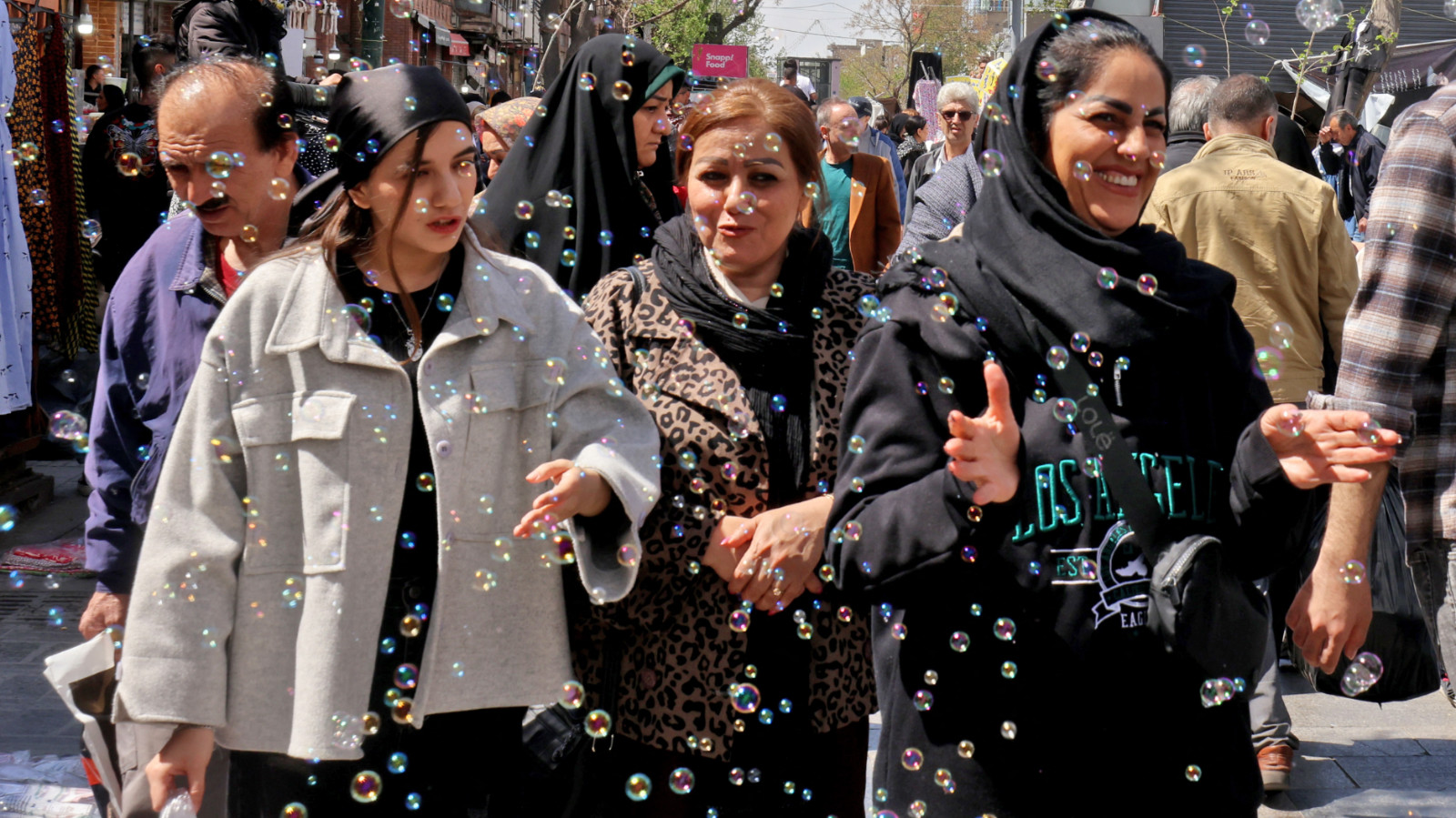
Before dawn broke on a September morning in Velayat Park, just south of Tehran, hundreds of runners had already packed the green space, gathering to compete in a 10-kilometer road race. Participants trickled in, arriving in groups of friends and family or stepping into the crowd alone, as upbeat music filtered through the park. Athletes chatted, laughed, and adjusted their gear while waiting for the starting signal, with the women’s division scheduled to take off first.
Many of the female runners wore event-provided sports head coverings consistent with national mandatory dress rules, but a number of participants chose to compete without covering their hair. Clips of the unorthodox scene spread rapidly across social media after the race, sparking fierce national debate and prompting Iranian authorities to launch legal action against the event’s organizers for violating public dress codes. Yet for the runners who spoke to Middle East Eye for this report, that early September morning was never about political protest — it was simply about the joy of running.
Fahimeh, a psychologist who joined the race, described the gathering’s electric atmosphere as a rare burst of collective energy, hope and everyday joy. She recalled being struck by the shared enthusiasm of the crowd that turned out in the pre-dawn hours on September 18. Her definition of hope, she explained, is straightforward: it is not a blind belief that tomorrow will automatically bring better days, but an active choice to claim joy and purpose today.
To understand the weight of that small, intentional choice, it is necessary to examine the broader climate of uncertainty that has shaped Iranian public life in recent years. The ripple effects of two consecutive regional wars, paired with constant fears of a new round of open military conflict, have seeped into every corner of daily life. Decades of international economic sanctions have gutted household purchasing power, while soaring inflation, widespread unemployment, and skyrocketing housing costs have pushed long-term life planning out of reach for millions. Political frustration and pervasive restrictions on personal autonomy have only deepened the national sense of instability, leaving many Iranians no longer asking if the future will be better — they are wondering if any future can be planned for at all.
On that same September day, just a few kilometers away in central Tehran, a second large public gathering unfolded. Jan-Fada, a government-backed mobilization movement launched after the 2024 US-Israel war on Iran began, brought together military units, armed civilian volunteers, and ordinary citizens for an event centered on messages of national defense and collective sacrifice. On the surface, the two events read as stark opposites: one group of Iranians chasing personal joy through running, the other gathering to prepare for sacrifice in defense of the nation. But this framing oversimplifies the shared reality connecting all Iranians across different ideological commitments.
Participants in both events gathered with loved ones, colleagues, and acquaintances, and both crowds carried a similar energy of collective purpose. Most attendees, regardless of which gathering they joined, share the same core concerns: supporting their families, holding steady employment, managing household finances, and building some kind of viable future. What has shifted for most Iranians is not the desire for hope, but the scale of their expectations.
Hamed, a Tehran-based journalist and father of a teenager, frames hope as “the last asset a person has.” Years of severe economic hardship have not entirely erased Iranians’ capacity to hope, he explains, but they have reshaped what people hope for. Where a family home or a new car once felt like a realistic long-term goal for many, today aspirations have shrunk to small, immediate joys: affording a new smartphone, taking a day trip, grabbing coffee at a local cafe, or finding a low-cost way to spend time together as a family. Even these smaller plans matter, Hamed argues, because they prove people are still choosing to look forward — even when that forward only stretches a few weeks or months ahead.
Maryam, a Tehran sports and dance instructor, sees this same quiet resilience among the students who continue to attend her classes, even amid widespread economic crisis. In recent years, she has sustained steady interest in a wide range of dance styles, from traditional Iranian folk forms to Western and contemporary styles that have faced government scrutiny. The economic collapse has hit her industry hard: fewer families can afford non-essential recreational classes, and many have been forced to drop out to cut costs. Still, a core group of students keep showing up, and Maryam says their choice to return holds deep meaning.
Dance offers immediate pleasure through music and movement, provides much-needed physical activity, and gives students the chance to master a new skill, she explains. It also creates community, and offers a rare escape from the constant pressure of daily uncertainty. For Maryam, learning any skill is an investment in the future — people spend time and money mastering languages, music, or crafts because they believe those skills will serve them for life. Dance, she says, is no different. This belief is what keeps her teaching: her students have continued to practice through waves of political unrest, war, and even pandemic-era lockdowns that forced classes online. For them, showing up is itself an act of hope for better days ahead.
In Tehran’s historic Grand Bazaar, 26-year-old Reza, a car dealer and second-generation trader, has made his own bold act of future-building: he is set to marry next month, a decision that shocked most of his friends and extended family. The wedding will cost him roughly 2 billion tomans, equal to $8,500 — a massive expense at a time when rampant inflation, housing shortages, and economic uncertainty have pushed marriage out of reach for millions of young Iranians. Reza’s reasoning is uncomplicated: “I fell in love,” he said. For him, marriage is a chance to leave his father’s home, build an independent life with the partner he has chosen, and invest in a shared future by building a home and working toward the life they both want. Uncertainty is unavoidable, he acknowledges — he has no guarantee his future will be stable or secure. But he is choosing to make his plans anyway. “We have no choice but to be optimistic,” he said. “We have no choice but to continue to live.”
Not all Iranians have seen their expectations shrink — some have faced deep disappointment after unmet political hopes, yet still cling to purpose. An anonymous Tehran-based environmental activist and writer says she had hoped the 2024 election of reformist president Masoud Pezeshkian, following the death of principlist incumbent Ebrahim Raisi, would open more space for civil society and bring modest improvements to daily life. While some limited changes have taken place, they fell far short of her expectations, a disappointment deepened by the ongoing regional wars. Watching widespread destruction of local ecosystems and wildlife, she felt increasingly powerless to create change, and eventually lost her job to the latest conflict, adding personal economic instability to the broader national uncertainty. Still, she does not identify as hopeless.
She invokes former Czech dissident and writer Vaclav Havel’s distinction between hope and optimism: “Hope is not the certainty that things will turn out well, but the belief that what one does can still have meaning, regardless of the outcome,” she told Middle East Eye. She has no idea whether her life will be better or worse in two years, she says — but she still believes “Life is worth it.”
Back at the government-organized Jan-Fada gathering, Hamid, a participant, frames his vision of the future around what he feels called to defend. “For me, it is not about the government. It is about Iran,” he said. Defending the country means defending his home, his family, and his children, he explains. The stable life he wants for his family is not so different from the ambitions of most other Iranians: a home of their own, a reliable car, university educations for his children, occasional family trips, and enough income to avoid constant stress over unexpected expenses. Even so, the pressures of the present have already tested that vision: he recently paid several million tomans to cover medical costs for his sick mother, a massive burden for a salaried worker at a time when war, sanctions, and supply chain disruptions have driven up drug prices and made critical care harder to access. For Hamid, these struggles do not contradict his commitment to defending his country — they are part of why he chooses to stand for it.
Back at the Velayat Park road race, Fahimeh describes hope in nearly identical terms: hope is not confidence that circumstances will get better, it is a choice to do something small that is within your control. Put on your running shoes. Step outside. Start moving. That pre-dawn September morning showed her how hope becomes real when it turns into action.
Maryam sees the same pattern in her dance students. “People have been stuck in a long period of uncertainty and often cannot make long-term plans,” she said. “Instead, they take the next step they can see.” She summed up the collective Iranian experience of hope in a single metaphor: “Our situation is currently like holding a lantern in the dark. You can only take a few steps in front of you, and then you look for the next step.”
This reporting is published by Middle East Eye, an independent media outlet delivering unrivaled original coverage of the Middle East, North Africa and broader region.