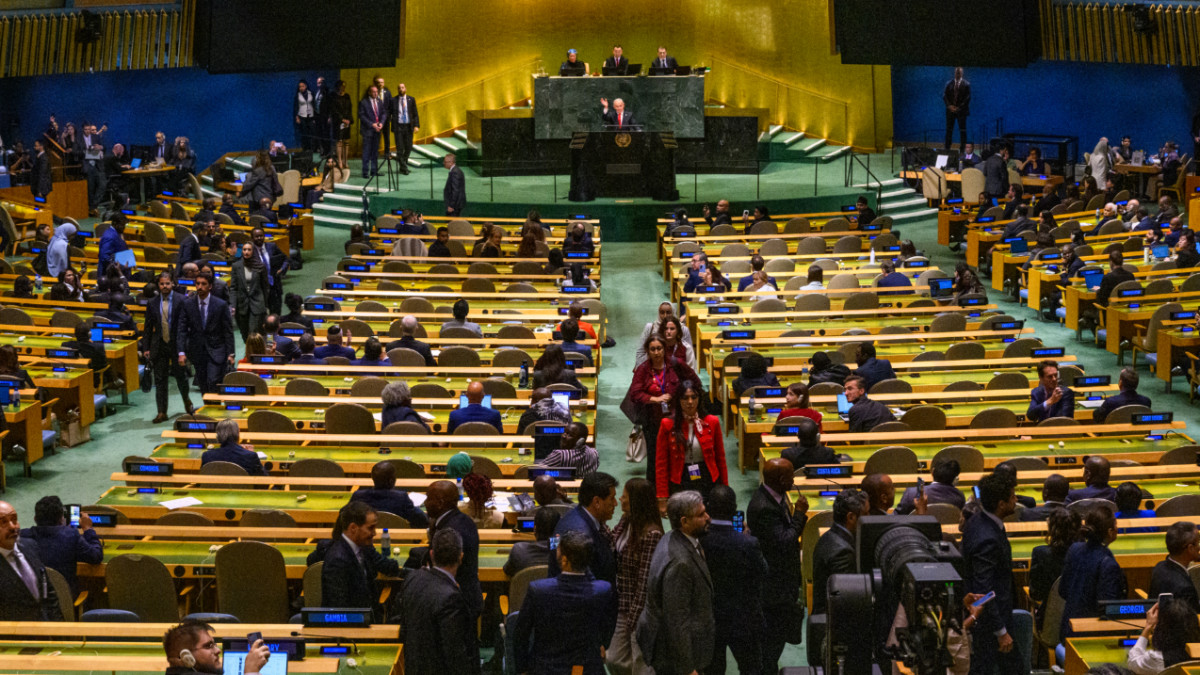
As the United Nations General Assembly entered its fourth day of deliberations, the fallout from the US-Israeli military campaign against Iran and the long-running Israel-Palestine conflict remained the centerpiece of global debate, with leaders from across regions and blocs laying out starkly diverging positions on the crises and their far-reaching global impacts.
For vulnerable economies already grappling with years of internal instability, the ripple effects of the current conflicts have proven devastating, Somalia’s President Mohamed Hassan Sheikh Mohamud told the assembly. The East African nation, which depends almost entirely on imports of food and fuel from the Middle East and relies heavily on customs revenue to fund state operations, has seen steep price hikes for essential goods and a 40 percent collapse in customs collections since the conflict escalated, Mohamud said. Disruptions in the Strait of Hormuz, a critical global chokepoint for energy trade, have triggered disproportionate harm to developing nations like his own, he added, stressing that unimpeded, free navigation through the waterway is non-negotiable to protect the world’s most vulnerable economies. Turning to the Israel-Palestine conflict, Mohamud emphasized that a just, negotiated resolution to the Palestinian question remains a foundational requirement for lasting peace across the Middle East and the wider world, affirming that Somalia stands in unwavering solidarity with the Palestinian people and their internationally recognized right to self-determination and sovereign statehood.
European Union Council President Antonio Costa opened his address by reaffirming the bloc’s unshakeable commitment to multilateralism, arguing that no single nation can deliver durable peace in an increasingly interconnected world. While he did not explicitly name the United States’ repeated attacks on the International Criminal Court, Costa issued a clear warning against the spread of double standards in the application of international law, and pledged the EU’s full, unwavering support for both the ICC and the International Court of Justice. “We support these courts firmly, and we will defend their independence, integrity and ability to fully carry out their mandate,” he stated, condemning ongoing targeting of the court. The United States has already imposed sweeping sanctions on multiple senior ICC officials, including court president Tomoko Akane and senior trial lawyer Abdoulaye Seye, who were sanctioned in August. Former chief prosecutor Karim Khan was the first to be targeted last February, followed by two deputy prosecutors and nine judges leading investigations into alleged atrocities in Palestine and Afghanistan. Multiple reports this week have confirmed Washington is preparing to roll out even broader sanctions against the court in the coming weeks.
Costa also indirectly pushed back against former U.S. President Donald Trump’s claims of having achieved a lasting peace deal for Gaza, noting that Israeli military operations in the enclave have continued despite a 2025 ceasefire agreement. Stating that the EU regrets the ongoing stalemate in Gaza and across the occupied Palestinian territories, Costa reaffirmed the bloc’s longstanding position that a two-state solution remains the only viable path to durable peace in the Middle East. Unlike many critics of the current conflict, Costa did not condemn the US-Israeli campaign against Iran, instead saying the EU supports diplomatic efforts to find a negotiated resolution to the standoff. He reiterated the EU’s longstanding policy that Iran must never be permitted to acquire nuclear weapons, and expressed hope that the Iranian people will one day live in conditions of peace, security and full freedom. Costa also joined global calls for unconditional, unhindered freedom of navigation through the Strait of Hormuz.
Yemen’s Vice President Abdullah Abdulkader al-Alimi-Bawzer used his address to condemn the Houthi militia and urge the global community to unite against the group, which he accused of advancing Iran’s geopolitical agenda at the expense of regional and global security. Alimi-Bawzer noted that the Yemeni people have endured 12 years of crisis since the Houthi coup against the internationally recognized government, adding that Yemeni authorities have repeatedly supported a Saudi- and Omani-backed peace initiative that the Houthis have rejected. Instead of engaging in negotiations, the militia has escalated attacks on commercial shipping in the Red Sea and Bab el-Mandeb, he said, turning one of the world’s most critical maritime trade routes into a bargaining chip for Iran’s global confrontation. “The Houthi militia’s use of the safety of navigation as a tool for blackmail threatens not only Yemen. It is taking hostage the entire global economy,” al-Alimi-Bawzer said. He argued that long-term maritime security in the Red Sea, Bab el-Mandeb and the Gulf of Aden cannot be achieved as long as an armed non-state militia controls critical Yemeni coastline, stressing that restoring the sovereign Yemeni state and securing the Bab el-Mandeb waterway are inseparable goals.
Kuwait’s Crown Prince Sabah Al Khaled used his address to the UN Security Council to condemn what he called illegal Iranian aggression against his country, describing the attacks as a blatant violation of core principles of international law. “These brutal attacks have systematically and repeatedly targeted civilian objects and critical infrastructure… revealing a hostile approach aimed at disrupting the foundations of life,” he said. Al Khaled noted that the security and stability of the Arabian Gulf region is a core pillar of global security, as the ongoing conflict and its spillover have clearly demonstrated. Kuwait has been among the Gulf states hardest hit by Iranian retaliation for the US-Israeli campaign against the Islamic Republic: as host to tens of thousands of U.S. troops and multiple major U.S. military bases, both American facilities and key civilian infrastructure including Kuwait International Airport and national energy sites have been targeted in recent attacks. The country is also exceptionally vulnerable to Iranian disruptions of Strait of Hormuz shipping, as nearly 100 percent of Kuwait’s oil exports are transported via tanker through the waterway. Turning to Palestine, the crown prince reaffirmed Kuwait’s firm, principled position condemning ongoing violations by Israeli occupation forces against the Palestinian people, noting that Palestinians continue to endure brutal living conditions under Israeli policies of displacement, mass arrest and expanding settlement construction. He also praised France and the United Kingdom for their recent decision to impose new sanctions on trade with Israeli goods produced in illegal West Bank settlements. Al Khaled also joined growing global calls for reform of the UN Security Council, arguing that the body must adapt to shifting global power dynamics to remain effective. “There is an urgent need for the council to become more representative, effective and transparent in carrying out its responsibilities,” he said.
The day’s most dramatic confrontation came during Israeli Prime Minister Benjamin Netanyahu’s pugnacious address to the General Assembly, where the Israeli leader launched aggressive attacks on critics ranging from New York City Mayor Zohran Mamdani to Turkish President Recep Tayyip Erdogan and Western European leaders, as he works to counter growing international isolation for Israel and his government. When Netanyahu took the podium, the assembly hall erupted in loud boos, and a majority of delegates walked out of the chamber in protest. Undeterred, Netanyahu struck a defiant tone, challenging remaining critics to leave. “If there are any other moral cowards who haven’t left this hall, please do so now,” he said with a smile before beginning his prepared remarks.
Netanyahu devoted a large portion of his address to attacking Mayor Mamdani, accusing the New York leader of capitulating to what he called antisemitic protests. “Mr Mamdani, since you were elected mayor of this city, many Jews no longer feel safe in New York,” Netanyahu shouted. “Mr Mamdani, you tried to stop me from coming here. You tried to silence me. Well, you can’t silence me. You can’t silence the truth.” Outside the UN headquarters, hundreds of protesters gathered ahead of Netanyahu’s arrival and continued demonstrations throughout his speech, echoing widespread global anger at Israel’s ongoing military campaigns across the Middle East. Analysts noted that Netanyahu’s combative address was largely targeted at a domestic American audience and Jewish diaspora voters, coming ahead of Israel’s national elections scheduled for October. Netanyahu’s speech underscored the deepening rift between Israel and much of the international community even as the country expands its military campaigns against multiple neighbors, including Lebanon, Syria, Gaza and the occupied West Bank.