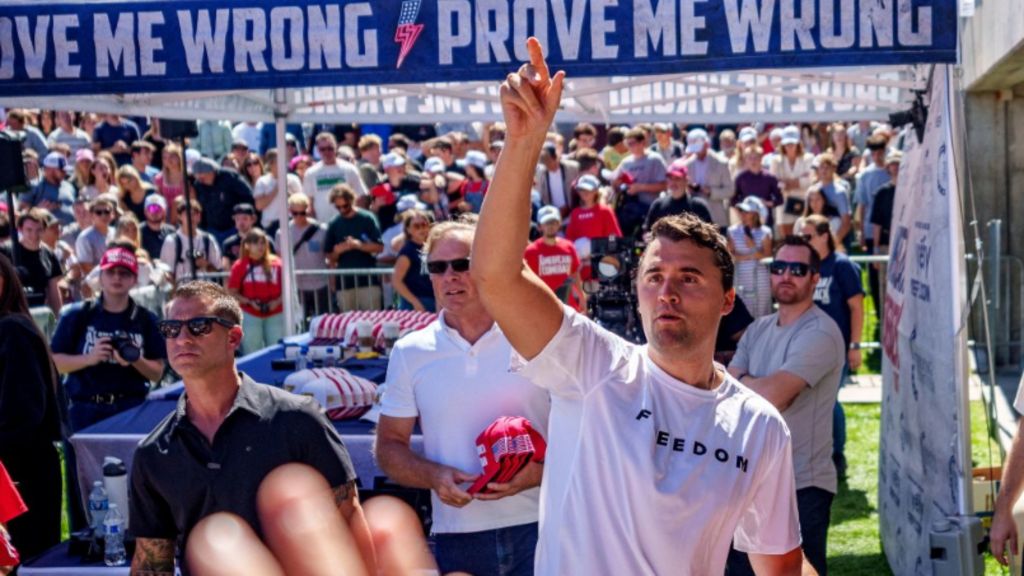
Almost a year after high-profile conservative activist Charlie Kirk was fatally shot during a public speaking event at Utah Valley University (UVU), an independent external review has confirmed a cascade of critical security gaps and missteps that left the event vulnerable to attack.
The September 2025 killing, which unfolded as Kirk addressed roughly 3,000 attendees in a campus courtyard surrounded by multi-story buildings, sent shockwaves across U.S. political and higher education circles. The shooting, carried out by a gunman firing from a nearby rooftop, left Kirk dead at 31 after he was struck in the neck and rushed to a local hospital.
The newly released report, commissioned by UVU and conducted by independent external security consultants, details a breakdown in pre-event planning that started months before the killing. Campus officials raised red flags as early as August 2025 about the planned outdoor courtyard venue, warning that its position ringed by tall structures created major security risks, and offered multiple alternative indoor locations for the event. Those concerns were overruled, however, when a representative from Kirk’s organization Turning Point USA insisted on retaining the courtyard, noting the activist had previously spoken at the site and the group was familiar with the space.
Far from taking control of security planning to address the identified risks, the report finds UVU deferred nearly all key safety decision-making to Turning Point USA. The university never completed a formal written security assessment of the venue, nor did it draft a structured event action plan aligned with standard protocols for high-profile public gatherings. Most critically, no documented line-of-sight assessment of surrounding buildings was conducted during planning, a basic step to identify potential sniper threats like the one that killed Kirk.
The review also uncovered major coordination failures between UVU’s campus police force and Kirk’s private security detail. A planned pre-event meeting between the university’s police chief and Turning Point’s security leadership never happened, and the two teams never held a joint security briefing or walked through the venue together. Reviewers noted this omission was a critical missed opportunity to flag unaddressed risks, clarify shared responsibilities, and implement additional protective measures before attendees arrived.
Notably, the review concluded no UVU employee or institutional representative acted in bad faith, nor did any party demonstrate willful, reckless disregard for attendee or speaker safety.
The findings have been embraced by Kirk’s family, who have long alleged the university’s negligence led to the activist’s death. The family has already filed a formal wrongful-death notice, a standard procedural step that opens the door to future civil litigation against the institution. Kirk’s family attorney Brett Parkinson said in a statement Friday that the independent review fully validates the concerns his clients have raised since the shooting.
“The buck stopped with UVU leadership and law enforcement,” Parkinson told the Associated Press. “Justice for Charlie and his family requires true accountability for UVU’s fatal shortcomings that day.” When reached for comment on the review’s conclusions, Turning Point USA declined to issue an independent statement and instead referred reporters to Parkinson’s remarks.
Beyond its findings of existing failures, the review puts forward a broad set of recommendations to overhaul UVU’s security protocols for major campus events. In response to the report, UVU President Jon Anderson committed the institution to implementing changes, saying the university has a responsibility to learn from the tragedy and follow through on all proposed safety updates.
Previous public reporting has already revealed additional gaps: campus police did not complete now-standard security procedures common for high-profile events, including drone surveillance of surrounding rooftops to monitor for potential threats, or basic entry-point security screenings such as bag checks and metal detector scans.
In the aftermath of the shooting, 30-year-old suspect Tyler Robinson was taken into custody and charged with aggravated murder. He has pleaded not guilty to the charge, and prosecutors have announced they will seek the death penalty in the case. The killing has reignited long-running national debates over gun violence, campus speech safety, and security protocols for high-profile public events at U.S. higher education institutions.