Developments at the 2026 United Nations General Assembly have thrust Venezuela’s shifting political landscape into the global spotlight, just nine months after a controversial U.S. military raid on Caracas that ousted long-time ruler Nicolás Maduro and left approximately 100 civilians dead. Maduro is now detained in New York, where he faces federal drug trafficking charges brought by U.S. authorities.
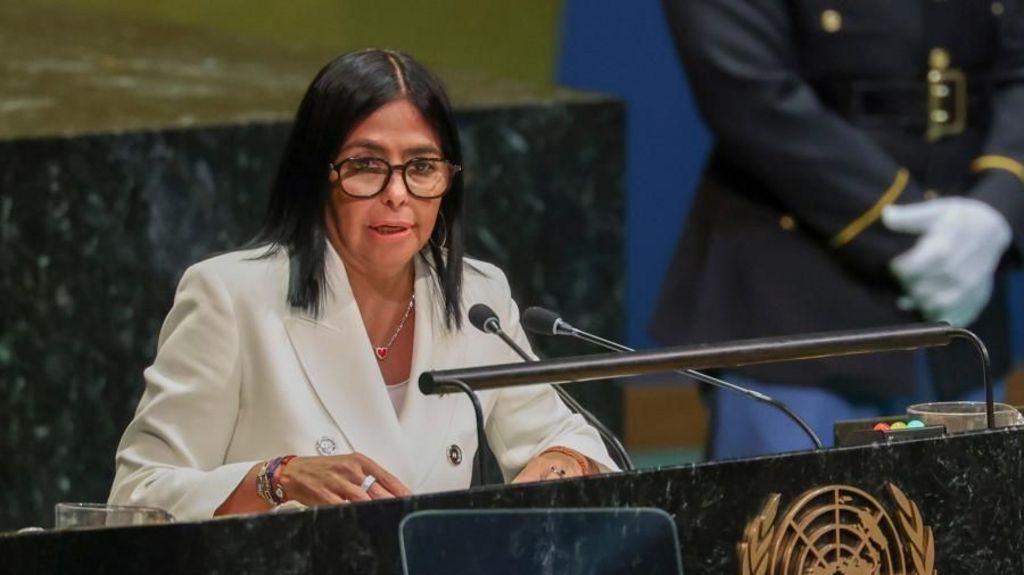
Days after Maduro’s removal from power, his former vice president and close ally Delcy Rodríguez was sworn in as Venezuela’s interim president, with immediate backing from the Trump administration despite her deep history with the ousted regime. Addressing the UN General Assembly on Tuesday, Rodríguez announced that the country would move toward a transition to full democratic rule through national elections — but notably declined to name any tentative or fixed timeline for the vote.
In her remarks, Rodríguez did not make a single reference to the jailed former president Maduro. Instead, she focused on building new ties with Washington, extending public gratitude to U.S. President Donald Trump for opening the door to diplomatic cooperation. She claimed that her interim government and the Trump administration are engaged in serious dialogue to resolve long-standing disagreements, and are laying groundwork for expanded energy collaboration, cross-border security cooperation, a joint campaign against transnational organized crime, and mutual economic growth that would benefit both nations and the broader South American continent.
Trump, who spoke shortly after Rodríguez at the assembly, took a far more direct approach to Maduro, repeatedly labeling the former leader an “outlaw dictator” and “real criminal.” The U.S. president used his address to celebrate a newly struck energy deal with Rodríguez’s government, which he described as the largest oil contract in history, granting U.S. firms access to 65 billion barrels of Venezuelan crude oil. In remarks that drew swift criticism from global observers, Trump declared “To the victor belong the spoils,” and added that the U.S. would not hesitate to deploy its “unmatched military might” to defend what it calls vital national interests in the region. Notably, Trump did not mention Venezuela’s promised transition to elections in his UN speech — and earlier this month, he told the Los Angeles Times that he does not believe Venezuela is yet prepared to hold free votes.
Rodríguez’s failure to set an election date has drawn sharp condemnation from Venezuelan opposition groups, who argue that the interim administration is delaying democratic transition to hold onto power. A brief sideline meeting between Trump and Rodríguez on the UN’s margins touched on election planning, according to U.S. Secretary of State Marco Rubio, who attended the talks. Rubio urged opposition leaders to show patience, arguing that a full political transition and institutional rebuilding must take place before free and fair elections can be held. “What we don’t want to see is that someone is elected, and they inherit a complete catastrophe, economic and social,” Rubio explained, pointing to ongoing negotiations between Rodríguez’s government and a faction of the opposition as evidence of incremental progress.
Critics of those talks, however, highlight a glaring exclusion: Venezuela’s most high-profile opposition leader, María Corina Machado, has been locked out of the negotiations entirely. Machado left Venezuela in December 2025 to accept the Nobel Peace Prize in Oslo, and has been barred from reentering the country ever since. One of her senior advisors confirmed that she made three separate attempts to return to Venezuela this week, all of which were blocked by interim government authorities. The ban on her reentry extends to a long-standing restriction, first imposed under Maduro, that bars Machado from running for public office. Venezuelan Interior Minister Diosdado Cabello has previously warned that if Machado attempts to return, authorities have “a surprise” waiting for her. Ahead of Rodríguez’s UN address, dozens of her critics held public protests in New York to denounce the interim government’s anti-democratic actions and exclusion of opposition voices.