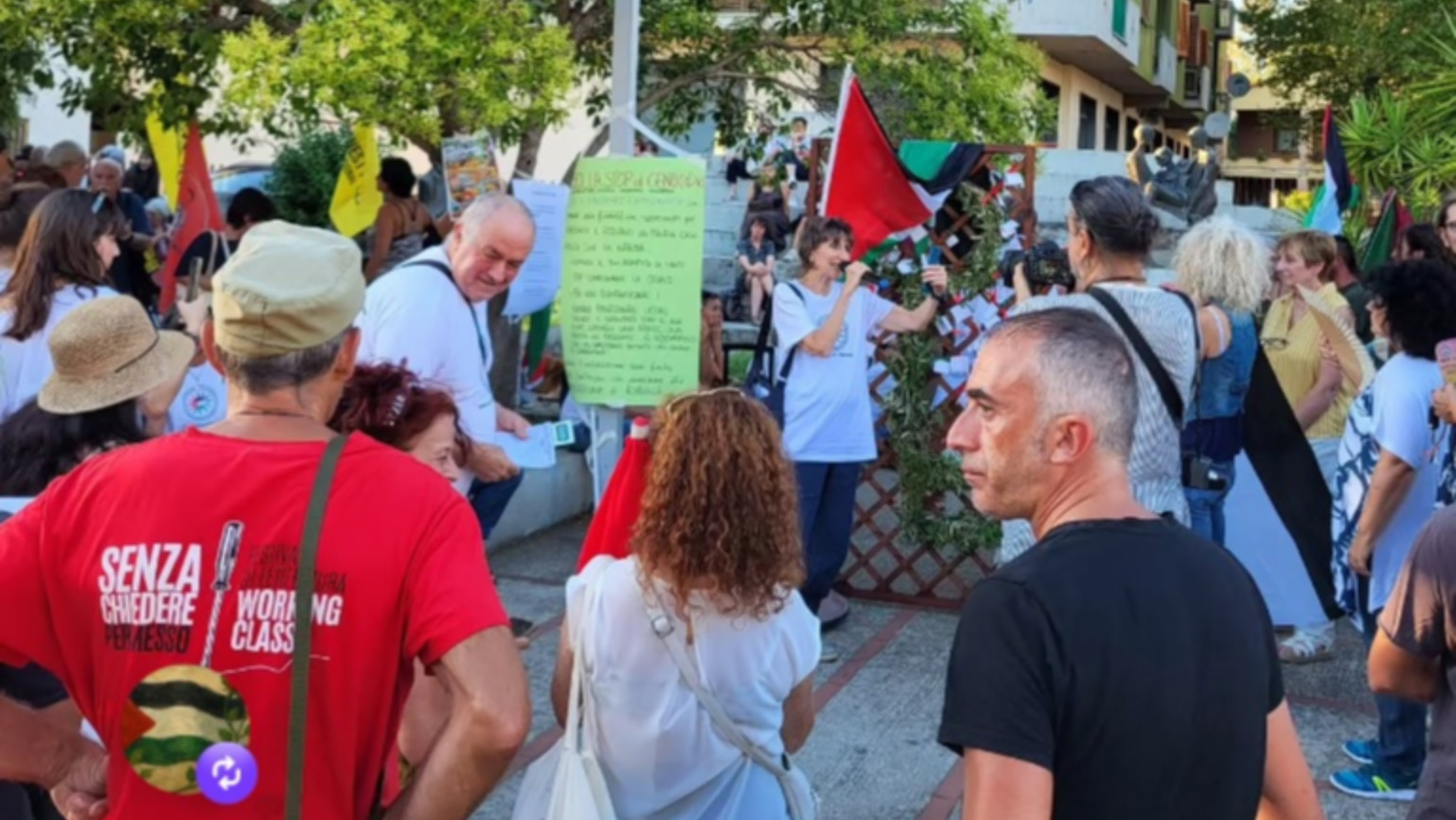
In the quiet small town of Ribolla in Italy’s Tuscany region, a grassroots movement led by local advocacy group Diritti in Palestina has ignited a widespread campaign against a planned agrivoltaic solar park, after investigators traced the project’s ultimate ownership to an Israeli firm with well-documented ties to Israel’s military and illegal occupation of Palestinian territories.
The campaign launched in early September, after activists conducting routine scrutiny of the proposed development uncovered that the project was being fronted by a Milan-based special-purpose vehicle (SPV) called SPV Energy 3, a shell company with no registered employees and just €2,500 in share capital. This opaque corporate structure, designed to obscure ultimate ownership, led the team to dig deeper, revealing the firm is a subsidiary of Tel Aviv-based Shikun & Binui, a multinational conglomerate with operations spanning real estate, energy and global infrastructure development.
Shikun & Binui has ambitious plans to build five utility-scale solar plants across Tuscany, using a network of five separate SPVs registered in northern Italy to hide the company’s ultimate control of the projects. Land lease documents reviewed by Middle East Eye confirm SPV Energy 3 is the formal signatory for the Ribolla development, a structure legal experts say is intentionally designed to limit transparency.
“This suspicious lack of basic corporate substance prompted us to dig deeper, especially as we have seen a surge of Israeli investments into our region’s renewable energy sector in recent years,” explained 72-year-old Alessandra Bertero, co-founder of Diritti in Palestina, in an interview with Middle East Eye. After the project was first announced in May, Bertero and four fellow activists filed multiple freedom of information requests to map the firm’s operations, uncovering a pattern of Shikun & Binui operating across multiple European Union member states under different local branch and shell company names.
Critics of the project point to a long record of violations tied to the conglomerate: in September 2025, the UN High Commissioner for Human Rights added Shikun & Binui to its official blacklist of companies operating illegally in Israel’s occupied West Bank and occupied Golan Heights. The firm’s roots stretch even further back, tracing to historic construction firm Solel Boneh, which collaborated with the Israeli military during the 1948 Nakba, the mass violent expulsion of hundreds of thousands of Palestinians from their ancestral land.
Beyond the occupation ties, the project has sparked fierce local pushback over its strategic location: Ribolla sits roughly 110 kilometers from the port of Livorno, a key transit hub for arms shipments headed to Israel, a detail that has amplified community concerns about the development’s broader implications.
Activists stress there is still time to block the project, as it has not yet received the required Single Energy Authorization, a permit that falls under the oversight of Tuscany’s regional government. If approved, the development would see 36,000 solar panels installed across agricultural land in the town.
Michela Arricale, a jurist providing legal support to the campaign, argues that allowing capital linked to Israeli occupation to move forward with the project would directly violate the principle of non-recognition laid out in the International Court of Justice’s landmark July 2024 advisory opinion on Israeli occupation. “We hope we can stop this project, set a legal precedent for communities across other affected regions, and deter similar harmful developments in the future,” Arricale said.
The controversy also comes amid growing broader criticism of agrivoltaics, a model marketed as a win-win for food production and renewable energy that installs panels high enough to allow crops and grazing to continue underneath. Promoted by European energy lobbies in Brussels as a green solution to land abandonment and climate change, agrivoltaics has expanded rapidly across the continent, but critics warn that poorly regulated projects often amount to greenwashing, delivering few of the promised environmental and social benefits.
Fabrizio Garbarino, president of Italy’s Rural Association, argues that agrivoltaic projects deployed by foreign multinationals to date have failed to deliver tangible benefits for local farmers or food production. “We have carried out dozens of on-the-ground tests, and none have resulted in meaningful benefits for farmers or viable edible crop production,” Garbarino told Middle East Eye. “This so-called green approach, masked as sustainability, reinforces a neocolonial mindset that exploits crisis-hit rural areas to meet the energy needs of multinational corporations with no connection to local farming – they get praised for their work, but only on paper.”
Italy’s regulatory landscape has opened the door to this wave of foreign investment: since 2021, permissive national land use rules and generous post-Covid green transition funding have created ample opportunities for international firms to acquire large swathes of Italian agricultural land. In 2023, retail giant Amazon and French energy firm ENGIE launched Europe’s largest agrivoltaics park in Sicily, but three years on, promises of community benefits have yet to materialize.
At the same time, Israel has positioned itself as a leading player in the global sustainability sector with EU backing and funding, while multiple reports have documented that the country’s green industry contributes to the system of apartheid imposed on Palestinians in the occupied West Bank.
The unfolding controversy in Tuscany has pushed farmers and campaigners to call for far greater transparency around land ownership and the beneficiaries of Italy’s green transition. “Israel has substantial economic resources, so its investment in profitable greenwashing projects across our country is not surprising,” Garbarino noted, adding that his team has reviewed dozens of contracts from local farmers approached by suspicious foreign investors, most of which use the same shell company structure as SPV Energy 3, with minimal share capital and no prior experience in energy or agriculture.
Giancarlo Innocenti, head of the retired workers’ association for one of Italy’s largest farming unions and former mayor of Roccastrada, the Tuscan district where the agrivoltaics projects are planned, has also traced a string of recent farmland acquisitions back to Israeli investors or their European front companies. “Recently, a local farmer reached out to me to mediate a conversation in English with an Israeli man who wanted to buy his land,” Innocenti recalled. He has documented a pattern where intermediaries target struggling farmers facing low crop yields and wildfire damage, snapping up land at cut-rate prices during bankruptcy auctions.
After 40 years working in agriculture across Tuscany’s rolling fertile hills, Innocenti draws a careful parallel between the gradual displacement of Italian farmers by foreign multinationals and the decades-long displacement of Palestinians by Israeli settlement expansion, while acknowledging the profound difference between the two contexts: Palestinians live under direct military occupation and face systematic ongoing land theft. “Our farmland, which is meant to feed our communities, is increasingly exploited for profit,” he said. “Farmers are being quietly, forcibly pushed out of our territories little by little to make room for multinationals, and our historic olive groves are falling to this process. But these protests are our attempt to defend and take back our land – it is impossible not to see this as a metaphor.”
The Ribolla campaign unfolds against a complex national political backdrop: Italian Prime Minister Giorgia Meloni’s government lists Israel as one of its closest European allies, despite broad grassroots support for Palestinian rights across Italian civil society. The Ribolla project is not an isolated case, but a symptom of a much larger underreported trend of growing Israeli investment in Italy’s agricultural and renewable energy sectors, which is now drawing scrutiny across the country’s southern regions.
In Puglia, one of Italy’s most productive agricultural regions, foreign investors have targeted large tracts of land for both renewable energy and real estate developments. Across the Strait of Otranto in Albania, widespread public protests have already broken out against real estate projects backed by former US President Donald Trump’s son-in-law Jared Kushner in protected coastal areas, raising broader awareness of how foreign capital – including growing Israeli investment – is targeting vulnerable Mediterranean communities.
Similar tensions have erupted on the island of Sardinia, where the rapid expansion of large-scale renewable projects has prompted fierce pushback from farming communities and local authorities concerned about uncontrolled land use and irreversible damage to the island’s iconic landscape. Sicily, meanwhile, has become a major magnet for solar development after Amazon’s early investment and public comments from Elon Musk highlighting the island’s potential utility for large-scale energy production. Arricale, the campaign’s legal advisor, says she is currently monitoring two additional Israeli-linked SPVs buying land in western Sicily under local wine grape names Nerello and Nero d’Avola, which are planning large-scale projects with a combined total capacity of 126 megawatts.
Inspired by the mobilization in Ribolla, residents of the nearby town of Lavaiano have now launched their own campaign to stop a second 22-hectare Shikun & Binui agrivoltaics project, fronted by another shell company called SPV Energy E32. Tuscan regional councillor Lorenzo Falchi has even submitted a national parliamentary inquiry, pushing for the regional government to reject the Israeli-linked projects and set a formal precedent to block similar developments in the future.
Arricale argues that the controversy exposes the urgent need for clearer national legislation that classifies large agrivoltaics projects as infrastructure, rather than routine agricultural interventions, which would tighten scrutiny and prevent speculative, bad-faith investors from accessing land. “This is a battle that matters to all of us,” she said. “The energy transition is a critical challenge we must overcome, but not at the cost of accepting large-scale speculative projects that hurt working farmers forced to sell their land out of financial desperation – especially when that capital is tied to the illegal occupation of Palestine and violates international and humanitarian law.”
Bertero echoes this call, urging communities across Italy to increase scrutiny and mobilize to keep foreign speculative projects out of local agricultural land. “Most of the time these deals go through because no one is paying attention,” she said. “The problem is that citizens are not informed, especially in this current political climate, about what is happening right in their own backyards. Our land is the most precious thing we have, and just as Palestinians have shown us, it should not be sold for harmful, self-serving purposes.”
Middle East Eye, which first reported on this campaign, is an independent media outlet covering the Middle East, North Africa and global issues connected to the region. Requests for republishing this content can be submitted via the outlet’s official contact form.