Following UK Prime Minister Andy Burnham’s high-profile warning about Russia-linked disinformation operations targeting British audiences, BBC Verify has launched a deep investigation into how these coordinated influence campaigns operate, and the growing role of artificial intelligence in supercharging their spread.
Over years of monitoring, the outlet’s fact-checking team has tracked and debunked dozens of covert campaigns organized by groups tied to the Russian government, designed to shift global public opinion on critical geopolitical issues, disrupt democratic elections across the U.S. and Europe, erode social cohesion, and undermine public trust in state institutions.
In his recent address to the United Nations, Burnham highlighted the insidious, deliberate nature of these Russian efforts to reach and influence ordinary UK residents. One striking example, uncovered by the investigation, dates back to last year, when a wave of AI-altered fake videos targeting ordinary British public sector workers spread across social media. Aaron, a 999 emergency call operator based in Preston, told BBC Verify he was stunned to discover his voice had been cloned using AI to create a fabricated video that falsely framed him as commenting on the 2025 Polish presidential election. Aaron’s case marks a worrying shift: previously focused on public figures and institutions, the Matryoshka disinformation campaign – the large-scale Russian-linked operation BBC Verify and independent research groups have long tracked – is now targeting ordinary private citizens.
Matryoshka relies heavily on AI to churn out dozens of deepfake videos daily, impersonating respected journalists and major news outlets including the BBC itself to push false narratives about Ukraine and Western countries directly into users’ social media feeds. Ahead of the 2024 U.S. presidential election, BBC Verify documented a strategic shift in the campaign’s focus, moving away from Ukraine-related disinformation to flood platforms with fabricated content about the race. Early evidence now points to the same tactic being deployed ahead of November’s upcoming U.S. midterm elections.
This is far from the only large-scale coordinated disinformation operation the fact-checking team has exposed. Previously, BBC Verify uncovered a sprawling network run by a former U.S. law enforcement officer based in Russia, which used AI to build hundreds of fake local news websites across the UK, U.S., France and other Western nations to publish entirely fabricated stories. One example, a fake outlet called the *London Crier*, falsely claimed that Ukrainian President Volodymyr Zelensky had purchased a mansion owned by King Charles at a heavily discounted price. The fabricated story reached hundreds of thousands of users on X, and was even shared by an official Russian embassy social media account. The bogus narrative originated from an AI-narrated fake video uploaded to YouTube, which the platform removed after BBC Verify reported it.
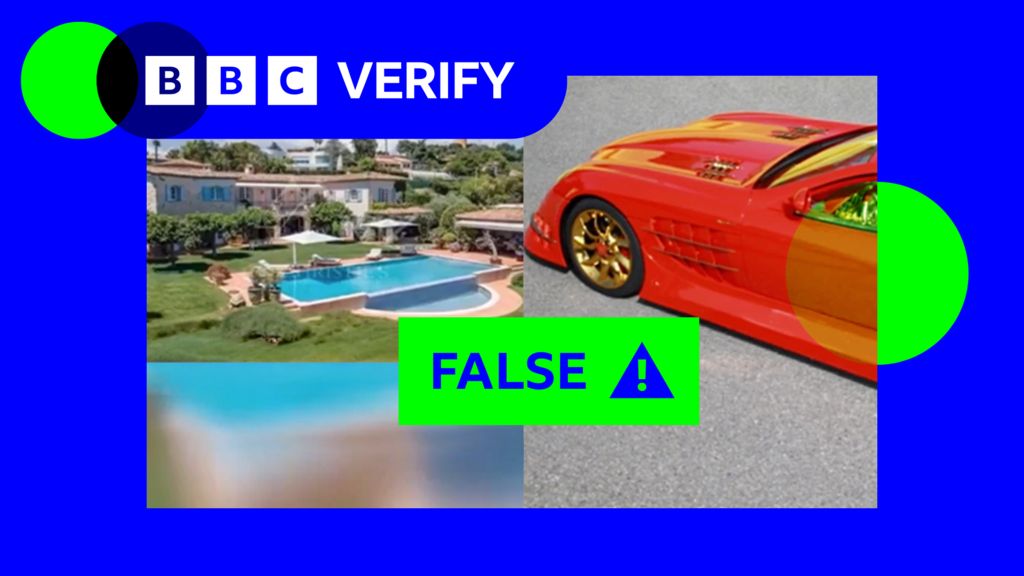
In 2023, the team uncovered a major propaganda operation on TikTok, where thousands of fake accounts posted misleading multilingual videos – including English-language content – that racked up millions of views, aimed at swaying European public opinion on the Russian invasion of Ukraine. TikTok ultimately removed more than 12,000 fake accounts linked to the operation, after confirming the network originated in Russia. One of the most viral false narratives accused former Ukrainian Defence Minister Oleksii Reznikov and his daughter of illegally purchasing luxury property and vehicles.
Coordinated Russian disinformation interference in Western democratic processes dates back more than five years: during the 2019 UK general election, an anonymous user on Reddit posted a trove of confidential documents purporting to detail secret negotiations for a UK-U.S. trade deal, which were later used by the Labour Party in its election campaign. Though the documents appeared authentic, Reddit later confirmed the leak was part of a coordinated campaign traced back to Russia.
Despite the clear scale and organization of these operations, measuring their real-world impact remains a major challenge. Researchers note it is difficult to quantify exactly how far many of these false narratives spread, or how much they have actually altered public opinion or shifted election outcomes. It is also important to note that Russia is not the only state that conducts large-scale disinformation operations to advance geopolitical goals. BBC Verify has previously documented X accounts pushing pro-Scottish independence content that were traced back to Iran. At the peak of the COVID-19 pandemic, the outlet uncovered a network of more than 1,200 fake or hijacked accounts across Facebook, Twitter and YouTube pushing pro-China government messaging and anti-U.S. propaganda.
Evidence also shows Western governments have engaged in covert disinformation efforts, though the full scale of these operations remains unclear. A 2024 Reuters investigation revealed that during the COVID-19 pandemic, the U.S. military ran a hidden anti-vaccine influence campaign designed to discredit China’s Sinovac vaccine. Meta has also previously removed a coordinated influence campaign originating from France that targeted multiple African nations.
The rise of accessible, advanced AI has drastically worsened the global disinformation crisis. Modern tools make it far easier to create convincing fake images, misleadingly edit video content from text prompts, and generate coherent, plausible-sounding fake news reports that mimic authoritative journalism. BBC Verify observed this acceleration first-hand during the 2025 Iran-U.S.-Israel conflict: while the early weeks of the Russia-Ukraine war mostly saw disinformation made up of recycled old footage and inaccurate written claims, the outbreak of the Iran conflict this past February brought a tidal wave of AI-generated fake images and videos flooding social platforms.
Carl Miller, founder of the Centre for the Analysis of Social Media at the UK think tank Demos, told BBC Verify that state-run influence operations deliberately amplify and exploit existing social divisions and public grievances, making it extremely difficult to measure their full impact. “Influence operations are quite fragile things, usually, and we need to find ways of making them much more likely to fail if they target us,” he said.