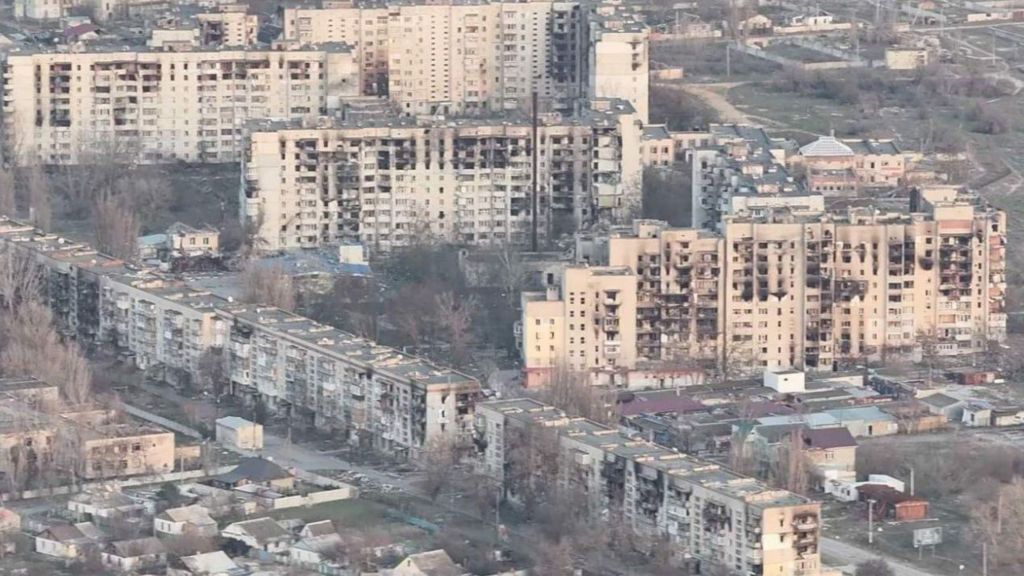
Nestled between the Dnipro River and Russian military positions in southern Ukraine’s Kherson region, Oleshky has been locked under Russian occupation since the early days of Moscow’s full-scale invasion in 2022. For the thousands of residents who remain in the once-thriving riverside city, every day is a brutal fight for survival marked by shortages, constant shelling, and widespread violence against civilians.
Halia, a resident trapped in the city whose name has been changed to protect her from retaliation by occupation forces, shared a devastating account of a recent civilian killing in an interrupted phone interview with the BBC. She first reported that two more civilians had lost their lives overnight, and three days later confirmed the victims were a married couple she knew personally. The pair had traveled 23 kilometers to the nearby town of Radensk to collect a bag of food, but failed to return before Russian occupation authorities implemented a curfew. They were subsequently killed in a drone strike. Four independent sources have confirmed the September 20 deaths of the two civilians, who were killed solely while seeking basic sustenance.
Halia’s story is far from unique. Dozens of harrowing firsthand testimonies from Oleshky residents have been collected by the BBC in recent weeks, painting a picture of a humanitarian disaster that has escalated dramatically since the destruction of the Nova Kakhovka Dam in June 2023. The dam collapse flooded the entire region, submerging Oleshky’s buildings up to their rooftops and displacing thousands. While Ukraine and NATO have accused Russian forces of blowing up the dam, Moscow has blamed Ukrainian military actions for the destruction.
Before the 2022 full-scale invasion, Oleshky was home to roughly 24,000 people. Today, the Ukrainian government estimates that only around 6,000 residents remain trapped in the city and its surrounding outskirts, including 200 children. For this trapped population, basic needs that most take for granted have become impossible to secure.
Residents report that children in the area are suffering from acute malnutrition, lack access to any formal education, and have almost no access to emergency medical care. Only one hospital remains partially operational in the entire city, opening just a few days a week almost exclusively to perform emergency amputations for people injured by shelling and landmines. Oleshky has been completely cut off from gas, electricity, and running water since the dam collapse, forcing residents to scavenge for alternative sources of fuel and clean water.
Ukrainian authorities have made repeated attempts to deliver humanitarian aid and supplies to the trapped population, but these efforts have failed to reach residents in recent months. Earlier this week, the Kremlin acknowledged that Oleshky is facing what it called a “critical situation” with acute shortages of food and medicine, but attempted to shift blame to Kyiv, claiming Russian military forces are working to resolve the crisis. Ukraine’s Foreign Minister Andriy Sybiha rejected that framing, telling the UN General Assembly in New York this week that Oleshky is under a “full blockade” imposed by Russian forces, and called on the international community to exert pressure on Moscow to allow unimpeded access for humanitarian aid.
For residents like Halia, the daily struggle for food is the most immediate threat. She told the BBC that the last official food delivery to Oleshky arrived back in May, and she now only eats one small meal a day. “I make some plain bread, sometimes I can have it with a tomato, or with some honey, and a tea. That’s it,” she explained. With summer vegetable gardens now exhausted, many residents have been forced to forage for edible wild weeds in local gardens, and discussions about which plants are safe to eat, along with posts to swap, sell, or share tiny portions of food, dominate local messaging chat groups on Telegram. No shops remain open in the city, meaning residents cannot access replacement clothing, hygiene products, or basic household goods.
Some residents previously risked traveling on foot along mine-littered roads to leave the city in search of supplies, but the security situation has deteriorated so sharply that even that dangerous option is now considered too deadly.
Counting the full civilian death toll in Oleshky has been made nearly impossible by restrictions imposed by occupation authorities. The UN Human Rights Monitoring Mission in Ukraine has recorded at least 29 civilian deaths and 54 injuries in Oleshky and the nearby town of Hola Prystan so far this year, but local volunteers say the actual number is far higher.
Ksenia Arkhipova, a Ukrainian volunteer who escaped Oleshky in summer 2022, shortly after it fell to Russian forces, has spent more than two years compiling a public record of civilian deaths in the city. Working with residents still trapped inside, she has recorded the names and dates of birth of roughly 1,200 dead civilians in a running spreadsheet, and said the list grows by one or two names every single day. “Someone was killed by a drone, someone else stepped on a landmine,” she explained. While the BBC cannot independently verify the full death count, multiple residents have confirmed the scale of unrecorded killing.
Tetiana, another trapped resident whose name has also been changed for her safety, shared her own experience of losing both of her parents to violence in Oleshky earlier this year. She provided the BBC with the couple’s dates of birth and photos to confirm their identities, but asked that their names not be published to protect her from retaliation. “They were shot inside their home. Russian soldiers came there and wanted to take it,” she said.
Worse than the uncounted deaths, residents say, is the Russian occupation authorities’ ban on burying civilians killed by violence. Occupation forces require that any non-natural death be confirmed by a post-mortem examination conducted by a Russian doctor, a procedure that is completely impossible to carry out in Oleshky’s collapsed healthcare system. Only residents who die of natural causes are allowed to be formally buried, Tetiana said, meaning “some bodies have been on the streets since December.”
Unclaimed bodies are either piled in the local hospital’s morgue, which has had no power since last winter, or left out in the open where stray dogs feed on the remains, according to volunteer Arkhipova. The BBC has verified this detail through multiple graphic photos provided by residents, which are too disturbing to publish.
Ester Vrataryova, co-founder of the charity Humanity that provides support to trapped residents in Oleshky and other occupied Ukrainian territories, described the burial ban as a deliberate tool of violence against the local population. “This is a tool of psychological pressure,” she said. “If you try to bury a dead body, you’ll become the next one.”