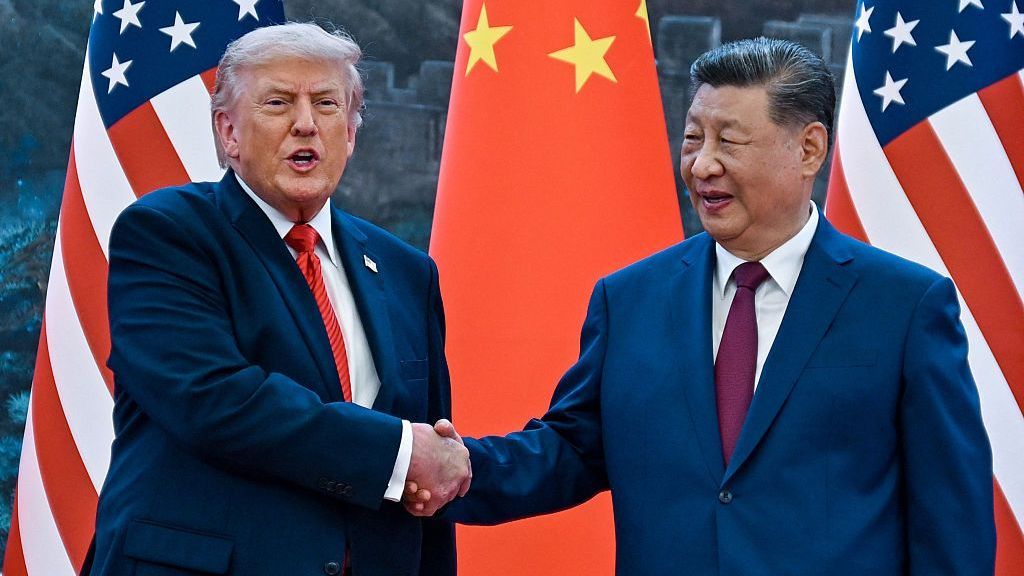
As diplomatic preparations wrap up in Washington D.C., U.S. President Donald Trump is set to host Chinese President Xi Jinping for a landmark three-day state visit this week, a gathering that carries global implications as the world’s two largest powers negotiate critical agreements and longstanding points of tension. This trip marks Xi’s first formal state visit to the United States since 2015, and his third in-person meeting with Trump over the past 12 months, underscoring the urgency of the talks on the agenda.
The visit will open with a rare ceremonial greeting: Trump will personally welcome Xi at Andrews Air Force Base, followed by a military flyover and an official state dinner at the White House, a level of pageantry that foreign policy experts have described as unprecedented. Xi will be joined by First Lady Peng Liyuan, who is scheduled to tour the Smithsonian National Museum of Asian Art alongside U.S. First Lady Melania Trump on Thursday, alongside attending official social events during the summit.
The most pressing topic on the agenda is the upcoming expiration of the 2025 U.S.-China trade truce, set to end in November. The agreement, reached when the two leaders met in South Korea in October 2025, paused a planned round of steep U.S. tariffs on Chinese imports, while China rolled back restrictions on rare earth exports—materials critical to advanced U.S. manufacturing. Analysts and trade observers widely expect the two leaders to make an announcement regarding an extension of the truce during the summit, though preliminary talks held on the sidelines of the United Nations General Assembly last Tuesday failed to produce meaningful progress, multiple anonymous sources confirmed to the BBC. U.S. negotiators resumed bilateral talks with their Chinese counterparts in Washington on Wednesday, immediately following Xi’s arrival, with talks focused on non-tariff barriers and agricultural export access. The U.S. still carries a $91 billion trade deficit with China, per latest U.S. Census Bureau data, and Chinese rare earth exports to the U.S. have fallen despite the 2025 truce, creating lingering frictions ahead of the summit.
Artificial intelligence has also rapidly climbed the priority list for the meeting, according to China policy experts. The U.S. and China are locked in a widely documented global AI race, but growing bipartisan and public pressure has mounted on the Trump administration to agree to guardrails for AI development, following a string of high-profile AI-related security incidents. Senator Bernie Sanders publicly called this week on X (formerly Twitter) for Trump and Xi to immediately negotiate a treaty to pause advanced AI development and ban superintelligent systems, a call echoed by former White House senior adviser Steve Bannon and multiple congressional Republicans. However, President Trump has thus far resisted strict regulation, framing AI as a core driver of U.S. economic growth and a critical battleground in great power competition. “Whoever wins AI, wins,” Trump has repeatedly stated, prioritizing outpacing China’s AI development over sweeping restrictions. Still, experts including David Firestein of the Bush China Foundation say the two leaders are expected to explore limited avenues for collaborative governance of the emerging technology. Ahead of the summit, U.S. Treasury Secretary Scott Bessent held what he called “very successful” preliminary talks with his Chinese counterpart He Lifeng on both trade and AI issues. In a sign of AI’s centrality to the summit, leading tech industry figures including OpenAI CEO Sam Altman, Nvidia CEO Jensen Huang, and X CEO Elon Musk are all confirmed guests at Thursday’s White House state dinner.
The third core sticking point on the agenda is Taiwan, a longstanding flashpoint in U.S.-China relations. The U.S. Congress has already approved a multibillion-dollar arms sales package to self-governing Taiwan, which is currently awaiting Trump’s signature. The president has delayed signing the measure to date, framing it as a bargaining chip in negotiations with Beijing. China has long maintained that Taiwan is part of its territory and has not ruled out the use of force to achieve reunification, and Firestein says Beijing will push for Trump to extend the delay or cancel the arms sale entirely.
Both leaders face domestic economic pressures heading into the meeting: Xi is navigating slowing growth at home, and is eager to discuss deepening bilateral trade ties to support Chinese economic activity. For Trump, any move toward closer trade relations carries political risks, as hardline factions within his own administration and base hold deep suspicions of Chinese economic and geopolitical goals. Just last month, U.S. Transportation Secretary Sean Duffy issued a public letter to Ford Motor Company urging the automaker to cut all commercial ties with China, citing national security risks and the protection of U.S. manufacturing jobs.
Despite widespread expectations that major breakthroughs on any of the core issues are unlikely this week, Trump has repeatedly framed personal, high-level engagement with Xi as a critical step toward reducing bilateral confrontation. “Trump has made a decision that no matter what, we need to not have a confrontational relationship with China,” explained Stephen Orlins, president of the National Committee on U.S.-China Relations. “He believes that the more he and President Xi meet, the less confrontational that relationship will be, and he is right,” Orlins added.