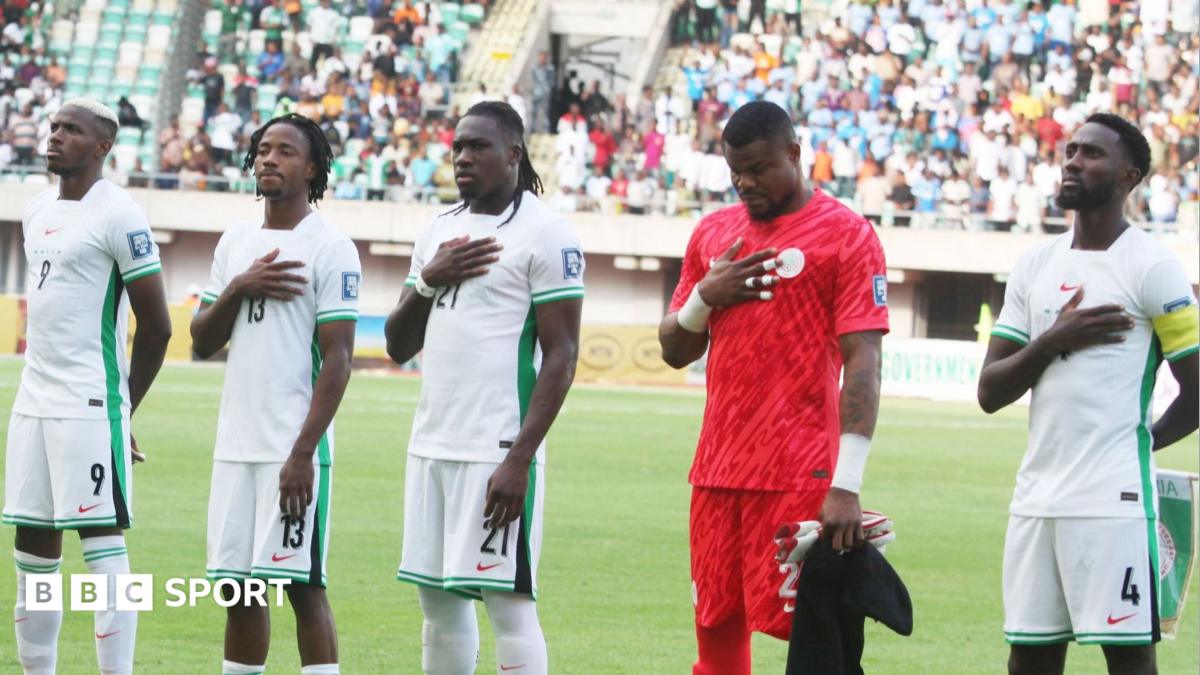
Nigeria, long recognized as one of African football’s most dominant traditional powers, is now navigating its darkest period in the history of the sport, according to national legend Segun Odegbami. As the country’s men’s senior team, the Super Eagles, prepares to kick off its 2027 Africa Cup of Nations qualifying campaign this week, the entire football ecosystem is grappling with a cascading series of failures that have triggered top-level leadership resignations, government-backed reform calls, and urgent debates about long-term restructuring.
Over the last 12 months, the scope of Nigerian football’s struggles has spread beyond the senior national squads. Both the men’s Super Eagles and the women’s Super Falcons, long a dominant force in women’s football on the continent, missed out on qualification for their respective 2026 FIFA World Cup tournaments. This marks the first time in Nigeria’s history that both senior teams have failed to book a spot at the men’s and women’s World Cups in the same cycle. The downturn also extends to youth football and African club competitions, with the quarter-final finish of the country’s under-20 women’s team at the 2024 World Cup standing as one of the few bright spots in an otherwise bleak stretch of results.
Odegbami, a 74-year-old former international who led Nigeria to its first ever Afcon title on home soil in 1980, described the current string of underperformance as a “tectonic shift” that has shaken the foundation of the sport in the West African nation. “It has never been this bad in our entire history that we didn’t qualify for the World Cup,” he told BBC Sport Africa. “Our girls, who were African champions, failed to win a 2025 Women’s Afcon qualification that was well within their grasp. All our junior teams are struggling, our domestic league cannot generate sustainable revenue. Something is fundamentally broken here.”
Widespread public anger over the repeated failures has already forced sweeping changes at the top of the Nigeria Football Federation (NFF). Last month, NFF president Ibrahim Gusau, general secretary Mohammed Sanusi, and multiple members of the federation’s executive committee stepped down from their roles amid mounting public and political pressure. Odegbami noted that the ousted leadership did not represent the best possible group of administrators for Nigerian football, and is now pushing for a full structural restructure to lay the groundwork for sustainable long-term development.
“Public outcry was universal. Every Nigerian wanted the old leadership out, and even President Bola Tinubu publicly called for sweeping reforms,” Odegbami explained. “All these factors have come together, and we are now working to build a comprehensive development blueprint that addresses every gap in our football ecosystem.”
In the weeks following the leadership resignations, a joint delegation from global governing body FIFA and the Confederation of African Football (Caf) has held formal talks with Nigeria’s National Sports Commission to map out a path for reform. The NFF’s scheduled leadership elections, originally set for September 27, have been suspended while the reforms are negotiated, and interim officials have been appointed to lead the federation through the transition: Emmanuel Ikpeme takes over as interim general secretary, with Ademola Olajire serving as his deputy. President Tinubu has made his own support for full reform clear, citing the need to reverse what he has called “repeated failures” at all levels of the national game.
Even with top-level leadership changes in place, stakeholders across Nigerian football warn that reform must go deeper than swapping out senior officials. Nigerian sports journalist Fisayo Dairo argues that a complete overhaul of governing structures is required to unlock sustainable growth. “Reform can’t just stop at changing who sits in the top offices,” Dairo explained. “We need to build a formal, functional framework that lets our football thrive. That means investing in national team development, nurturing talent from the grassroots level, and building a governance model that includes input from all stakeholders. The corporate sector needs full representation to help the administration generate consistent, reliable funding.”
For Odegbami, the current crisis stands in stark contrast to the golden era he helped create more than four decades ago. Nicknamed “Mathematical” for his precise, clinical skill on the pitch, Odegbami scored 23 goals in 46 appearances for the Super Eagles, and was named to the tournament All-Star team when Nigeria lifted its first Afcon trophy with a 3-0 final win over Algeria in Lagos in 1980.
“We had unprecedented state support, and everything aligned for us to succeed,” he recalled. “The atmosphere during that time was indescribable. That experience remains indelible in our minds, nothing can compare to it.”
Following that 1980 triumph, Nigeria went on to lift the Afcon trophy two more times in 1994 and 2013, finished as runners-up at the 2023 tournament, and claimed third-place finishes in 2019 and 2025. But Odegbami argues that successive Nigerian governments have long sidelined sport as a national priority, and that poor administration has derailed development since the mid-1990s.
“Our leaders have not guided us well, and that failure has affected every single layer of our football development,” he said. “That includes grassroots scouting, player discovery and development, the institutions that support players, academies, and domestic and international club pathways. We don’t even have a clear national coaching methodology, a unifying football philosophy, or a defined national style of play anymore.”
Beyond administrative failure, crumbling infrastructure and chronic underinvestment have emerged as core barriers to rebuilding Nigerian football. While other African nations have poured resources into hosting major international competitions – Senegal is set to host the Youth Olympic Games in October 2025, the 2026 men’s Cricket World Cup will be co-hosted by South Africa, Zimbabwe and Namibia, Kenya will stage the 2029 World Athletics Championships, and Morocco will co-host the 2030 men’s World Cup with Spain and Portugal – many of Nigeria’s once-iconic top-class venues have fallen into severe disrepair from decades of neglect.
Odegbami singled out historic venues including Lagos’ Surulere National Stadium, which hosted matches during the 1980 and 2000 Afcons, Ibadan’s Obafemi Awolowo Stadium (formerly Liberty Stadium), Kaduna’s Ahmadu Bello Stadium, and Calabar’s UJ Esuene Stadium as landmarks that have suffered irreparable damage. “I weep when I think about what has happened to our football infrastructure and these historic national facilities,” he said. “Whether it was intentional neglect or just ignorance, they did permanent damage to Nigeria’s football heritage. Even the Godswill Akpabio Stadium in Uyo, currently the best venue we have, is not even half as good as the top facilities we had from the 1960s through the 1990s.”
Now, as the Super Eagles get ready to open their 2027 Afcon qualifying campaign with a match against Madagascar at Uyo’s Godswill Akpabio Stadium on Friday at 16:00 GMT, followed by a September 29 away fixture against Guinea-Bissau, the team will be without star forward and former African Footballer of the Year Victor Osimhen, who was ruled out of head coach Eric Chelle’s squad through injury. For a nation once used to continental and global success, the qualifying campaign kicks off against a backdrop of uncertainty, as leaders and stakeholders work to build a new foundation for the future of Nigerian football.