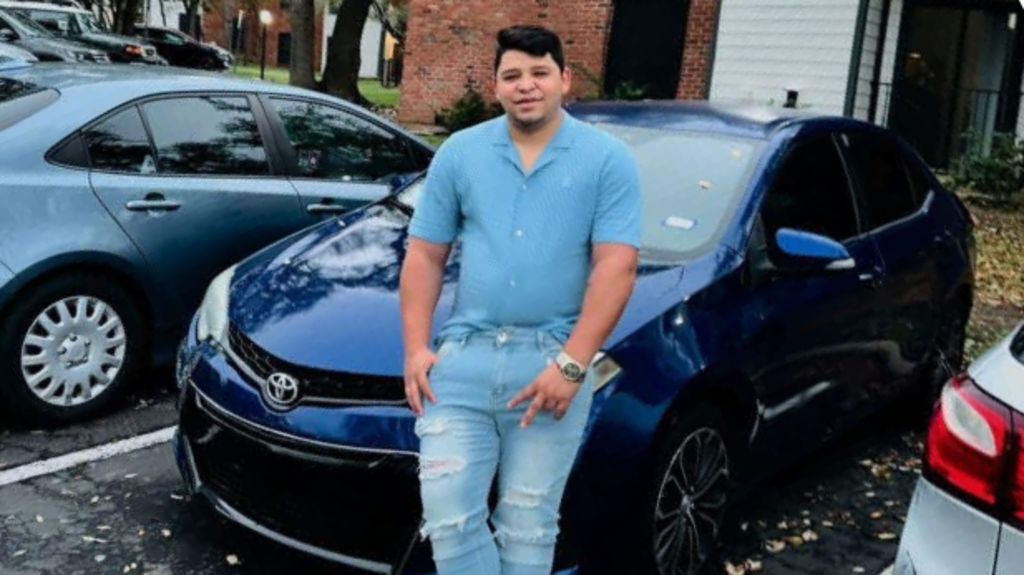
A high-profile encounter between U.S. Immigration and Customs Enforcement (ICE) agents and a Venezuelan DoorDash delivery worker in Texas has sparked fierce public debate, legal action, and political pushback after the 28-year-old man was shot during an arrest, with a federal judge now temporarily halting his deportation. Wilber Rafael Garces Perez, the immigrant in question, remains in ICE custody holding an unfired bullet in his back with untreated injuries that have raised alarms over inadequate medical care in detention facilities. The incident, which unfolded on a Sunday afternoon in Austin, has reignited long-simmering tensions over federal immigration enforcement tactics in sanctuary jurisdictions.
According to Garces Perez’s immigration attorney, Kate Lincoln-Goldfinch, her client was on a routine delivery when an unmarked black vehicle — later confirmed to be tied to ICE — sideswiped his car. Unaware that the vehicle belonged to law enforcement, Garces Perez made a U-turn to escape what he believed was an attack or robbery, only to be hit a second time by the ICE truck before agents exited the vehicle and opened fire. The gunshot fractured his clavicle, leaving him with severe swelling, chronic pain, and unexplained loss of mobility that has yet to be fully diagnosed by medical professionals. He currently wears an arm sling to manage his injury.
Following the shooting, Lincoln-Goldfinch filed an emergency federal lawsuit requesting a temporary restraining order to block Garces Perez’s deportation before his case could receive a public court hearing. On Wednesday, Judge Orlando Garcia — a federal district court judge appointed during the Clinton administration — granted the temporary block, scheduling an in-person hearing for Garces Perez on September 30. This ruling means the immigrant cannot be removed from the U.S. before the hearing concludes.
In a social media post following the judge’s ruling, Lincoln-Goldfinch called the order a critical first win, but emphasized that the legal fight is far from over. “For now, we have secured a temporary block on his deportation while his case moves forward,” she wrote. “This is an important step, but our work is not over. Wilber still needs appropriate medical care, and we will continue fighting to protect his rights.”
The attorney has further alleged severe mistreatment of Garces Perez while in ICE detention. She claims that after his initial hospital treatment, he was transferred back to the detention facility while still injured, placed in full restraints — handcuffs, ankle shackles, and a waist chain — and handled roughly by staff. Detention officials later revoked his communication privileges, moved him out of the facility’s infirmary, and confined him to an isolated cell with a non-adjustable hard bed, even as he continued to experience severe pain from his gunshot wound. It was only after he lost all mobility in one arm that he was transported back to the hospital for further care, before being returned to detention once again.
Released police footage from the Austin Police Department, which was not involved in the ICE operation but responded to the scene after the shooting, corroborates that Garces Perez sustained a single gunshot wound to the back. While the footage does not capture the actual shooting, multiple gunshots can be heard on one officer’s dashcam recording, and a separate clip shows officers approaching Garces Perez’s vehicle before cutting away his t-shirt to reveal the entry wound on his back.
The Department of Homeland Security (DHS), which oversees ICE, has pushed back aggressively against claims of mistreatment, dismissing widespread public criticism as “false narratives” spread by sanctuary city leaders and media outlets. In a public statement to the BBC, DHS Secretary Markwayne Mullin defended the agency’s actions and claimed Garces Perez, who entered the U.S. without legal authorization and saw his work permit expire last year, has received top-tier medical care. “Contrary to their claims, this person is an illegal alien who has no legal status to be here and has been given some of the best medical care he’s ever received in his life,” Mullin said. He added that “no amount of smears and false narratives will slow down ICE from doing its job by removing dangerous illegal aliens from our communities and making America safe again.” DHS has also denied claims that Garces Perez was denied pain medication or forced to sleep on the floor, confirming he was placed on a standard bed after returning to detention following hospital treatment.
A spokesperson for the U.S. Attorney’s Office for the Western District of Texas declined to comment on the ongoing case when reached by reporters.
This shooting comes just months after another ICE officer fatally shot a man during an operation in Houston, amplifying calls for accountability this time around. Prominent Texas Democrat Congressman Joaquin Castro was among the first public officials to call for Garces Perez’s immediate release from detention, and a coalition of local and state leaders has formally demanded a full independent investigation into the shooting and subsequent handling of the detainee.
Within hours of the shooting, dozens of protesters gathered at the incident location to demonstrate against federal immigration enforcement in Austin. Many carried signs calling for ICE to exit the city, while some waved the national flags of Mexico and Guatemala to show solidarity with immigrant communities. In response to the protests, DHS reiterated Tuesday that the agency has no plans to scale back its operations in Austin.
As the country awaits the September 30 court hearing, the case remains a flashpoint in the ongoing national battle over U.S. immigration policy, law enforcement use of force, and the treatment of immigrants in federal detention.