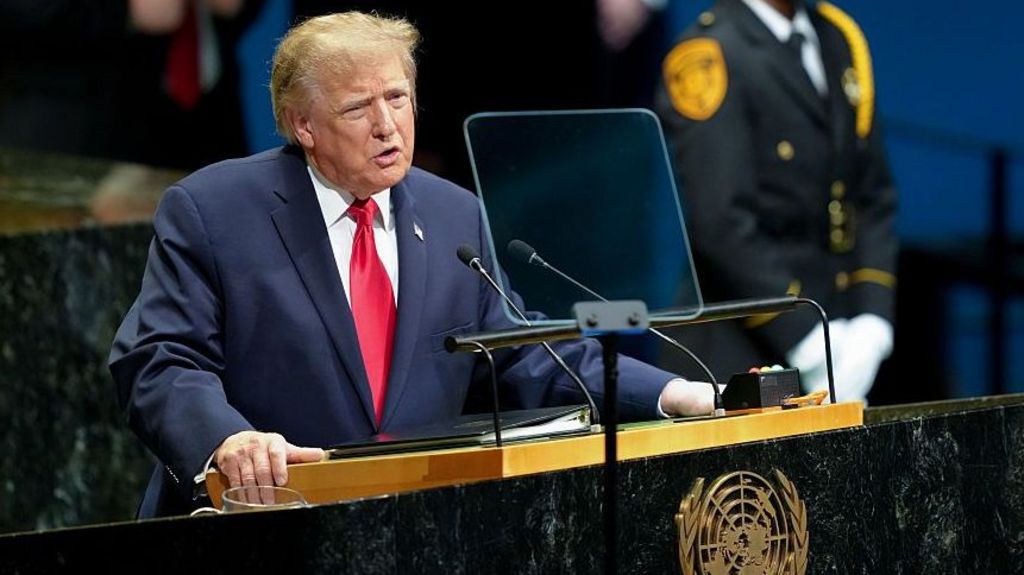
On the opening day of the 2026 United Nations General Assembly in New York, U.S. President Donald Trump delivered a high-stakes address that blended bellicose rhetoric toward Iran, domestic political campaigning, and bold pledges to reshape global order, capping a day of busy high-level diplomacy that offered tentative hints of progress on Iranian peace talks.
Addressing a standing-room-only crowd of global diplomats and leaders, Trump opened his speech by touting what he framed as transformative domestic achievements across economic growth, border security, immigration control, and reductions in violent crime. Political observers widely noted the remarks appeared tailored more to galvanize American voters ahead of November’s pivotal midterm elections than to win over the international audience assembled in Manhattan.
The core of Trump’s address centered on the ongoing conflict between the U.S.-led coalition and Iran, which began with joint U.S.-Israeli military action in February 2026. The war has sent global oil prices soaring and dragged down the president’s domestic approval ratings in recent months. In a remark that marked a dramatic escalation of coercive diplomacy, Trump revealed he was facing an imminent “big decision” between pursuing a negotiated peace deal with Tehran or launching a new, devastating strike that would “annihilate” the Islamic Republic.
“Will a deal be made with Iran that lets them rebuild and create a far greater country than it ever was before?” Trump asked the assembly. “Or do I annihilate the Islamic Republic and do it quickly, never giving them a chance to kill and destroy people and countries again? Do I drive them into hell?”
The president framed the current conflict as a necessary step to block Tehran from acquiring a nuclear weapon, arguing it validated his doctrine of “peace through strength” — relying on ultimatums and overwhelming military pressure rather than compromise and traditional diplomacy. He added that he expected a long-elusive peace deal with Iran to be finalized shortly after November’s midterm elections, pointing to what he described as productive behind-the-scenes talks held on the sidelines of the General Assembly.
Hours after his speech, the White House confirmed that U.S. Special Envoy to the Middle East Steve Witkoff had held a three-hour “very productive” meeting with Iranian Foreign Minister Abbas Araghchi, facilitated by Qatari mediators. Iranian state media confirmed the talks, noting that Tehran’s core conditions for any final deal include an immediate end to all military operations across Iranian territory and a halt to what it describes as ongoing U.S. acts of aggression. Leaving the UN compound after the negotiations, Witkoff gave reporters a thumbs-up to signal progress, later posting on X that the first round of discussions had been completed successfully.
“They successfully completed a round of discussions that we hope will prove constructive and promising,” Witkoff wrote. “The mediators will continue their work.” Only one member of Iran’s official delegation was present in the assembly chamber to hear Trump’s opening address.
Beyond Iran, Trump used his speech to lay out his broader foreign and domestic policy vision, pushing back hard against the framing of global cooperation laid out earlier in the day by outgoing UN Secretary-General António Guterres. In his farewell address to the General Assembly, Guterres warned that global fault lines were rapidly widening amid intensifying geopolitical rivalries, ongoing wars, the climate crisis, and unregulated AI development, stressing that all world nations are inherently interdependent. He also urged major global powers to acknowledge the limits of their influence, saying “that their power isn’t so super.”
Trump rejected that framing outright, attacking the United Nations as beholden to a “far-left agenda of globalist bureaucrats who nobody ever elected.” He firmly rejected the concept of a global government, reaffirming his commitment to absolute American national sovereignty and the dominance of U.S. military power.
On other key global conflicts, Trump reiterated his pledge to broker a lasting peace deal between Russia and Ukraine, where fighting has continued to intensify with both sides launching sustained cross-border missile and drone strikes. “We’re working very closely with the leaders of Russia and Ukraine, and we will get that one done,” he said. “It’s going to happen, I think, more quickly than people understand.” The U.S. State Department later confirmed that Secretary of State Marco Rubio will meet with Russian Foreign Minister Sergei Lavrov in New York on Wednesday to advance those talks.
On artificial intelligence, Trump pushed back against growing global alarmism around the technology, vowing the U.S. would maintain its global lead over China and reject what he called a “globalist scheme” to exert centralized control over AI innovation. He also announced a rebranding of the technology, arguing that the term “artificial” misrepresents its transformative potential. “The use of the word artificial makes it sound fake,” he said. “It’s not fake, it’s actually amazing. But we have to be careful.”
On the sidelines of the assembly, Trump signed a new bilateral agreement with Danish and Greenlandic leaders to expand U.S. military access to Greenland, the autonomous Danish territory located in the North Atlantic. The deal explicitly reaffirms Greenland’s sovereign status while granting U.S. forces broad access to the island’s airspace and territory, strengthening American strategic positioning in the Arctic.
Trump’s day of diplomacy also included a packed schedule of bilateral meetings with more than a dozen world leaders, including a first face-to-face encounter with new British Prime Minister Andy Burnham, talks with Ukrainian President Volodymyr Zelenskyy, and a gathering with leaders from multiple Gulf and Arab states focused on Middle East security. When addressing tensions in the Western Hemisphere, Trump issued a stark warning that the U.S. would not tolerate hostile presences in the region, saying “If necessary, we will use our unmatched military might to secure the vital national interests of the United States.”
He launched a sharp attack on Cuba’s communist government, accusing it of cultivating ties to left-wing American groups including the Communist Party USA, Antifa, and the Democratic Socialists of America, labeling Cuba a “failed state.” Immediately after Trump began his remarks on Cuba, the entire Cuban delegation walked out of the assembly chamber in protest.