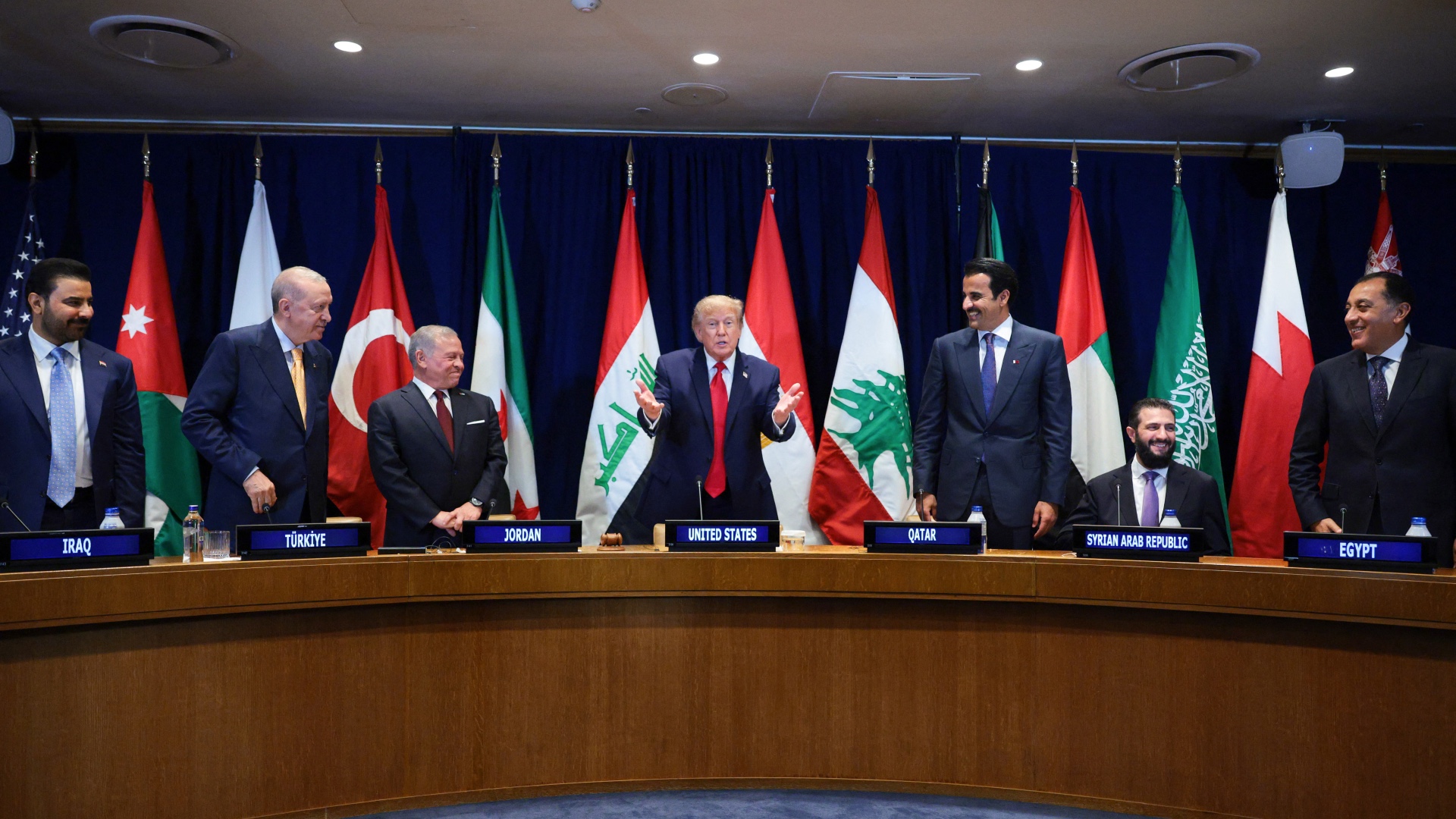
On the sidelines of the annual United Nations General Assembly in New York on Tuesday, former and current U.S. President Donald Trump convened a high-profile gathering of top Arab and Muslim regional leaders, an event that drew widespread global attention amid escalating tensions across the Middle East. While Trump heaped extensive praise on his assembled guests and revealed that U.S. envoys had held a landmark three-hour negotiation session with Iranian officials aimed at de-escalating ongoing conflict, the closed-door meeting concluded without any major policy announcements or concrete agreements to address the region’s long-running turmoil.
Speaking to reporters shortly before entering the closed meeting, Trump confirmed the surprise diplomatic breakthrough, framing the discussion between U.S. and Iranian representatives as a constructive step toward finding a mutually acceptable exit to the open hostilities that have roiled the region since February. “They had a very good meeting, a very productive meeting,” Trump told the press pool, adding that a follow-up negotiation has already been scheduled for the near future to continue the dialogue.
During the meeting with regional leaders, Trump personally credited two of his closest associates for spearheading the indirect talks with Iran: special peace envoy Steve Witkoff, and Jared Kushner, Trump’s son-in-law who holds no formal official position in the 2025 administration. “We’ll see what happens with that… We’ve been mediating for a while, but I think there’s a lot of momentum for them to make a deal. That’s what we’re hearing from everybody,” Trump told attendees and the assembled press before reporters were escorted out of the room.
The gathering brought together a who’s who of top leadership from across the Middle East and Muslim-majority region, including Jordan’s King Abdullah II, Qatar’s Emir Sheikh Tamim bin Hamad Al Thani, Turkish President Recep Tayyip Erdogan, Syrian President Ahmed al-Sharaa, Iraqi Prime Minister Ali al-Zaidi, Egyptian Prime Minister Mostafa Madbouly, Lebanese Prime Minister Nawaf Salam, Kuwaiti Crown Prince Sabah Khaled Al Hamad Al Sabah, United Arab Emirates Foreign Minister Abdullah bin Zayed Al Nahyan, and Saudi Arabia Foreign Minister Faisal bin Farhan Al Saud.
Trump opened his opening remarks to the group with unusually glowing public praise, calling the gathering a milestone in U.S. engagement with its regional partners. “It’s an honour to be here with some of America’s greatest and closest friends, allies, and partners to continue our effort toward a safer and more prosperous Middle East,” the president said. “Special place, and it’s become more special over the last period of time since I’ve been in politics… I’ve got a lot of great friends sitting around this table. They’re amazing people, and we make sure their lives are good.”
He went on to note that every participating nation had been “outstanding” in its cooperation with the United States, and thanked leaders for the approximately $21 trillion in regional investment that has flowed into the U.S. economy since he took office in January 2025. Trump reserved particular warm praise for Erdogan, with whom he has cultivated a close personal relationship dating back to his first presidential term, calling the Turkish leader a “fantastic guy” and a “tough cookie.” He joked to the room, “Don’t mess around with him,” drawing laughter from the assembled leaders.
This marked the second consecutive year that Trump has held this type of dedicated regional meeting on the UNGA sidelines. Last year’s gathering included leaders from the world’s most populous Muslim nations, Pakistan and Indonesia, and centered heavily on brokering an immediate ceasefire in the Gaza Strip. That ceasefire ultimately took effect three weeks after the 2024 meeting, though Israeli forces have continued to conduct regular air strikes on the enclave on a weekly basis in the months since.
This year’s meeting comes as Iran dominates regional policy discussions, following Iranian retaliatory strikes against U.S. interests that triggered the current open U.S.-Israeli campaign against Iran that launched on February 28. In his remarks, Trump boasted of the damage the coalition campaign has inflicted on Iranian military capabilities, claiming: “Operation Epic Fury crippled Iran’s Navy… Eliminated its air force. They have no planes. Hit over 90 percent of its weapons factories and destroyed 450 ballistic missile storage facilities and 800 drone storage facilities.” He went on to issue a fresh warning, saying the U.S. is prepared to launch additional strikes on the key Iranian site Pickaxe Mountain if any military activity is detected there. “We’re not seeing a lot of activity there, but if we do, we’ll blow it up immediately,” he said.
Following Trump’s opening remarks to press, reporters were ushered out of the meeting room. The assembled regional leaders did not address media, and maintained stoic expressions during Trump’s public comments, with no pushback or public comment on his stark warnings against Iran.
This report was originally sourced from independent regional outlet Middle East Eye, which provides dedicated, unrivaled coverage of the Middle East, North Africa and surrounding regions.