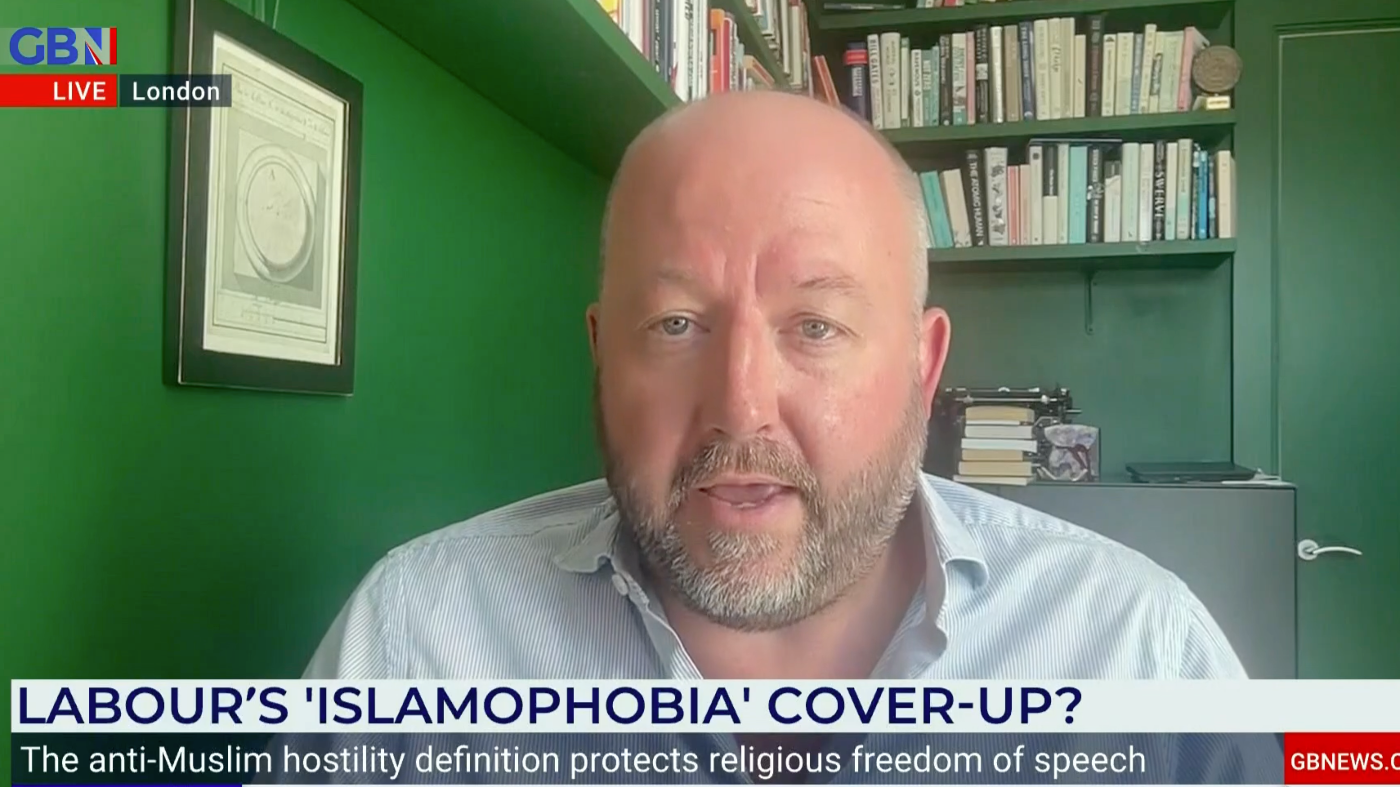
A heated political controversy has erupted in the United Kingdom after senior Conservative Party figures launched explosive accusations that the current Labour government orchestrated a cover-up to hide alleged influence from “extremist” Muslim groups over the newly adopted definition of anti-Muslim hostility. However, newly emerging evidence and public statements from the chair of the definition’s drafting working group have completely undermined these high-stakes allegations, building on previous investigative reporting that exposed key contradictions in the Conservatives’ narrative.
The latest confrontation began this week when Shadow Justice Secretary Nick Timothy claimed that extremists “almost certainly influenced” the definition, which the Labour government formally adopted earlier in 2025. Timothy’s accusation was echoed by Shadow Housing, Communities and Local Government Secretary Katie Lam, who publicly questioned what public interest could justify withholding information about the definition’s drafting process, framing the deletion of public consultation submissions as deliberate secrecy.
But this narrative has been thoroughly undercut by Dominic Grieve, a former Conservative minister and the independent chair of the working group tasked with developing the definition. Grieve’s public intervention confirms long-running reporting from Middle East Eye (MEE), which first revealed last July that the British government actually barred the working group from holding formal consultations with major mainstream Muslim organizations, including the Muslim Council of Britain (MCB) — the UK’s largest umbrella body for Muslim community groups, with more than 500 affiliated mosques, schools, and advocacy organizations across the country.
Instead, Grieve confirmed on Monday that the working group only met with individuals and organizations cleared by the government, adhering to the longstanding Conservative policy of disengagement from groups labeled controversial that the current Labour government has retained. “As the present government has kept the policy of its Conservative predecessors, no meetings took place with any groups or individuals who had been identified as having expressed unacceptable views incompatible with a free democracy,” Grieve stated.
This week, the Ministry for Communities launched a formal review into the deletion of public submissions received during the working group’s call for evidence, a move Timothy has seized on to push his “cover-up” claim. But government officials have clarified that the submissions were destroyed in compliance with UK data protection law, due to the large volume of sensitive special category data — including information on religious beliefs and political opinions — that cannot be legally retained longer than necessary for consultation purposes. Additionally, senior government sources with direct knowledge of the process confirmed that a large share of unsolicited submissions contained violent abuse and explicit death threats targeting working group members, leaving the government with no legal or practical reason to retain the material.
Contrary to Timothy’s framing, the working group’s final product is not a definition of “Islamophobia” — a term the UK government has formally discontinued — but a definition of “anti-Muslim hostility.” The government has explicitly denied any involvement by extremist groups in shaping the policy in a statement to *The Telegraph*, and Grieve has publicly pushed back directly against Timothy’s unsubstantiated claims. In a post on X, Grieve questioned Timothy’s credibility, writing: “Nick Timothy needs to decide whether he is a serious politician or a rabble rouser mingling valid points with entirely disreputable and unsustainable ones.”
Further contradictions in the Conservative narrative have come to light around the role of Policy Exchange, the neoconservative think tank where Nick Timothy holds a senior fellowship. MEE’s 2024 reporting confirmed that the working group actually extended a consultation invitation to Policy Exchange, an offer the think tank ultimately declined. Despite being invited to participate, Policy Exchange has emerged as one of the definition’s most vocal critics. In an August article for *The Telegraph*, Policy Exchange’s Head of Security and Extremism Paul Stott claimed the “secrecy surrounding Labour’s anti-Muslim hatred definition is chilling” and speculated that extremist groups could have influenced the working group’s deliberations — while failing to disclose that his own organization was invited to contribute to the process and declined.
A review of the working group’s actual consultation list confirms that the group held formal discussions with a range of critical and independent organizations, including the National Secular Society, Humanists UK, and the Community Security Trust, which monitors antisemitism. The group also consulted Trevor Phillips, a former broadcaster who was suspended from the Labour Party over unproven Islamophobia allegations that he has consistently denied, before having his suspension lifted in 2021. Along with these figures, the working group invited John Jenkins, a former British ambassador to Saudi Arabia and a Policy Exchange senior fellow, to give input on whether a formal definition would be useful. Jenkins publicly published his critical response in *The Spectator*, where he attacked the working group for having five Muslim members out of six, claimed the group had pre-determined its conclusions, and compared the adoption of any definition to a 1737 censorship law that restricted theatre licensing. In 2024, Jenkins was accused of endorsing online posts that are openly Islamophobic and spread anti-Muslim propaganda, a claim he never responded to when contacted by MEE.
Along with barring formal consultation with the MCB, the government also prohibited the working group from holding formal talks with the Centre for Media Monitoring (CfMM), a media watchdog that originally launched under MCB auspices but now operates as an independent organization focused on monitoring anti-Muslim media coverage. In response to the exclusion, an MCB spokesperson confirmed last year that the organization mobilized its grassroots membership to submit comments through the open public call for evidence, even without a formal invitation.
Parliamentary records further confirm that no contact took place between the working group and the four organizations Conservative politicians have repeatedly named as “extremist” — MEND, Cage, the Muslim Association of Britain, and the MCB. In a June parliamentary answer, Conservative MP James Cleverly asked whether the working group had engaged with any of these groups, and junior minister Nesil Caliskan explicitly confirmed that the department follows a policy of non-engagement with all four, and the working group did not meet with any of them. This explicit parliamentary denial has gone entirely unmentioned in public statements from Policy Exchange and Conservative politicians pushing the extremist influence claim.
Grieve has pushed back against Timothy’s repeated allegations by clarifying the open nature of the call for evidence process. “There was a call for evidence that allowed anyone to submit their opinion. Many did, including individuals with views right across the political spectrum, including extreme hatred of Muslims. These were not considered individually,” Grieve explained, noting that the working group was never responsible for retaining submissions long-term, and any deletion of material followed government policy set by Downing Street. “It was always for the government to decide what to do with our advice which was private to government. Whether or not the deletion of material received by us during the course of our work follows government guidelines or not is not for me to comment. We did not request it.”
The definition of anti-Muslim hostility formally unveiled by the government in March is not legally binding, and explicitly carves out protections for legitimate freedom of expression, including the right to criticise Islam as a religion. It defines anti-Muslim hostility as three core categories of harmful action: intentional criminal acts targeting Muslims or people perceived to be Muslim, harmful prejudicial stereotyping that frames all Muslims as uniformly negative to encourage hatred, and unlawful discrimination that disadvantages Muslims in public and economic life.
Ministers have repeatedly stressed that the definition does not restrict free speech, a point Grieve reaffirmed in his recent public statement. “It is certainly not a blasphemy law. There was no new law suggested and it was outside the terms of reference of the working group and specifically excluded,” Grieve said, noting that he has long campaigned to repeal blasphemy laws in the UK and would never have chaired the working group if restrictions on free speech were on the table. “To suggest this on the clear evidence of the wording and the text is nonsense,” he added.
Despite the overwhelming evidence contradicting his claims, Timothy doubled down on his cover-up allegations on Tuesday, repeating his demand for a full list of organizations that submitted comments to the working group. His request casts an extremely broad net, as any individual or organization was permitted to submit comments through the open call for evidence, and the MCB alone has more than 500 independent affiliated organizations across the UK. The longstanding disengagement policy that bars formal government contact with the MCB originated in 2020, when the organization published a public dossier documenting hundreds of alleged Islamophobic comments by Conservative MPs, councillors, and Downing Street advisers. The Conservative Party broke off relations with the MCB that year, and the current Labour government retained the disengagement policy when it took office in 2024.