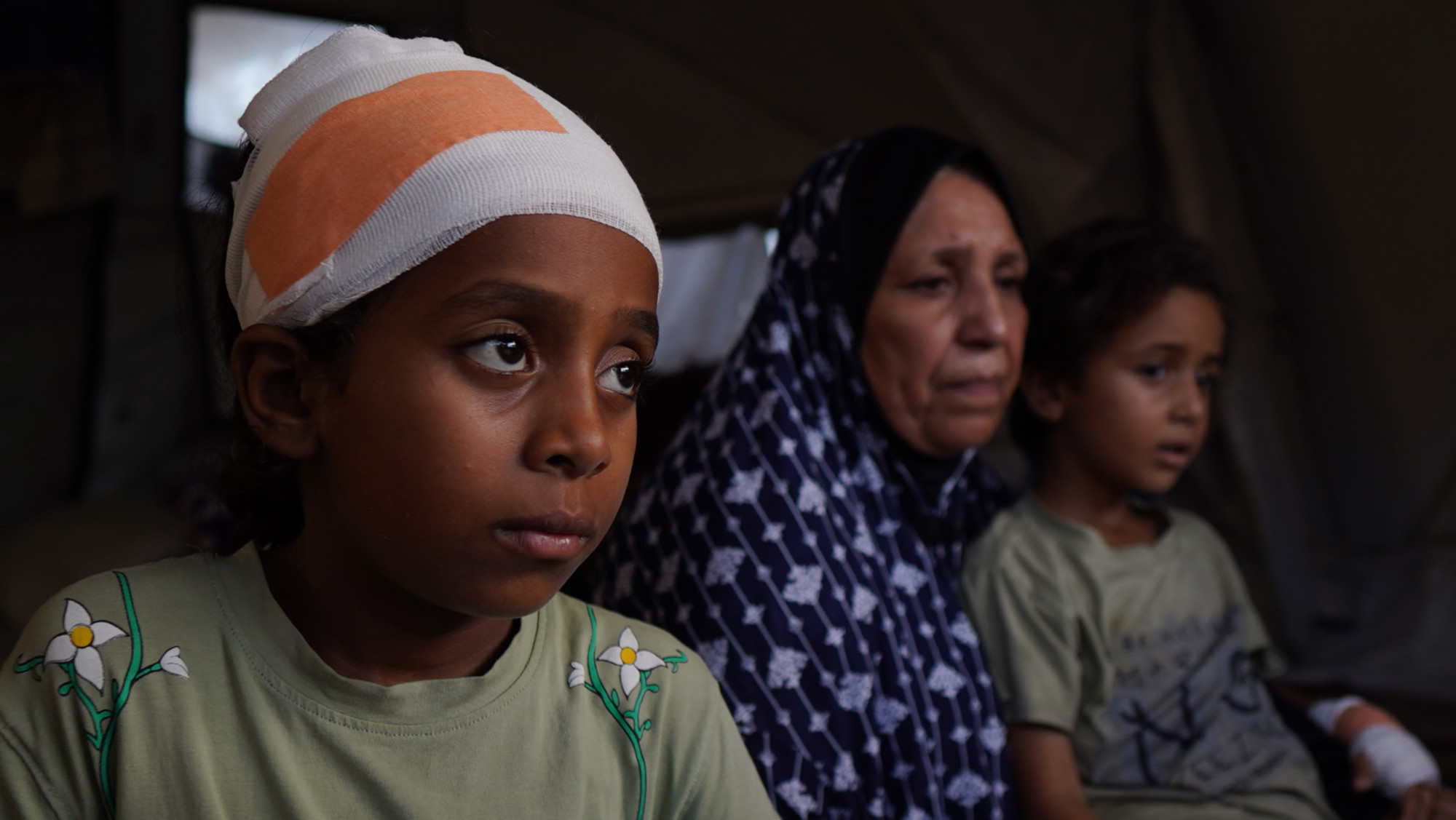
One week after rescuers pulled seven-year-old Abdulrahman Azzam from the concrete rubble of a collapsed multi-story building in northern Gaza, the young boy still carries the crippling psychological scars of the disaster. His father Iyad recounts that the child still instinctively reaches out to shield his mother’s pregnant belly when he fears danger, only to be jolted back to the brutal reality that she is gone forever. Every day, Abdulrahman re-experiences the pre-dawn collapse that crushed the building around him, his mother, and his siblings, leaving only him and his 9-year-old sister Ferial as survivors after hours trapped under debris.
Islam Azzam, Iyad’s 7-month-pregnant wife, and their 3-year-old son Rizq were among the 21 people killed in the collapse – 12 of whom were children. Another 45 people were pulled from the wreckage with life-altering injuries. For the Azzam family, the tragedy is the latest in a years-long cycle of displacement and loss sparked by the Israeli military campaign in Gaza that began in October 2023.
Originally from Gaza City’s Shuja’iyya neighbourhood, the Azzam family had already been forced to flee their home multiple times after it was destroyed in an Israeli strike. After a ceasefire was announced in October 2025, they set up a makeshift tent on a patch of tiled ground near the rubble of Gaza’s Legislative Council building. Heavy rain turned the tent into an uninhabitable flood zone, with water pooling under their bedding and soaking all their belongings. With winter approaching and his wife pregnant, Iyad encouraged Islam to take the children to stay with her family in their damaged fourth-floor apartment in the six-story Saada Building – whose name translates to “Happiness” in Arabic – to wait out the storm. Iyad remained behind in the family tent, never imagining the trip would be fatal.
The Saada Building had already been heavily damaged by Israeli strikes in 2023, and observers had long flagged it as at high risk of collapse. Despite this, at least 70 displaced people – most of them children – had nowhere else to go after Israeli bombardment destroyed their homes, so they sought shelter within its unstable walls. Iyad explained that there is simply no available vacant land in Gaza to set up new tents, leaving displaced families with no alternative to occupying damaged, unsafe structures. This risk is not hypothetical: last winter, at least eight children – most of them infants living in makeshift tents – died of hypothermia as freezing temperatures swept through the strip.
Islam was supposed to celebrate her birthday the day after the collapse, and the couple were just two months away from welcoming their fourth child, a son they had already named Muhib, and had even bought newborn clothes for. Eyewitnesses recount that the entire building caved in in less than 10 seconds around 3:30 a.m. When a friend came to fetch Iyad at his tent, he immediately sensed disaster. Arriving at the site, he found the entire building reduced to a pile of rubble. When he told Civil Defence workers his wife’s family name, they broke the news: only Abdulrahman and Ferial had been pulled alive.
“ I couldn’t fathom what was happening. My wife was due to give birth to our youngest baby boy in just two months. We had chosen the name Muhib for him, and we had already bought his clothes,” Iyad told Middle East Eye.
Ferial survived with a serious head injury, while Abdulrahman suffered broken bones in his arm and leg. But their physical wounds pale in comparison to the long-term psychological trauma the children now live with. Before the building gave way, Abdulrahman woke up and felt the ceiling shifting. He immediately threw his arm over his mother’s pregnant belly to protect her, before concrete collapsed onto his body. Now, he wakes screaming multiple times a night, his arm still raised in that same protective position, reliving the disaster over and over.
Ferial has barely spoken of her ordeal. The Civil Defence rescuer who pulled her out later told Iyad that the extraction was so dangerous he ended up trapped alongside her while digging with his bare hands to reach her. Circulated online video footage captures the 9-year-old begging rescuers to save her, saying “I can’t [hold on]. Forgive me, uncle. Oh God, please don’t let me die, because I want grandma to stay alive.”
Iyad tries to distract his children, joke with them, and talk through their grief, but he acknowledges he is broken himself. “They suddenly withdraw and go to the place where their mother used to sit and teach them the Quran, or they hold her belongings and start crying. Yesterday, I found Abdulrahman arranging her things and saying, ‘Mom liked to put this here,’” he said. “I look at them, and I don’t know what to do. Do I comfort them when I’m the one who needs comforting? I don’t know what to do.”
Despite the loss, Iyad does not blame his in-laws or other displaced families for taking shelter in the Saada Building. His father-in-law, who also died in the collapse, had already lost one son to the war and had another missing for more than a year and a half, leaving him with no resources to find safer shelter. “He searched extensively for a place where he could protect his daughters, but he couldn’t find anywhere, so he was forced to live in that building,” Iyad explained.
The collapse of the Saada Building is not an isolated tragedy. UN data estimates that Israeli military action has damaged or destroyed roughly 90 percent of all housing units in Gaza since the start of the conflict in 2023. Nearly all of Gaza’s 2.2 million residents have been internally displaced, and a recent Shelter Cluster report led by the Norwegian Refugee Council found that 1.98 million Palestinians – 94 percent of Gaza’s population – still need emergency shelter and basic household assistance. Since the war began, at least 61 Palestinians have been killed in building collapses across the territory, with the 21 Saada victims added to that toll.
Palestinian Civil Defence data shows that more than 2,000 damaged buildings across Gaza are at immediate risk of collapse and require urgent intervention or demolition. In Khan Younis alone, 474 structures are marked for demolition, 330 of which need full removal. With winter approaching, emergency officials warn that heavy rain and strong winds will trigger more collapses, but Israel continues to ban the entry of heavy machinery and equipment required to demolish unsafe structures and clear rubble – a commitment it agreed to under the October 2025 ceasefire agreement.
“Winter is approaching, and we are increasingly worried about the buildings that remain damaged and unstable,” said Abdullah al-Majdalawi, Civil Defence director of public relations and media. “The heavy rain and strong winds could cause many buildings to collapse. We need to remove these structures before the weather gets worse, but the Israeli occupation still completely bans heavy machinery and equipment required for this work. Every day that these buildings remain standing is another day that people are exposed to this danger. Israel is literally turning these buildings into graves for the displaced.”