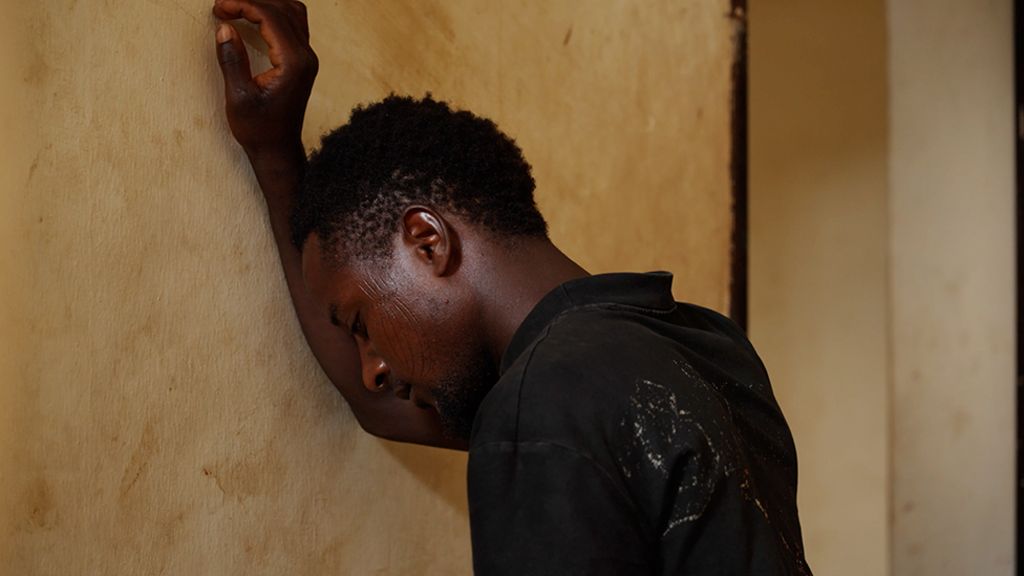
Usman Muhammad, a 20-something artisanal miner and the sole survivor of a catastrophic mass death incident in a Nigerian detention cell, stands frozen at the cramped cell’s entrance, pressing his forehead to the concrete wall in grief too heavy for words. Just one day prior, he had been locked inside this 18-square-meter stifling space alongside more than 50 other detained miners, in conditions that would ultimately claim 37 lives: 33 died inside the cell, and four more succumbed to their injuries after being transferred to hospital.
The tragedy, which unfolded at a detention facility run by the Nigeria Security and Civil Defence Corps (NSCDC) in Minna, capital of Niger State, has sparked nationwide public outcry and widespread protests, including targeted attacks on government buildings. Grieving relatives and angry local residents are demanding full transparency and accountability for the deaths that could have been prevented.
Initially, federal authorities attempted to attribute the mass fatalities to an outbreak of diphtheria, but the exact cause and sequence of events are now the subject of an official government investigation. In his first on-the-record interview with the BBC, Muhammad recounted the unrelenting horror of his 24 hours trapped inside the cell. “I have never felt heat like that in my life. When we touched each other’s bodies, it felt like fire burning,” he said, after gathering the strength to speak.
When Muhammad and the other detainees were locked in, overcrowding was so extreme that no one could sit or lie down — there was standing room only. Humidity in the windowless (save for a tiny high opening) room climbed above 90%, while outdoor temperatures hovered above 25°C. High humidity blocks the body’s natural cooling process, where sweat evaporates from the skin, creating a potentially lethal environment even at moderately warm temperatures. The only ventilation the group had came from a small window set high on the cell’s wall, far out of reach for any of the detainees.
According to Muhammad’s account, the first crisis struck when one detainee lost consciousness from the heat. The group banged on the cell door frantically to alert guards, begging for water and medical help. “When a guard came we asked him for water. He looked at the guy that fainted and closed the door. That’s how they started dying one after the other,” he explained.
All of the detainees arrested by the NSCDC were artisanal miners, who scrape together a meager living panning for precious metals across Nigeria. The federal government has recently ramped up a crackdown on informal small-scale mining, labeling the activity illegal, claiming it siphons billions in lost government revenue, causes widespread environmental damage, and is linked to organized criminal networks. NSCDC officers carried out mass arrests of miners near Minna earlier that week, on Tuesday and Wednesday, detaining the entire group at their Minna facility. To date, the NSCDC has not released any public list of detainees or confirmed the total number of people it held in the facility the night of the deaths.
As the hours dragged on and temperatures and desperation climbed, dehydration became crippling. Multiple survivors confirmed that with no access to water, some detainees resorted to drinking their own urine and collecting sweat from their own bodies in a desperate bid to stay hydrated. Muhammad described seeing detainees grow increasingly distressed, gasping for breath as their bodies shut down from heatstroke. “People were calling for help, some were already very weak,” he said. But despite repeated calls for assistance, no guards responded to the detainees’ cries.
Another survivor, Adamu Isah, shared his account with Reuters, confirming the repeated failures of security staff to intervene. “While in the cell, we were shouting and telling them that people were dying,” Isah said. “We tried to break down the door when they refused to open it… At one point, a security officer came to the door. We were shouting and telling him that people were dying, but he said it wasn’t his problem if people died.”
Guards finally opened the cell door on Thursday morning, revealing the full scale of the tragedy, littered with the bodies of dead detainees. The NSCDC has not issued any formal response to the survivors’ accusations of neglect and cruel mistreatment, but it has confirmed that 24 of its personnel, including Suberu Aniviye, the suspended Niger State commandant of the force, are currently in police custody in connection with the deaths.
Niger State Governor Umaru Bago told the BBC that the gravity of the incident demands a full unobstructed probe. “The people who were killed are not flies. How can this go unlooked? We will get to the bottom of this,” he said. Because the NSCDC is a federal agency rather than a state-level force under the governor’s jurisdiction, Bago cannot direct the investigation directly, but he has publicly backed the federal probe ordered from the national capital Abuja.
Federal authorities have assembled a 10-member independent investigative committee to uncover the exact circumstances of the deaths, identify responsible parties, and recommend possible legal action against anyone found culpable. The committee has been given two weeks to complete its work and submit its findings. Interior Minister Olubunmi Tunji-Ojo has publicly stated that no officer, regardless of their rank, will be granted immunity from investigation or prosecution, and any attempt to obstruct the probe will be treated as a serious offense.
As Muhammad left the cell after speaking with the BBC, he said he chose to speak out publicly to push for justice for the dead, and to bring a measure of closure for the families of the victims and other survivors who lived through the unthinkable ordeal.