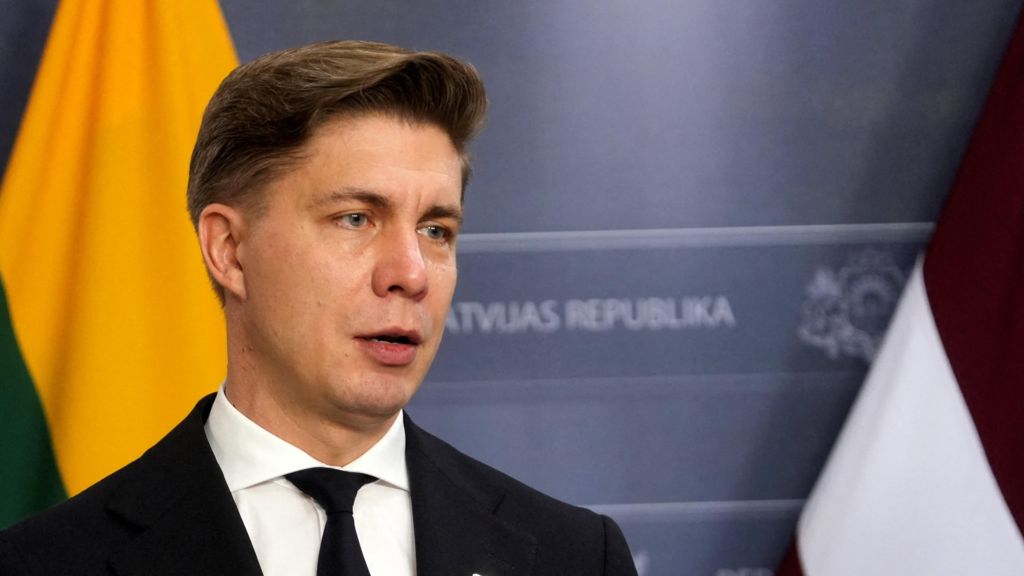
As tensions along NATO’s eastern flank continue to escalate following a recent drone incursion into its airspace, Lithuania’s prime minister has publicly confirmed the Baltic nation has prepped emergency evacuation protocols for high-risk scenarios, while issuing a firm pledge that the country will never surrender to any Russian aggression.
In an exclusive interview with the BBC’s Newsnight program, Prime Minister Mindaugas Sinkevičius outlined the persistent sense of insecurity that shapes daily life in Lithuania, a NATO member state that shares a direct land border with Russia’s Kaliningrad enclave. He explained that repeated unauthorized airspace intrusions, including multiple drone sightings over Lithuanian territory, have left the public feeling constantly under threat from Moscow.
“If Russia chooses to attack our country, we will fight back without hesitation — we will engage and defend every inch of our sovereign territory,” Sinkevičius stated. He added that Lithuanian officials have drafted contingency plans for a wide range of potential security scenarios, with detailed preparations to evacuate vulnerable populations such as elderly citizens from major population centers in an orderly manner, free of the gridlock and chaos that often accompanies emergency evacuations.
Sinkevičius noted that most contingency planning remains behind closed doors, out of public discussion, to preserve operational security. “We face concrete, tangible threats. They do not emerge every single day, but they are a consistent part of our reality that we cannot ignore,” he added. The prime minister also called for a fundamental shift in the United Kingdom’s strategic approach to defense, acknowledging that Lithuania’s geographic proximity to Russia puts it on the frontline of heightened threat that not all NATO allies experience directly.
The prime minister’s comments come just one week after NATO fighter jets intercepted and shot down an unidentified drone that had entered Lithuanian airspace. While the drone’s origin has not been formally confirmed, Lithuanian Defense Minister Robertas Kaunas told the BBC’s Newshour that the unmanned vehicle entered from the direction of Belarus, a close military and political ally of Russia that has supported Moscow’s full-scale invasion of Ukraine since it launched in 2022. Moscow has so far declined to issue any comment on the recent drone incident.
UK Defense Secretary Wes Streeting reaffirmed the alliance’s collective commitment to territorial defense in response to the incident. “Thanks to the swift, professional actions of Lithuanian and Italian forces, NATO once again demonstrated that we maintain constant readiness to protect all of our allied airspace,” Streeting said. “We stand united 24 hours a day, seven days a week, in defense of every inch of NATO territory.”
This incident is part of a growing trend of military drone incursions across European airspace that has accelerated since Russia launched its full-scale invasion of Ukraine. Back in May, a drone alert forced residents of Lithuania’s capital city Vilnius to take emergency shelter, disrupting both air and rail travel for several hours. This year, NATO fighter jets have also scrambled multiple times to intercept and down stray drones that crossed into the other Baltic NATO members, Estonia and Latvia.
Ukraine has repeatedly pushed back against suggestions that the stray drones are Ukrainian, instead blaming Russian electronic warfare systems designed to hijack and redirect Ukrainian drones off their intended flight paths. As Baltic NATO members, Lithuania, Estonia and Latvia all joined the alliance in 2004, and are fully protected by Article 5 of NATO’s founding treaty — the cornerstone collective defense provision that states any armed attack against one member is considered an attack against the entire alliance.