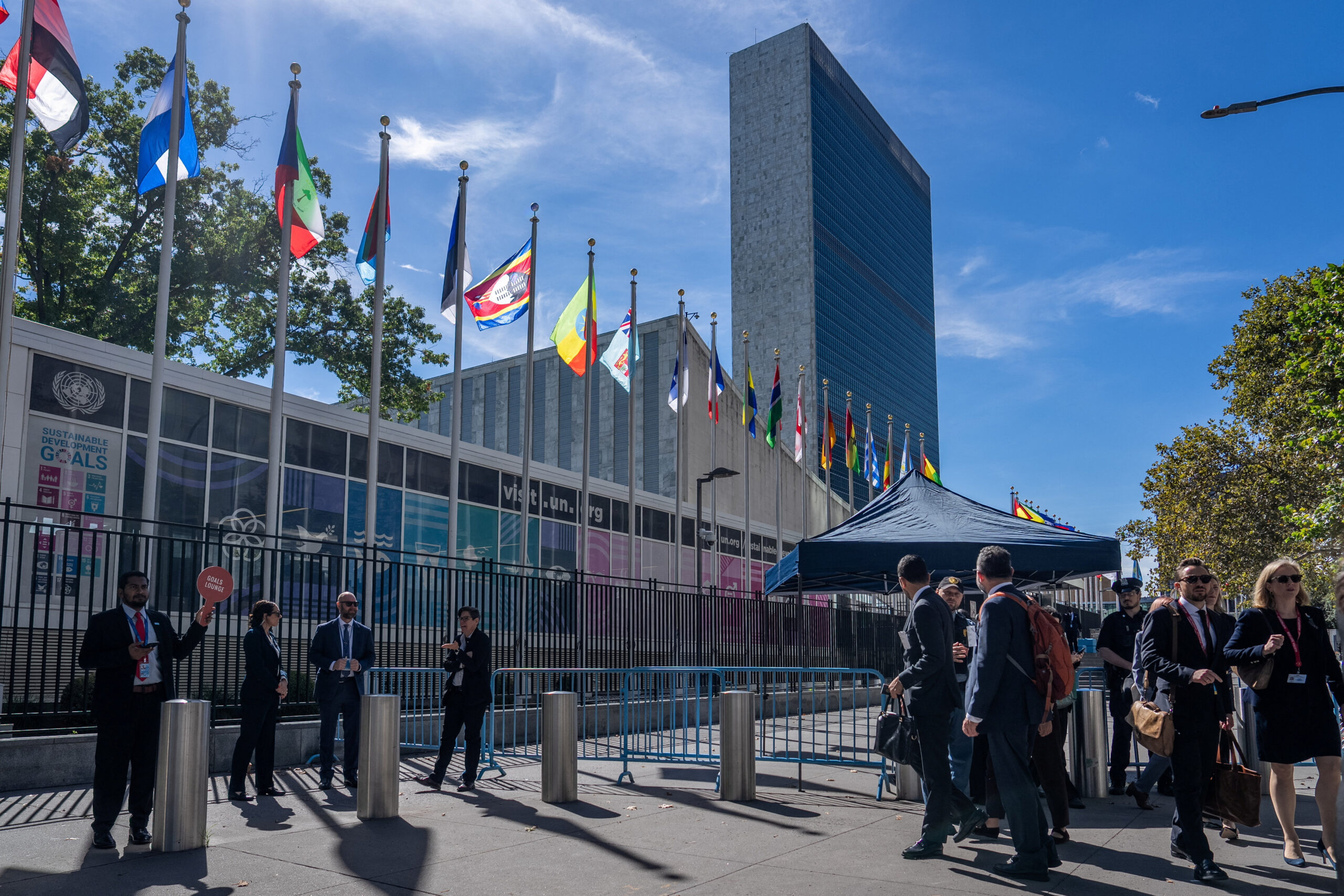
This week, global heads of state will gather in Manhattan for the 79th United Nations General Assembly, an annual diplomatic gathering that opens against a backdrop of heightened U.S.-Iran tensions and a sprawling regional conflict across the Middle East.
U.S. President Donald Trump is set to deliver the opening major address to the assembly early Tuesday, marking his return to the UN stage one year after he announced that American military strikes had eliminated Iran’s nuclear program. Unlike his 2024 appearance, however, Trump will address a deeply skeptical international community. In recent months, Iran has responded to U.S. pressure by limiting commercial transit through the Strait of Hormuz, the world’s single most important chokepoint for global energy exports, triggering widespread fears that disruption could send shockwaves through the already fragile global economy.
Tensions have spilled beyond the Persian Gulf as well. Just days ahead of the General Assembly meeting, Yemen’s Houthi movement announced it had seized large swathes of territory along the Red Sea coastline, including strategic positions overlooking the Bab el-Mandeb Strait. Another critical global trade chokepoint, the Bab el-Mandeb handles roughly 12% of total global maritime commerce by volume, making its stability critical to international supply chains.
U.S. Ambassador to the United Nations Mike Waltz previewed Trump’s address to reporters Friday, confirming that the president would center his remarks on his administration’s management of global conflict and the ongoing threat he says Iran’s nuclear ambitions pose to global security. “The president will highlight how he has and his administration have confronted complex problems head-on around the world,” Waltz said, adding “He will touch on the importance of ensuring that Iran never has a nuclear weapon.”
Iran will get its own chance to address the global assembly the following day: Iranian President Masoud Pezeshkian is scheduled to speak Wednesday, accompanied by newly appointed Foreign Minister Abbas Araghchi. The speaking slot gives Tehran a high-profile international platform to lay out its own narrative of the ongoing conflict and directly push back against U.S. claims just 24 hours after Trump addresses the same body.
Beyond the U.S.-Iran standoff, the 2025 General Assembly also faces growing questions about the UN’s continued relevance in a fragmented global order, as a growing number of major world leaders have opted to skip the in-person gathering entirely.
Chinese President Xi Jinping, who last participated in the UN General Assembly remotely in 2021, will not travel to New York for this year’s event. Instead, he is scheduled to hold one-on-one bilateral talks with Trump in Washington D.C. just four days after the assembly opens. Russian President Vladimir Putin, who has not attended the General Assembly in more than a decade, will be represented by Foreign Minister Sergey Lavrov. The heads of state of India, Germany, and South Africa have also announced they will send senior representatives rather than attending in person.
The year-long war in Gaza is also set to be one of the most debated topics during the week of diplomatic talks. Despite an outstanding International Criminal Court arrest warrant alleging he has committed war crimes and crimes against humanity in Gaza, Israeli Prime Minister Benjamin Netanyahu is scheduled to address the General Assembly in person on Thursday.
In a repeat of last year’s dynamic, Palestinian President Mahmoud Abbas will be unable to attend the gathering in person after the Trump administration extended its longstanding entry ban on senior Palestinian officials. The White House says the ban is a response to Palestinian efforts to “internationalise the Israeli-Palestinian conflict”, including legal actions against Israel at international judicial bodies. On Thursday, the General Assembly passed a resolution allowing Abbas to address the body via pre-recorded video link.
Diplomats familiar with the General Assembly’s side agenda confirm that a high-level diplomatic meeting will be held alongside the main gathering to advance long-stalled negotiations toward a two-state solution for Israelis and Palestinians, though most observers do not expect significant breakthroughs from the session. Another high-level side meeting will focus on the two-year-long civil war in Sudan, which erupted in April 2023 after a power struggle between Sudan’s ruling military junta and the paramilitary Rapid Support Forces devolved into open conflict. The war has displaced more than 14 million Sudanese people and created one of the worst humanitarian catastrophes on the globe, with millions facing acute food insecurity and limited access to medical care. Sudan’s de facto head of state, army chief General Abdel Fattah al-Burhan, is scheduled to address the main General Assembly chamber on Thursday.
On the bilateral front, Iraqi media outlets have confirmed that Trump is scheduled to hold a one-on-one meeting with Iraqi Prime Minister Ali Faleh al-Zaidi on the sidelines of the General Assembly gathering this week. This report was produced by Middle East Eye, an independent outlet specializing in original coverage and analysis of the Middle East, North Africa, and broader global affairs.