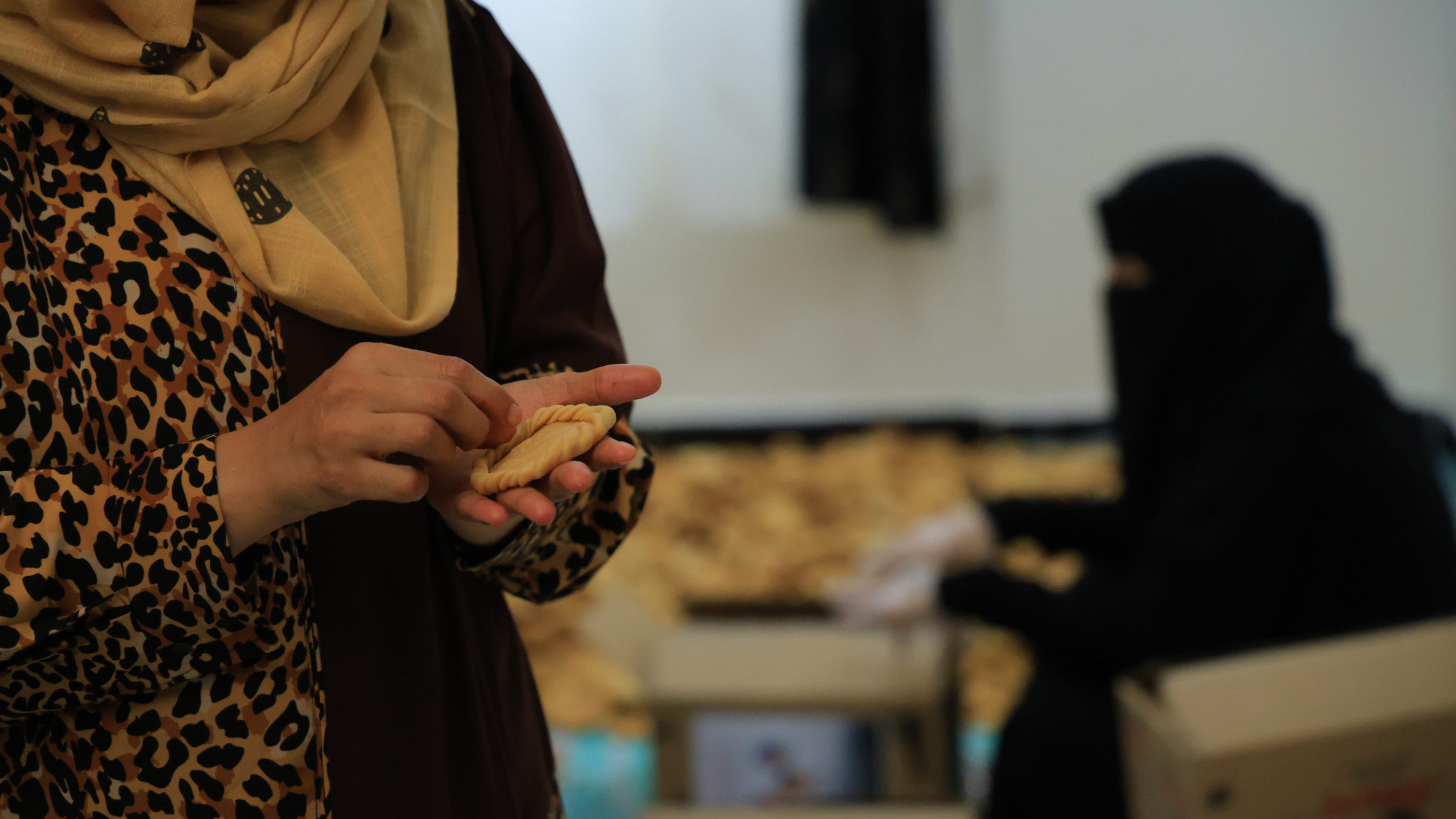
Before dawn breaks over the war-torn Yemeni city of Taiz, Naseem al-Odaini and a group of fellow women already stand gathered in a small kitchen, their hands deep in flour as they knead dough for date-filled pastries and sweet biscuits. Nearby, an oven hums to temperature, and a large mixing bowl waits for the next batch. Every warm, fragrant treat they pull from the heat is bound for the front lines, carrying a quiet, unshakable message of solidarity stitched into every ingredient: “Women stand beside you.”
This grassroots act of support is no new impulse for Yemeni women. For years, through cycles of intense conflict, they have gathered in home and community kitchens to back government forces fighting on the front lines. The initiative that Odaini now leads first launched in 2015, when large-scale conflict erupted across the country, but it went dormant for more than four years as fighting cooled. Now, after a major new military escalation across Taiz governorate, Odaini and her fellow volunteers have brought the mission back to life.
The resurgence of violence began on September 3, when Houthi forces launched a sweeping offensive against government-held positions in both Hodeidah and Taiz governorates. The offensive succeeded in seizing control of the remaining districts of Hodeidah city, the coastal port of Mocha, the strategic Bab al-Mandab Strait, and Mayyun Island. Today, fierce clashes continue to rage across western Taiz governorate, where Houthi forces have clawed out small territorial gains, while sporadic skirmishes persist along the eastern edges of Taiz city.
For Odaini, the renewed violence makes the work of civilian support non-negotiable. She says women in Taiz carry a clear duty to stand with frontline fighters, not just by providing food and critical medical supplies, but by lifting morale through every possible means. She oversees the production of hundreds of pastries each week, funding the operation through a mix of her own personal savings, small donations from friends and acquaintances, and contributions from supporters who found the initiative through social media.
To Odaini’s surprise, the level of public support for the revived initiative has far outstripped what the group saw a decade ago. “The support base has grown significantly compared to previous years, with many women from both inside and outside Taiz eager to participate,” she explained. “I did not expect this level of engagement, especially after being inactive for more than four years. I was truly surprised.” To protect the safety of fighters, the group has strict protocols: they do not accept pre-prepared food from unvetted sources, instead asking donors to buy key ingredients like flour and cooking oil from pre-approved trusted vendors, and submit proof of purchase.
Unlike many volunteers who send supplies through intermediaries, Odaini insists on delivering the baked goods to the front lines personally – a practice she has maintained since 2015, even after tragedy struck the group. “Three of my colleagues were killed on the front lines while delivering supplies, but I continued delivering the food myself,” she said. The fallen members – Moamen, Osama, and Reham – were core contributors to the initiative, and their loss has only deepened Odaini’s commitment to carrying on their work. “When I reach the front lines and see the fighters enduring the scorching sun and freezing cold, I feel that baking these biscuits and preparing preserved food is the least I can do for them,” she added.
Fighters say Odaini’s presence means more than any amount of supplies. When she visited frontline positions last week, she recalled, the troops greeted her with overwhelming joy. “They told me, ‘We don’t care as much about the biscuits as we do about your presence among us – it gives us immense psychological support, ‘” she said. Beyond baking and frontline delivery, Odaini is keen to emphasize that women’s contributions to the conflict stretch far beyond this initiative: many have lost their husbands, fathers, or sons – their families’ primary breadwinners – and have been forced to enter the workforce to keep their children fed and housed, taking on roles they never expected to hold amid the chaos of war.
Odaini is not alone in reviving this work. Israa al-Tayeb, another Taiz-based activist whose mother was killed during the 2011 revolution against former president Ali Abdullah Saleh in Taiz’s Freedom Square, also launched her own baking initiative in 2015, paused operations in 2022 as fighting calmed, and has now restarted her work at a larger scale than ever before. For six straight days, Tayeb and her team have worked almost non-stop to turn out thousands of biscuits and package other essential supplies including fresh milk, bottled water, and non-perishable snacks for fighters. “We do not feel tired because we know this food is reaching those who deserve it,” she said.
Tayeb’s team operates with a structured division of labor, adapted to meet the sharp increase in demand for supplies. Some members collect cash donations and source ingredients from local markets, others handle baking and packaging, and a separate trusted team handles frontline delivery – meaning Tayeb herself does not travel to the combat zone. Women who do not have the time or ability to bake often contribute cash instead, allowing the team to rent a small commercial kitchen and scale up their output. “We didn’t realise we could provide this much support, but with the steady stream of donations coming in, we have managed to grow our operation dramatically,” Tayeb explained. Encouraged by messages from fighters, she says the group has no plans to slow down: “These supplies make the fighters feel that the entire city stands behind them, so we will continue.”
This tradition of baking for frontline fighters is not unique to government-held Taiz: it is widespread across Yemen, with women in Houthi-controlled areas also preparing home-cooked food for their fighters, especially during major religious holidays. Men across the country also contribute, delivering everything from medical supplies and warm blankets to water and milk to frontline units as an act of solidarity.
For fighters on the front lines of western Taiz, this civilian support is transformative. Ahmed, a frontline fighter who spoke on condition of anonymity, said lightweight, non-perishable food and other supplies are not just critical for physical survival – they provide a huge boost to troop morale. “When I see a car loaded with food arrive at the front line, I feel as though the entire governorate is fighting alongside us and that we are not alone,” he told Middle East Eye. He noted that while most civilians flee combat zones to seek safety, many Taiz residents choose to stay behind to support the troops. “We all belong to this governorate, and everyone has a role to play,” Ahmed said. “While we fight on the front, others contribute financially, and women refuse to sit idly by – they bake for us.”
Psychological expert Hail al-Fakeeh explains that home-baked goods carry a unique emotional weight that generic ready-made food or direct financial aid cannot match. Unlike outside donations, these treats are prepared in the very homes that fighters are defending, creating an immediate emotional connection. “These biscuits connect the fighter on the front line emotionally to home, sending a powerful message that the people back in the city stand with them,” Fakeeh said. “It goes far beyond basic material support.” He added that this practice is a generations-old Yemeni tradition, with women across the country preparing homemade baked goods for fighters to lift morale during wartime dating back decades.
This report is part of independent, on-the-ground coverage of the Yemeni conflict by Middle East Eye, a publication focused on independent reporting from the Middle East and North Africa region.