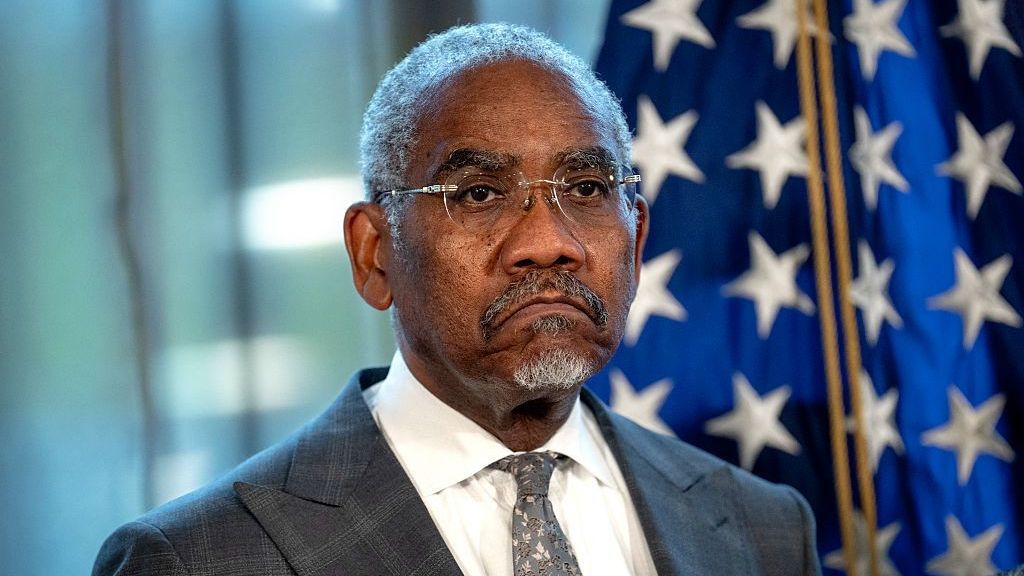
A top congressional Democratic leader has formally announced his opposition to a proposed $2.8 billion arms package for Israel, throwing a spotlight on growing divisions within U.S. politics over American military support for the country amid ongoing conflict in the Middle East.
Gregory Meeks, the ranking member of the U.S. House Foreign Affairs Committee and a New York congressman, confirmed he will not back the planned transfer of 2,000-pound (900kg) bombs to Israel. His objection is rooted in deep concerns that the powerful munitions could be deployed in violation of international humanitarian law, according to his public statement.
Meeks’ opposition comes on the heels of emerging reports that the Trump administration is preparing to send roughly 40,000 of these heavy bombs to Israel — weapons that Meeks described as some of the most destructive munitions held in the U.S. military arsenal. Even with the high-ranking lawmaker’s rejection of the deal, however, his objection alone lacks the legal weight to block the transfer. Current U.S. arms sale rules allow the sitting presidential administration to bypass congressional objections and move forward with the deal unimpeded.
In his statement, Meeks emphasized that he remains steadfast in his commitment to Israel’s security, but stressed that the proposed transfer raises grave, unresolved questions about how these massive weapons would be used in the densely populated civilian regions of Gaza and southern Lebanon. He noted that Congress holds a core responsibility to guarantee that U.S. taxpayer-funded arms are used lawfully, responsibly, and with robust protections for innocent civilian life. The BBC has reached out to the Israeli Embassy in Washington for comment on the controversy, and no response has been publicly released as of yet.
J Street, a liberal pro-Israel advocacy organization based in the U.S., offered a sharp rebuke of the planned transfer in a statement obtained by Israeli newspaper Haaretz, arguing that, “You cannot rebuild Gaza with 2,000lb bombs.”
Under longstanding U.S. policy, the State Department is required to notify Congress of all arms sales that exceed a specific monetary threshold, which gives lawmakers the ability to place an informal procedural hold on the deal. To override a presidential push for the sale, however, Congress would need to pass a veto-proof resolution with the support of two-thirds of both the House of Representatives and the Senate — a high bar that is unlikely to be met in the current political climate. The current administration can also move forward immediately if the president declares a national emergency that requires an urgent transfer of arms.
This is not the first time the transfer of these specific bombs to Israel has sparked political controversy. Israel’s past use of General Dynamics-manufactured 2,000-pound bombs in Gaza has drawn widespread international condemnation, due to the extreme, widespread civilian harm they cause in densely populated urban areas. In 2004, then-President Joe Biden paused a scheduled shipment of these same bombs over humanitarian concerns, a policy that was immediately reversed when Donald Trump took office for his second term last year.
The reported arms transfer would be funded through the U.S. Foreign Military Financing program, an initiative backed by American taxpayer dollars that allocates billions of dollars annually to Israel and other U.S. allies to purchase American-made military equipment.
While broad bipartisan support for the U.S.-Israel security relationship has remained a longstanding staple of American politics for decades, that backing has softened noticeably among Democratic lawmakers in recent years amid growing public concern over civilian casualties in Gaza. Just months ago, in July, Republican Representative Thomas Massie forced a full House vote on an amendment that would cut $3.3 billion in annual security aid to Israel. While Massie was the only Republican to support the measure, an unprecedented 103 House Democrats backed the cut, signaling a dramatic shift in the party’s approach to military aid for Israel.