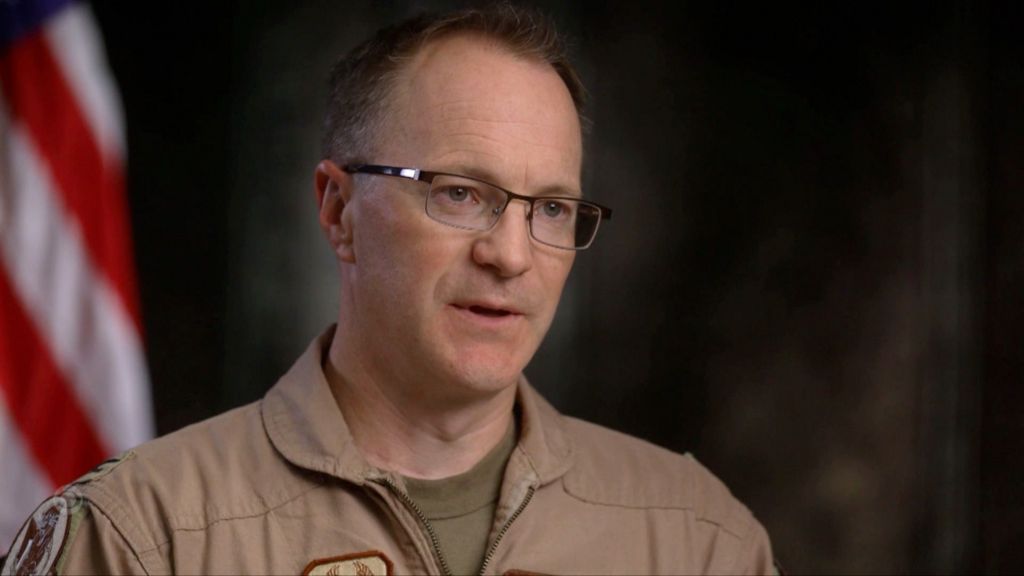
In a landmark, first-hand account of one of the most high-stakes military incidents of the ongoing US-Israeli war against Iran, a downed United States Air Force airman has opened up about his harrowing experience of free-falling to earth with a malfunctioning parachute and evading enemy forces for two days before a dramatic special operations rescue. The interview, which aired Sunday on CBS News’ flagship program 60 Minutes, marks the first public statement from any crew member involved in the April shootdown incident over Iranian territory.
Identified only as “Bravo” to protect his identity, the airman described the split-second chaos after his $30 million two-seat F-15E Strike Eagle was downed by an Iranian shoulder-fired missile valued at just $100,000, per CBS reporting. After ejecting from the crippled aircraft, Bravo looked up to discover his parachute had failed to deploy fully. “At one point, when I looked up and saw no parachute, that was the most terrifying thing I’ve ever experienced,” he told the program. He added, “Free-falling is a good way to put it. I wasn’t focused on the speed at which I was falling. I was instead focused on trying to correct the problems that were in front of me and doing anything I could to unfurl or pull pieces of the parachute loose.”
Despite his frantic efforts to fix the damaged parachute, Bravo hit the ground at speeds between 70 and 100 miles per hour, leaving him with broken bones in his back, shoulder, and arm. Calling his survival a “miracle,” the injured airman still pushed himself to hike to the peak of a high ridgeline to avoid detection, constantly looking over his shoulder for approaching Iranian forces. His guiding mantra through the ordeal: “Never let a lack of motivation put you on Iranian TV.”
Bravo and the jet’s second crew member, identified only as “Alpha,” were separated after ejecting, with both evading Iranian troops while waiting for extraction by US special operations forces. Alpha, who declined to participate in the CBS interview, was rescued within six hours of the crash, in an operation that US Secretary of Defense Pete Hegseth confirmed involved sustained close-quarters combat. “It was a gun fight all the way in and all the way out,” Hegseth said of the mission. “But they got Alpha back.”
Bravo’s rescue stretched to 48 hours behind enemy lines, in what Central Command Admiral Brad Cooper confirmed is the first large-scale American military operation on the ground inside Iran in 46 years. At the peak of the mission, more than 90 US service members were operating inside Iranian territory. The operation suffered significant setbacks, however, when multiple American aircraft meant for evacuation became stuck in deep desert sand. Two of these stuck aircraft, valued at approximately $100 million apiece, along with several “Little Bird” reconnaissance helicopters, had to be destroyed by US forces to prevent Iranian forces from seizing sensitive American military technology.
The incident comes amid a war that has stretched into its seventh month, launched five weeks before the shootdown by a joint US-Israeli military campaign against Iran. As the United States approaches November’s congressional midterm elections, the conflict has grown increasingly unpopular among the American public, fueled largely by skyrocketing global energy prices and cascading inflation across consumer goods that have been linked to the war. Last week, former President Donald Trump predicted the conflict would continue at least through Election Day on November 3.