A major controversy has engulfed the British Museum’s high-profile Bayeux Tapestry exhibition after revelations that its lead sponsor, Belarus-born billionaire Igor Tulchinsky, has provided core funding for a community resilience center located in Efrat, an illegal Israeli settlement in the occupied West Bank that is now subject to UK sanctions.
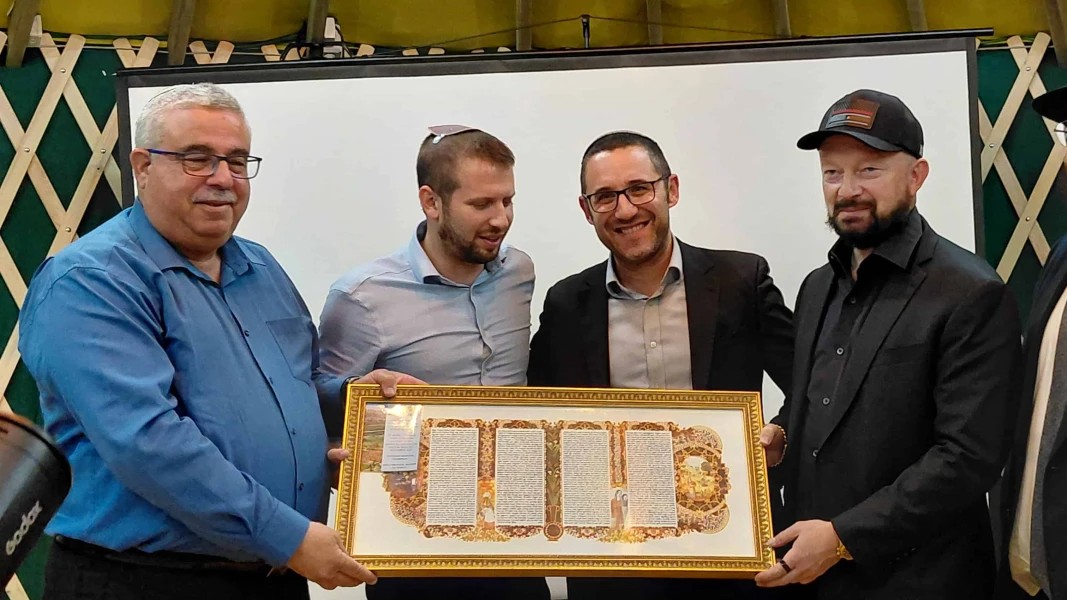
Tulchinsky, whose backing for the iconic medieval tapestry exhibition is reportedly valued at £5 million ($6.75 million), publicly unveiled a purpose-built therapy yurt at Efrat’s Mondlak Center in November 2025, appearing alongside the settlement’s far-right mayor Dovi Shefler for the ceremony. Public records from the Efrat Development Foundation, the nonprofit organization that operates the Mondlak Center, confirm Tulchinsky as the primary sponsor of the facility, which serves the entire Gush Etzion settlement bloc, a cluster of illegal Israeli settlements located just 12 kilometers southeast of Jerusalem.
According to an Instagram post from the foundation documenting the event, Tulchinsky dedicated the new facility to “Israel’s brave warriors and their families” during his opening remarks, where he famously described the therapy space as “Israel’s inner Iron Dome.”
Efrat, a settlement of roughly 12,000 Israeli settlers, was constructed on land seized from four indigenous Palestinian villages. It serves as the administrative capital of the expanding Gush Etzion bloc, which continues to push its boundaries toward the Palestinian city of Bethlehem. The Mondlak Center operates as a project of the Efrat Development Foundation, a nonprofit that states its mission is to advance Efrat’s social, cultural and physical development. The foundation’s public website outlines three tiers of donor partnership, with its top-tier “Vision Partner” designation requiring contributions of more than $50,000 and granting donors access to participate in strategic planning for the organization. The foundation also explicitly advertises support for “pioneer family support in Givat HaEitam” – a reference to the highly controversial E-2 hilltop settlement expansion that peace campaigners warn will cut Bethlehem off from the southern West Bank, effectively ghettoizing the Palestinian city.
The full scope of Tulchinsky’s support for the center, whether financial or in-kind, remains undisclosed. Middle East Eye attempted to reach Tulchinsky’s global investment firm WorldQuant for comment multiple times, but received no response. When contacted directly, the Efrat Development Foundation confirmed Tulchinsky is a donor but said his contribution was channeled through an unnamed third-party organization. A photograph of Tulchinsky at the yurt’s opening ceremony remains publicly displayed on the foundation’s official fundraising webpage.
The revelations about Tulchinsky’s connection to the illegal settlement come just 48 hours after UK Foreign Secretary Ed Milliband announced a sweeping new package of sanctions targeting individuals and entities linked to illegal Israeli settlement expansion in the occupied West Bank. Speaking to UK parliament, Milliband accused Israeli settlers of carrying out “ethnic cleansing” against Palestinian communities in the West Bank, stating that the Israeli occupation is unlawful due to Israel’s entrenched control, stated aim of claiming permanent sovereignty over the territory and expansionist agenda driven by illegal settlement building. “We will take action against specific companies and individuals who provide services such as construction, infrastructure financing or real estate for settlement expansion,” Milliband told lawmakers. “So to those who finance or facilitate illegal settlements, let me say this: You will face the full force of UK sanctions. Settlements are illegal. They should not be promoted in our country.”
Efrat’s mayor Dovi Shefler, who appeared alongside Tulchinsky at the yurt opening, has a long public record of vocal support for the full Israeli annexation of the occupied West Bank. The municipal council he leads has repeatedly violated even Israeli military regulations to expand Efrat into territory administered by the Palestinian Authority, and Shefler has openly boasted that Efrat’s eastward expansion has irreparably damaged any prospect of a viable contiguous Palestinian state. “We are physically blocking the connection between Bethlehem and Hebron,” he stated in an April 2025 interview. “Whoever is plotting to establish a terrorist state here – we are simply cutting off their dream through construction.”
Efrat is widely recognized as a stronghold of far-right religious-nationalist ideology in the West Bank. During Israel’s 2022 national election, nearly 48 percent of Efrat voters cast ballots for Religious Zionism and Jewish Power, the two extreme far-right parties led by Israeli cabinet ministers Bezalel Smotrich and Itamar Ben Gvir – both of whom were sanctioned by the UK in June 2025 for repeated incitement to violence against Palestinian communities. In May 2025, Smotrich appeared in a public video with Shefler praising the mayor’s settlement expansion work, and the pair called for new Israeli settlement construction in the Gaza Strip.
Roughly 50 to 60 percent of Efrat’s settler population are native English speakers, and in April 2025 investigative outlet Declassified UK exposed an Israeli organization caught on camera offering assistance to British citizens seeking to relocate to the settlement. The organization Shivat Zion told potential migrants, “You’re next to the Arabs; you’ll hear their mosques. But apart from this, it’s a great living standard.”
The Mondlak Center, named after British-born immigrants Moshe and Lina Mondlak who settled in Gush Etzion, provides specialized mental health services to the settlement community. The therapy yurt unveiled by Tulchinsky features three private therapy rooms and an outdoor space dedicated to yoga, mindfulness and breathing workshops, according to reporting from the Jerusalem News Syndicate. Demand for the center’s services from Israeli soldiers and settlers increased dramatically following the outbreak of the 2023-2025 Gaza war, which has been widely described as a genocide against Palestinians in Gaza.
In his dedication speech, Tulchinsky reaffirmed his support for Israeli forces, saying, “the war after the war being fought by therapists, volunteers and by soldiers and their families who are learning to breathe again.” Additional reporting from Middle East Eye published this week revealed that Tulchinsky runs a defense technology-focused venture capital fund based in Israel, led by a recently retired senior Israeli army commander who has publicly promoted the use of remote-controlled combat vehicles in Gaza. Israeli remote-controlled vehicles have been labeled a “direct tool for committing genocide” by one leading human rights group, and have been implicated in the systematic destruction of entire civilian neighborhoods in Gaza and southern Lebanon, including irreplaceable cultural heritage sites. In a March 2025 interview with the *Jerusalem Post*, Tulchinsky confirmed he has provided direct financial support to the Israeli army since the 7 October 2023 Hamas attacks and the start of the Gaza war, noting that he visits Israel on a regular basis.
The British Museum has so far declined to respond to multiple requests for comment about Tulchinsky’s sponsorship, which opened to the public this Thursday. Artists for Palestine UK, a prominent network of UK-based artists and cultural workers, has condemned the museum’s partnership with Tulchinsky as “outrageous.”