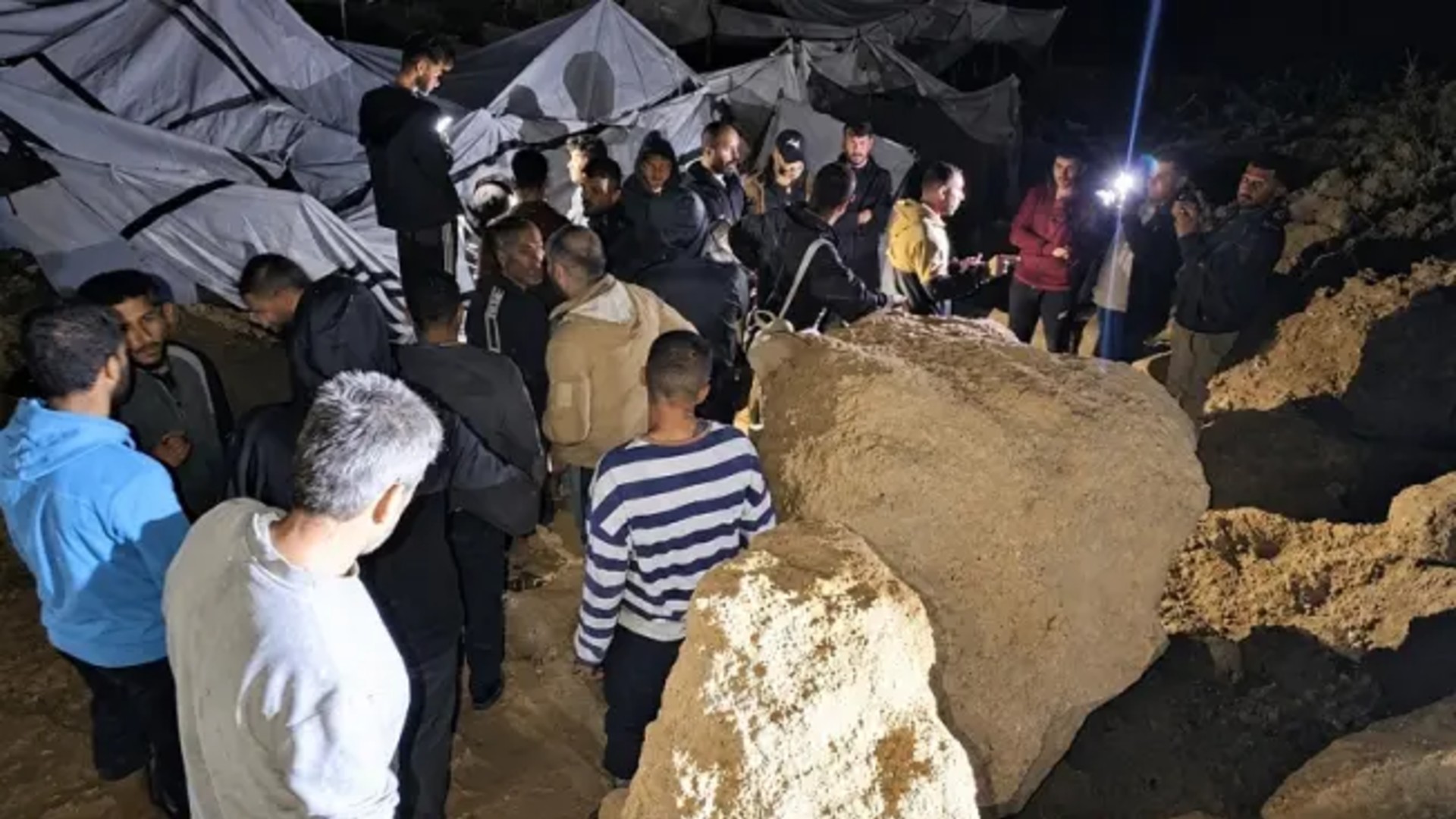
A catastrophic structural failure of a large sand embankment buried temporary tents housing displaced Palestinian families in the Gaza Strip late Sunday, claiming the lives of three children and two women as extreme winter weather swept across the besieged territory. Search and rescue teams from Gaza’s Civil Defence recovered five additional survivors with moderate to severe injuries at the makeshift settlement in Deir al-Balah, with crews still sifting through muddy debris for unaccounted people as of press time.
Mahmoud Basal, official spokesperson for the Palestinian Civil Defence in Gaza, confirmed the embankment and adjacent earthen mounds gave way entirely after a powerful low-pressure system dumped torrential, unseasonable rain and gale-force winds across the enclave throughout the weekend. Local authorities publicly identified five fatalities as Mariam Nabhan and her young son Salah Nabhan, alongside Reem al-Zain, Habiba al-Zain, and Ibrahim al-Zain, all members of the same displaced family living in the camp.
The weekend’s relentless downpours inundated roughly 70,000 temporary tents spread across displacement sites across Gaza, leaving tens of thousands of already vulnerable residents completely exposed to the elements with no dry, safe shelter to retreat to. Palestinian officials and local armed groups have uniformly emphasized that the deadly incident cannot be framed as a natural disaster alone, tracing the root cause directly to Israel’s multi-year military campaign and ongoing siege of the territory.
“This is not simply the result of severe weather. It is the direct consequence of prolonged Israeli genocide, the widespread destruction of infrastructure, continued displacement, and the denial of essential humanitarian assistance and adequate shelter,” the Palestinian Ministry of Foreign Affairs stated in an official Saturday statement. The ministry noted that nearly 2 million displaced Palestinians are currently crammed into roughly 270,000 makeshift tents across Gaza, all living in what it described as “appalling humanitarian conditions.” Official assessments further show 60 to 85 percent of these tents are already tattered, structurally unsound, and completely unfit for habitation, leaving more than 400,000 people at acute risk of flooding, standing rainwater, and dangerous coastal storm surges.
The Hamas governing movement echoed these condemnations in a Sunday statement, stating Israel bears full, unmitigated responsibility for the weekend’s “disaster” by maintaining sweeping restrictions on imports of new tents, prefabricated mobile homes, and critical shelter construction materials. “The tragedy is a direct result of the criminal policies imposed by the Zionist occupation on the Gaza Strip,” the group’s statement read. “The occupation has forced more than two million Palestinians to flee their homes, confining them to less than one-third of the Gaza Strip’s territory, in overcrowded areas and shelters that lack even the most basic standards of safety and protection. This makes the recurrence of such incidents foreseeable amid the continued aggression, blockade and severe weather conditions.”
Data from the UN Office for the Coordination of Humanitarian Affairs confirms that since the start of Israel’s military campaign in October 2023, Israeli forces have destroyed or inflicted severe damage on at least 92 percent of all residential structures across the Gaza Strip. Over the first nearly two years of the offensive, Israeli forces deployed more than 200,000 tonnes of explosives, with a total destructive energy equivalent to roughly 13 Hiroshima-level nuclear weapons. Nearly the entire 2.2 million person population of Gaza has been internally displaced, many forced to flee their homes multiple times, with 1.7 million people still residing in makeshift, unregulated camps.
A US-brokered ceasefire deal signed in October 2025 was originally designed to end the bombardment of Gaza and fully lift all restrictions on humanitarian aid access to the enclave. However, Israeli forces have continued to conduct near-daily aerial strikes and deliberate home demolitions across Gaza in violation of the agreement. The Palestinian Health Ministry reports Israeli forces have killed nearly 1,600 Palestinians since the ceasefire went into effect, bringing the total cumulative death toll of the offensive launched in October 2023 to no less than 74,600 people. Israeli authorities have also maintained stringent, arbitrary restrictions on the entry of almost all essential goods into Gaza, including staple food supplies, life-saving medical supplies, and shelter construction materials required to reinforce or replace failing tents for displaced populations.
Gaza: Five Palestinians killed as sand embankment collapses on displacement tents