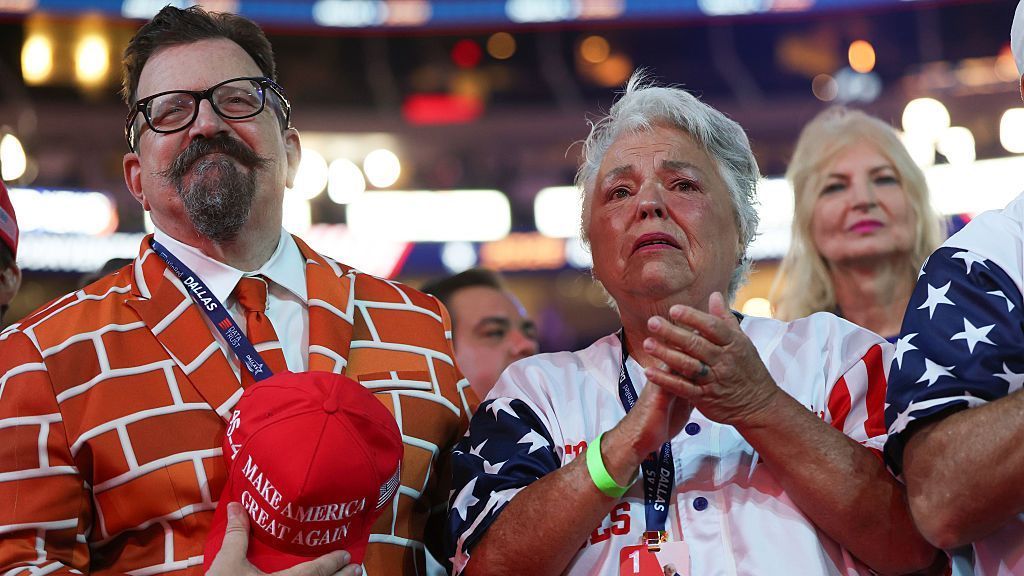
In Dallas this week, the Republican Party hosted its first ever pre-midterm convention, an event that carried all the pageantry of a traditional presidential nominating gathering – from cheering supporters waving custom signs and wearing vibrant event gear, to a packed schedule of candidate speeches and rows of vendors selling branded campaign merchandise. Unlike a standard party convention, however, no official organizational business was conducted. Instead, the two-day gathering served purely as a high-energy turnout rally, designed to energize the Republican base and help the party hang onto its narrow majorities in the U.S. House and Senate ahead of November’s midterm elections.
At the center of the event was former President Donald Trump, whose unchallenged hold over the modern Republican Party remained on full display throughout opening night. He delivered a marathon keynote address that covered his go-to policy and political talking points from this election cycle, mixed with a handful of unanticipated announcements that quickly drew national attention.
The massive convention arena was packed with die-hard Trump supporters, almost all decked out in the iconic red “Make America Great Again” gear from his past presidential campaigns. More than a decade after he launched his first successful White House run, Trump retains unwavering loyalty from his political base, and has reshaped the entire Republican Party in his image over the past 10 years. What remains of the old-guard moderate Republican establishment was nowhere to be found at the Dallas event: Senator Susan Collins of Maine and multiple other Republican candidates running in competitive swing districts opted to skip the gathering entirely.
This glaring absence of moderate Republican figures underscores just how dramatically the party has shifted under Trump’s leadership, and it has amplified ongoing questions about the strategic value of this unprecedented midterm convention format. The event’s core audience, both inside the arena and tuning in via television broadcasts, was overwhelmingly made up of already committed Trump loyalists, rather than the undecided moderates and swing voters that Republicans need to turn out in large numbers to hold their congressional majorities next month.
Trump’s complete dominance of the party also raises urgent questions about its long-term future: most notably, who will step forward as the party’s next standard-bearer when Trump eventually steps back, and how will the party perform in November, when Trump’s name will not appear anywhere on the ballot?
Trump offered a straightforward answer to the immediate electoral challenge in his Wednesday night address. After acknowledging that the sitting president’s party almost always loses ground in midterm elections, he urged the crowd: “I’m asking you to pretend that I’m on the ballot.”
The comment serves as a quiet admission that Trump remains the Republican Party’s most powerful tool to drive voter turnout, but it also highlights a core challenge for the party both in November and ahead of the 2028 presidential election: eventually, Trump will not be on the ballot, and even while he can continue campaigning for Republican candidates, there is no clear successor who can energize the base with the same level of enthusiasm Trump generates. In on-the-ground interviews with BBC reporters, many convention attendees already turned their attention to the 2028 presidential race, debating potential candidates to take over from Trump. The names most frequently cited as top contenders were Vice President JD Vance and Secretary of State Marco Rubio. Still, Trump made clear in Dallas that he remains firmly in control of the party and has no plans to cede the national political spotlight any time soon.
Earlier in the day, as he departed for the convention, Trump acknowledged that American voters may have to wait longer than the midterms to see relief from sky-high gas prices, telling reporters “I think it’s going to take a little bit longer than the midterms.” He doubled down on that message in his keynote, arguing that the short-term economic pain caused by the ongoing war in Iran is a necessary trade-off to stop Tehran from developing a nuclear weapons program. But that messaging is expected to be a hard sell for voters already struggling with the impact of rising energy and consumer costs.
For months, public opinion polls have consistently ranked the cost of living as the top issue for American voters, and Trump’s approval rating has dropped amid the prolonged war in Iran. A new poll conducted by the Financial Times and Focaldata, released on the Sunday before the convention, put Trump’s approval at a new low, with just 33% of registered voters saying they approve of his job performance. Many Republican candidates running in competitive races have pushed for a more direct plan to address rising living costs and end the war in Iran, a point of quiet friction within the party.
True to his pattern of rolling out unconventional policy ideas at large rallies, Trump made a headline-grabbing announcement Wednesday night: he pledged that every adult U.S. citizen would receive a $5,000 payout if Republicans win control of both chambers of Congress in November. The only condition Trump set was that the money had to be spent within the United States. He offered no further details about how the plan would be implemented, where the $5,000 per person would come from, or how the federal government would enforce the requirement that all funds be spent domestically.
Democratic leaders quickly dismissed the pledge as an “empty promise”, and legal and policy experts questioned whether such an executive payout would even be legal. With roughly 270 million adult citizens in the United States, the total cost of the proposed payout would reach an estimated $1.3 trillion. For Trump and the crowd in Dallas, however, the practical feasibility of the plan appeared secondary to its political impact: the announcement drew loud, raucous applause from the convention audience, and Trump clearly relished the moment of excitement.