Investigative journalist Seymour Hersh has recently uncovered new details about a covert U.S. economic campaign targeting Iran, revealing that its actual focus differs sharply from the official public narrative. In new reporting shared as context for an analysis from Asia Times, Hersh notes that the U.S. Treasury’s Operation Economic Outcast, framed as a measure targeting Iran’s ruling ayatollahs when announced by Secretary Scott Bessent, is instead designed to pressure ordinary rank-and-file members of the Islamic Revolutionary Guard Corps (IRGC).
The IRGC, one of Iran’s most powerful institutional actors, controls an estimated half of the country’s total state-held economic assets, including key sectors like oil and gas production and foreign trade, according to Hersh’s reporting. U.S. officials involved in the operation told Hersh their core strategy is to choke off funding flowing through the global financial system to the IRGC, with the end goal of eroding troop loyalty and weakening organizational morale enough to enable a popular overthrow of the Iranian government without triggering large-scale violent repression by the IRGC.
Hersh cited an anonymous U.S. official claiming the IRGC is already facing severe funding shortages. A well-placed Israeli source further told Hersh that many low-ranking IRGC members have gone months with little to no pay, with some forced to beg neighbors for food to support their families. Citing input from U.S. officials, Hersh added that most IRGC rank-and-file are not ideologically committed religious hardliners, but rather work for personal income, making them vulnerable to financial pressure. Current intelligence, including satellite imagery, confirms widespread fuel shortages across Iran, with motorists facing daily waits at gas stations and purchase limits of just five liters per vehicle, due in part to Iran’s limited domestic gasoline refining capacity. With the country already reeling from widespread shortages of food, clean water, jobs, and fuel, U.S. strategists believe a public street revolution could gain traction even without covert American or Israeli support, as a cash-strapped IRGC would be unwilling to mass-violently suppress protests.
Against this high-stakes geopolitical backdrop, University of Sydney researchers Hamideh Khaleghi Mohammadi and Ali Abbasi unpack how this escalating economic pressure is playing out for ordinary Iranians, documented from the ground up by Iranian social media users.
Long before Operation Economic Outcast launched on August 24, Iran was already grappling with a severe, cascading economic crisis. Decades of international sanctions, disrupted trade, restricted oil exports, and longstanding domestic economic mismanagement left the country on the brink. Recent official data cited by Reuters places Iran’s 12-month average inflation rate at 69.9%, with food, beverage, and tobacco inflation surging past 128% — nearly double the overall rate. Iran’s national currency, the rial, has plummeted to a record low, trading at more than 2.2 million rial to one U.S. dollar, up from roughly 1 million rial per dollar just one year prior. Official figures also lay bare the yawning gap between income and basic needs: the average monthly salary in Iran equals roughly $125 USD, while the minimum cost of basic household necessities totals around $450 USD per month.
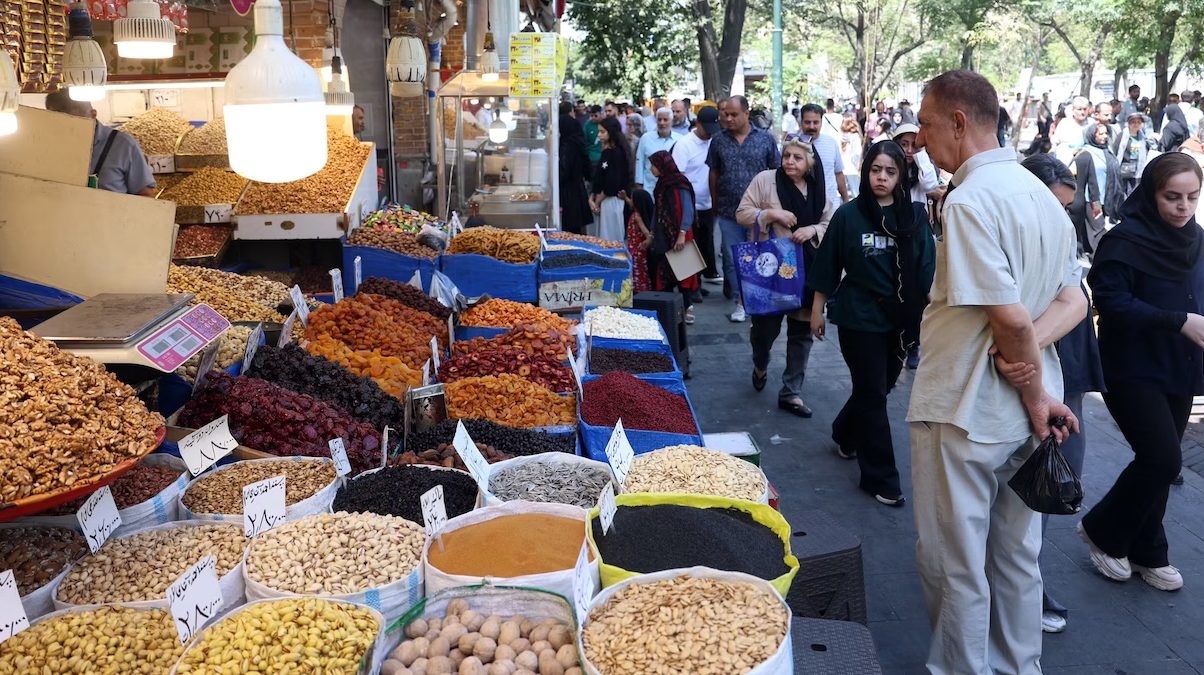
While these official statistics paint a grim picture, they fail to capture the day-to-day human experience of living through hyperinflation and economic collapse — a gap Iranian social media users are filling by creating an unofficial, bottom-up archive of national hardship. A widespread trend sees users sharing side-by-side comparisons of what a fixed amount of Iranian currency could purchase one or two years ago versus what it can buy today, using everyday goods from washing machines to bags of groceries and snack chips to illustrate the rapid collapse of purchasing power.
Other posts focus on current realities: users photograph supermarket receipts, capture images of half-empty store shelves, and list once-common household products that have now become unaffordable for most families. While academic economic indicators and government inflation data provide aggregate numbers, these social media posts convey the granular, personal experience of economic crisis: which items have disappeared from regular shopping baskets, what goods families have substituted with cheaper alternatives, which necessary purchases are being delayed indefinitely, and what products are now treated as unobtainable luxuries.
The tone of these posts varies dramatically across the platform. Some users express anger and despair over their lost purchasing power, while others use dark humor and memes to cope with the relentless rise in prices. Some posts call for boycotts, mass protests, and collective action against the government, while others frame the hardship as an unavoidable wartime condition and urge followers to practice endurance. Despite these divergent voices and political outlooks, all posts are united by their focus on grounding national economic crisis in everyday life.
Iranian government officials have not denied the severity of the current strain. Central Bank governor Abdolnaser Hemmati has acknowledged that managing household livelihoods has become extraordinarily difficult, while parliament speaker Mohammad Bagher Ghalibaf has named inflation, unemployment, and currency instability as three of the government’s most pressing major challenges.
For researchers Mohammadi and Abbasi, these grassroots social media posts carry long-term historical significance beyond documenting the current crisis. Official economic records will capture inflation rates, exchange rate fluctuations, and aggregate spending data for future historians, but the unedited, personal accounts shared on social media will preserve how ordinary Iranians actually experienced this period of crisis. Decades from now, the full economic history of this era will be written not only from government spreadsheets and inflation charts, but also from the receipts, shelf photos, memes, and images of shrinking shopping baskets that Iranians chose to capture and share with the world.