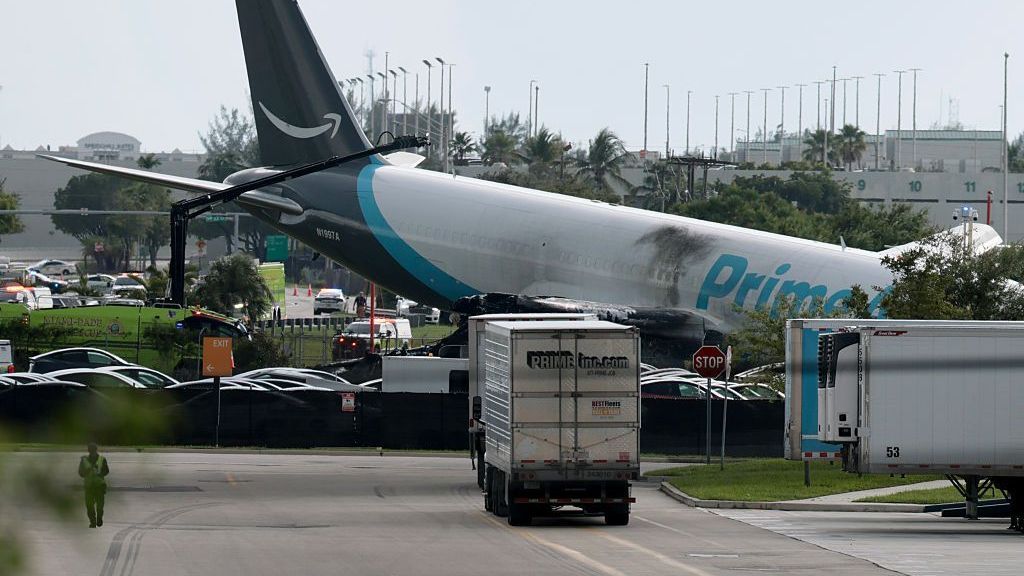
A devastating aviation incident at Miami International Airport on the busy Labor Day travel weekend has left five people dead and five others injured, three critically, after an Amazon Air cargo jet overshot the runway during landing. The Boeing 767-300 cargo aircraft, which departed from Luis Muñoz Marín International Airport in San Juan, Puerto Rico, crashed just before 2 p.m. local time, striking multiple ground vehicles before coming to a stop at the northwest end of the airport’s diagonal runway.
Emergency response teams mobilized rapidly to the scene, with more than 200 firefighters arriving within seconds of the crash to tackle heavy flames and smoke that erupted from the damaged aircraft. Miami Fire Chief Raied Jadallah confirmed that while crews successfully extinguished the blaze, a hazardous fuel leak remains at the crash site, which is located near a parking lot serving an Amazon warehouse and surrounding local businesses. Several injured people were trapped inside or beneath crushed ground vehicles, requiring specialized extrication efforts from rescue personnel, before all casualties were transported to area hospitals for treatment.
In a statement following the crash, Amazon Director of Corporate Global Media Relations Kelly Nantel expressed the company’s profound grief over the loss of life. “We’re heartbroken to learn that five people lost their lives in today’s incident at Miami International Airport,” Nantel said. “Our deepest sympathies go out to the families, loved ones, and all those affected by this devastating loss.” The flight was operated by North Carolina-based charter carrier 21 Air, and Nantel confirmed Amazon is cooperating fully with local authorities and investigators to determine the root cause of the incident. The BBC has attempted to contact 21 Air for comment, but as of Sunday evening, no response had been received.
Miami-Dade County Mayor Daniella Levine Cava described the event as an “incredibly difficult day” for the community during a Sunday evening press conference, noting that first responders had prioritized care for victims and their families from the moment of the crash. “Right now, our focus is on the families, those who were injured, and the ongoing response,” she said.
Initial flight data from aviation tracking service FlightRadar24 shows the aircraft was traveling at 112 knots (129 miles per hour, 207 kilometers per hour) when it exited the usable portion of the runway. The tracking service also reported light thunderstorm activity and gusting winds in the Miami area at the time of the attempted landing. Officials have emphasized it is too early to draw conclusions about what caused the overrun, and the National Transportation Safety Board (NTSB), the federal agency tasked with investigating all civil aviation crashes in the United States, will lead the probe into the incident. The NTSB has scheduled a press conference for Monday to share initial updates on its investigation.
In response to the crash, the Federal Aviation Administration ordered all outgoing flights grounded at the airport, one of the busiest aviation hubs in the United States and the nation’s busiest for international freight. Stranded passengers told the BBC they faced widespread frustration due to limited official information, with hundreds of travelers stuck in long lines at airline counters trying to rebook canceled or delayed flights. Many passengers reported they would be forced to extend their stay in Miami by at least one night due to the travel disruptions.
The crash comes during the busiest travel period of the year for U.S. airports. The Transportation Safety Administration projected that 17 million passengers would pass through U.S. airports in the week leading up to Labor Day, with 2.3 million travelers expected to fly on Sunday alone. Miami International Airport, founded in 1928, handles more than 60% of all international arrivals to Florida and offers more connections to Latin America and the Caribbean than any other U.S. airport.