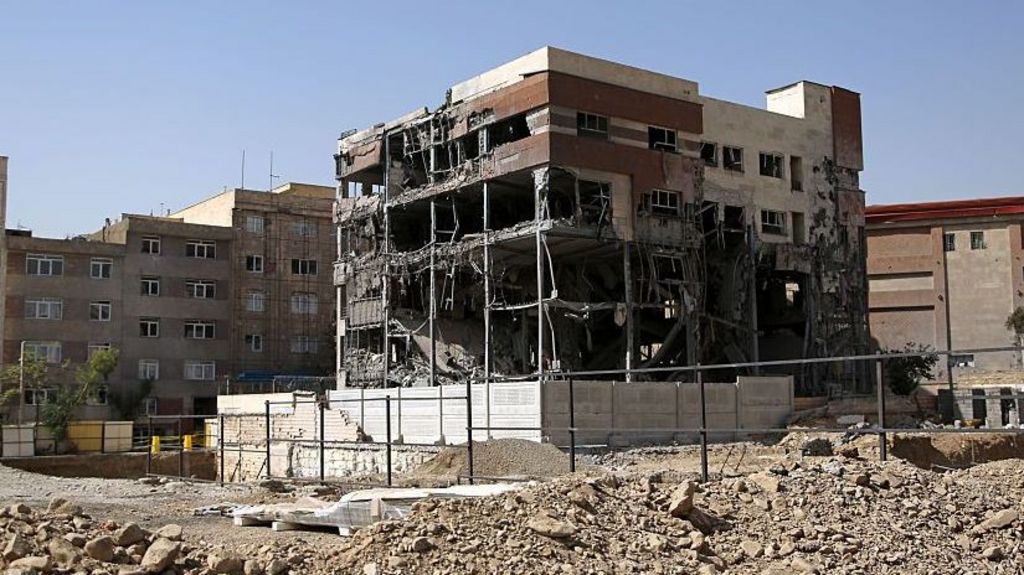
After seven months of open conflict between the United States and Iran, hopes for an immediate breakthrough peace deal have once again faded, as both sides exchange targeted strikes and dig in with uncompromising public rhetoric. The latest escalation comes just days after Washington announced a sweeping new phase of its campaign: a total economic blockade designed to punish not only Iran but also any third-party nations that continue to conduct trade with Tehran.
The core goal of this new pressure campaign, US officials say, is to force Iran back to the negotiating table and end its repeated disruptions to commercial shipping in the Strait of Hormuz, a critical global energy chokepoint that has been effectively closed to large-scale commercial traffic since the conflict began between the US, Israel and Iran in February. The June Memorandum of Understanding (MoU), a tentative framework negotiated by both sides that was supposed to lead to a permanent ceasefire and full peace agreement within 60 days, officially expired at the end of August without any progress toward its stated goals.
To unpack the current stalemate and the potential trajectory of the conflict, three leading regional security experts from major international think tanks shared their analysis of the shifting dynamics on and off the battlefield.
Jason Campbell, a Senior Fellow at the Washington DC-based Middle East Institute, argues that the biggest source of ongoing uncertainty is the lack of clear, fixed US strategic goals for the conflict. “The White House is constantly re-evaluating what political outcomes it is willing to accept,” Campbell explained. Early planning assumed that limited military action would deliver a quick US victory, but that assumption has failed to materialize, leading the US to test a mix of military pressure and economic coercion.
Currently, Campbell says the Biden administration appears comfortable with a state of controlled stasis: maintaining the broad economic blockade while carrying out periodic targeted strikes to limit Iran’s ability to disrupt shipping through the strait. US officials are betting that the new round of harsh sanctions will weaken Tehran’s position enough to force it back to negotiations on US terms. In recent weeks, US forces have managed to open a limited shipping channel through the strait, enough to avoid a catastrophic global oil price spike or broader economic collapse, but these incremental gains fall far short of the original US objectives when the conflict launched. For Campbell, the most likely outcome is that Iran will demand major concessions to reach a deal, terms that will remain politically unacceptable for the current US administration.
Dr. Aniseh Bassiri Tabrizi, an Associate Fellow with Chatham House’s Middle East and North Africa Programme in London, says the latest US strikes and sanctions have not changed Iran’s core calculations about the conflict. “Tehran is already preparing for tighter economic pressure and a continuation of the sporadic on-off attacks we have seen over the past two months,” Tabrizi noted. Iran’s strategy remains to respond to US attacks in a proportionate way, avoiding actions that would trigger a full-scale regional war while refusing to back down.
The new economic squeeze will undoubtedly deepen harm to Iran’s economy, which has already been battered by months of conflict and has long struggled with deep structural problems — instability that was already visible in large-scale anti-government demonstrations in December and January earlier this year. Even so, Tabrizi says there is no indication that economic pressure will push Iran’s leadership to change its position or make concessions at the negotiating table any time soon. That does not mean Tehran has ruled out a path to de-escalation, but rather that it is waiting for the US to return to the terms of the June MoU or offer concrete concessions of its own. “Tehran does not want to cave in to US pressure or alter its own approach in response to sanctions or additional attacks,” Tabrizi added.
Nicholas Hopton, a Distinguished Fellow in international security at the Royal United Services Institute in London and former UK ambassador to Iran, argues that the latest escalation of military action will not force Iran to surrender, and economic pressure is unlikely to work as intended. That is because major trade partners of Iran including China and Russia refuse to back Washington’s unilateral sanctions, allowing Tehran to maintain critical economic ties even under the blockade. “Iran can continue to disrupt the Strait of Hormuz — they have a thumb on the jugular of the global economy,” Hopton noted.
When it comes to the question of the White House’s exit strategy, Hopton argues the framework for a solution already exists in the June MoU. If Washington returns to negotiate the full deal outlined in that agreement, it would deliver what the US frames as a victory: weakening hardline factions within Iran’s Islamic Republic and creating international guarantees that Tehran will not develop a nuclear weapon. The core provision of the MoU — lifting all US sanctions on Iran — would over time weaken the influence of the powerful Islamic Revolutionary Guard Corp (IRGC), which dominates large swathes of Iran’s economy. Opening Iran to broad new global economic engagement would gradually drive radical political and social change, resulting in an Islamic regime that is fundamentally different in its approach and priorities, Hopton explained.
Reaching that outcome will not be easy, however, given the IRGC’s deep penetration of Iran’s economy. It would also require significant strategic patience from the US and its partners, a commodity that is in very short supply at this stage of the conflict. “For the time being, I think we’re going to carry on with a messy, inconclusive situation that is bad for everyone,” Hopton concluded.