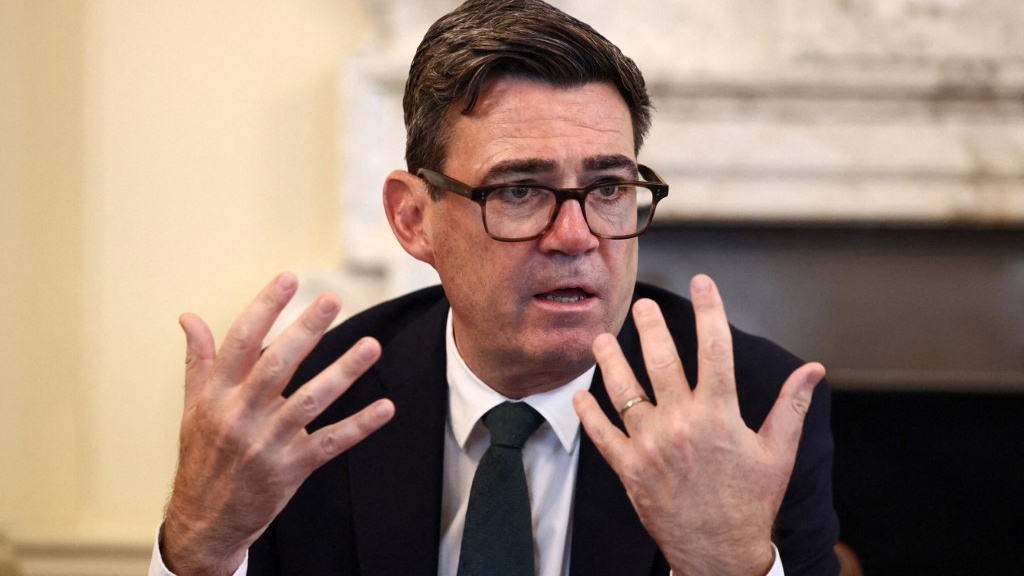
As the new Andy Burnham-led UK government prepares to unveil a sweeping package of policy measures targeting Israeli activity in the occupied West Bank—headlined by a proposed ban on goods imported from illegal Israeli settlements—the British political landscape has been split by a stark divergence of views among UK Jewish community leaders. Just days after major establishment Jewish organizations met the prime minister at Downing Street to lobby against the import ban, a coalition of progressive Jewish groups has thrown its full weight behind tougher action against Israel, while demanding the government protect the right to hold pro-Palestinian protests.
On Monday, UK Chief Rabbi Ephraim Mirvis met Foreign Secretary Ed Miliband to warn that any form of economic sanctions targeting Israel would carry harmful consequences for British Jewish communities across the country. The Jewish Leadership Council and the Board of Deputies of British Jews, two of the most prominent institutional Jewish groups in the UK, doubled down on this opposition during their Downing Street meeting with Burnham, arguing that restrictions on settlement goods would damage the longstanding cultural and religious ties between British Jews and sites in the occupied territories.
But just four days later, a competing open letter organized by three progressive Jewish organizations—Holocaust Survivors and Descendants against Gaza Genocide (HSD), Jewish Voice for Liberation (formerly Jewish Voice for Labour), and Jews for Justice for Palestinians—reached the prime minister’s desk, taking a directly opposite stance. The letter counts two Holocaust survivors, Stephen Kapos and Agnes Kory, among its signatories, and pushes back hard against the claim that institutional Jewish groups speak for all UK Jewish people on the issue of Israel.
“There are several Jewish ‘communities’ and a wide diversity of views on Israel among Jewish people in the UK and we trust that you will meet with us and other members of the Jewish Bloc in the near future,” the letter, which was reviewed by Middle East Eye (MEE), states. The signatories also welcomed Burnham’s earlier commitments to stronger action against Israel and his public apology for the previous Keir Starmer-led Labour government’s slow response in calling for a ceasefire in Gaza.
The groups make clear that their members regularly join the large Jewish Bloc contingent in national pro-Palestine marches, where they publicly condemn what they frame as an ongoing genocide of Palestinians in Gaza. They also reject widespread claims that pro-Palestine protest movements are hubs of antisemitism, noting that signatories have only experienced goodwill and solidarity from fellow pro-Palestine demonstrators. Any antisemitic hostility at protest events, they argue, has originated from pro-Israel counter-demonstrators, not pro-Palestine organizers or attendees.
This advocacy builds on a similar effort earlier this year, when 44 Holocaust survivors and their descendants sent an open letter to then-Prime Minister Keir Starmer urging him to abandon proposed restrictions on repeated pro-Palestine marches. Starmer had floated the restrictions after an antisemitic stabbing attack that injured two Jewish men in Golders Green, a majority-Jewish neighborhood in northwest London. Then-Policing Minister Sarah Jones responded to that 2024 letter by affirming that the right to peaceful protest is a core pillar of British democracy, but defended new expanded police powers to impose restrictions on intimidating protests near houses of worship, as well as a new requirement for senior officers to weigh the cumulative impact of repeated protests when approving conditions for demonstrations.
In their new letter to Burnham, the progressive Jewish groups reiterate this call, demanding the new prime minister block any future efforts to restrict or shut down pro-Palestine marches. They also criticize the Starmer-era Labour Party’s handling of antisemitism allegations, which saw roughly 70 Jewish Labour members publicly or internally accused of antisemitism for their pro-Palestine views. The letter argues that this pattern of disciplinary action has given Israel unwarranted political cover for its military actions in Gaza and the West Bank, while eroding core rights to free speech and peaceful protest in the UK.
Jenny Manson, co-chair of Jewish Voice for Liberation and a former Labour Party member who left the party in 2023, told MEE that establishment Jewish groups have long been granted regular access to UK government leaders, while alternative Jewish voices critical of Israel are sidelined. “Generally, the diversity of Jewish communities and Jewish views is largely ignored. We are not given any audience by the government, unlike the Jewish establishment bodies which are regularly welcomed in Whitehall,” Manson said.
She added, “We ask that Andy Burnham recognise that the mass marches in support of Gaza are a legitimate expression of the widespread horror felt in Britain at Israel’s war crimes and ethnic cleansing in Gaza and the West Bank. Many Jews feel this anger and misery too.” Manson also called on Burnham to act on the core demand of pro-Palestine protesters: an immediate end to all UK arms sales to Israel.
The upcoming policy announcement from the Burnham government was first teased last month by Miliband, who confirmed the government would unveil new measures in response to Israel’s advancement of the E1 settlement project east of Jerusalem. If completed, the E1 development would cut the occupied West Bank into two disconnected parts, effectively ending any possibility of a contiguous Palestinian state.
Alongside the opposition from institutional Jewish leaders, another UK-based anti-occupation Jewish group, Na’amod, has publicly welcomed the proposed measures, framing them as the bare minimum appropriate response to Israel’s ongoing expansion of illegal settlements and military activity in the occupied territories. As of Thursday evening, MEE has reached out to Downing Street for official comment on the progressive groups’ letter, and has not yet received a response.