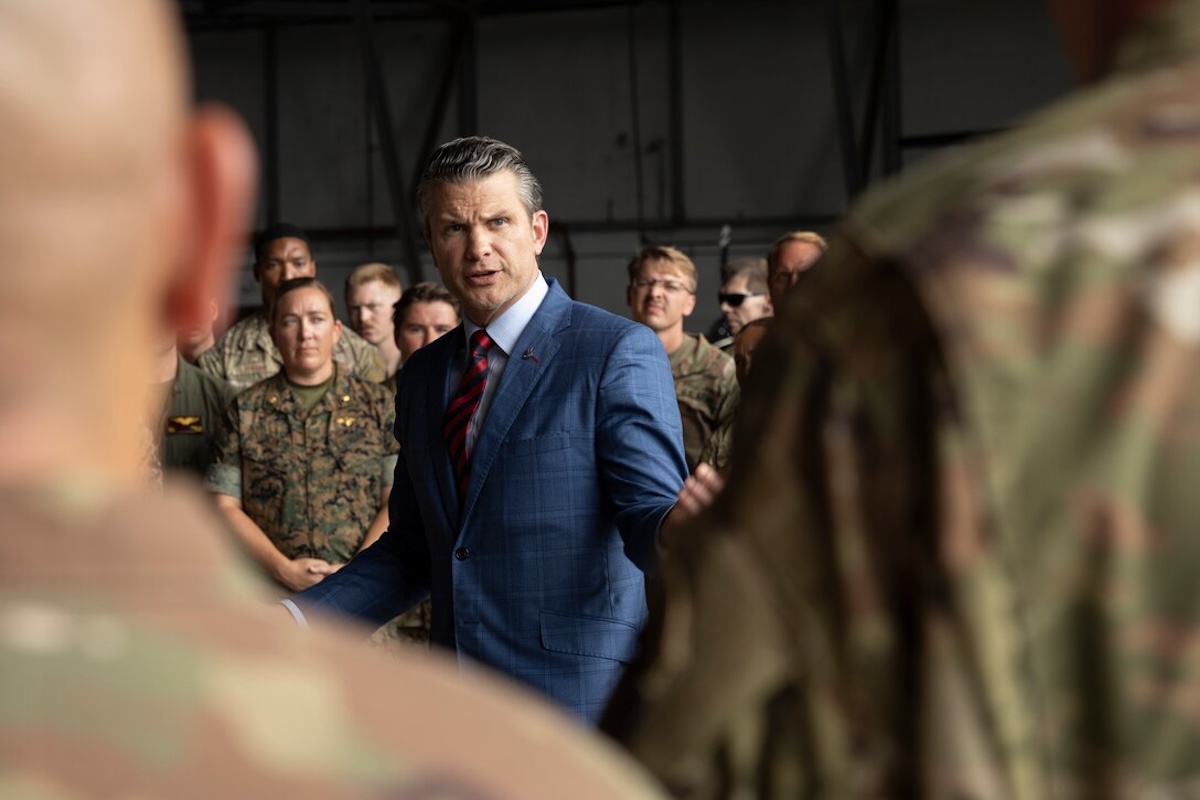
Three years into a deeply contentious, costly and unpopular U.S. military campaign against Iran, the U.S. Pentagon has confirmed plans to extend deployments of American troops, fighter jet squadrons and naval warships in the Middle East well into next year, with some ground forces potentially remaining as late as 2027, according to an exclusive Wall Street Journal report published late Wednesday.
The development marks a stark reversal of early promises from top Trump administration officials, including Pentagon Chief Pete Hegseth and President Donald Trump himself, who both repeatedly insisted the military assault on Iran would conclude quickly. Under the newly unveiled plan, the U.S. will maintain a force of roughly 50,000 service members in the region, a posture designed to preserve presidential flexibility for future policy shifts, the report notes, citing internal correspondence that military leadership sent to family members of deployed personnel. The document also confirms that elements of the Army’s elite 82nd Airborne Division could remain stationed in the Middle East through 2027.
Intriguingly, the report adds that Trump – who has drawn widespread criticism for falsely claiming Iran is a “dead” country – is currently holding closed-door discussions with senior advisors about formally declaring the Iran war over, even as cross-border airstrikes continue, thousands of U.S. troops remain deployed in theater, and the administration continues to ramp up crippling economic sanctions on Tehran.
Critics across policy and advocacy circles have rapidly condemned the administration’s handling of the conflict, calling the open-ended deployment a confirmation that the war was both unnecessary and illegal from its outset. “The Trump administration seems to excel at bombing schools and weddings,” Brian Finucane, senior adviser to the U.S. Program at the International Crisis Group, wrote in commentary Wednesday. “Winning the illegal and unnecessary war with Iran – not so much.”
Hegseth has publicly thrown his support behind a new strategy that relies on “periodic” targeted bombings across Iran to keep commercial ship traffic moving through the Strait of Hormuz, a critical global energy chokepoint. But independent analysts warn this approach would lock the U.S. into a permanent state of low-intensity conflict with Iran with no clear off-ramp.
Trita Parsi, executive vice president of the Quincy Institute for Responsible Statecraft, argued earlier this week that Trump’s current posture appears tailored to upcoming midterm elections: he is leaning toward maintaining a limited, low-level conflict through the vote, pursuing neither a diplomatic breakthrough to end the standoff nor allowing tensions to spiral into full-scale all-out war. “Iranian officials say, both publicly and privately, that they expect the U.S. and Israel to resume full-scale hostilities after the midterms regardless of the impact of the so-called D-Day sanctions,” Parsi noted in his analysis. “Regional diplomats have largely reached the same conclusion.” Parsi added that if sanctions gradually weaken Iran’s economy while global markets adjust to new trade patterns through the Strait, a prolonged pause in major operations will work against Tehran’s interests. That dynamic, he warned, could push Iranian leadership to launch dramatic military escalation in the run-up to the election, taking advantage of what they see as Trump’s domestic political vulnerability.
The human and economic cost of the conflict continues to mount. To date, the war has killed thousands of Iranians – including hundreds of civilian children – along with at least 18 U.S. service members. For average American households, the conflict has driven an extra $1,200 in annual costs, primarily due to spiking global energy prices that have pushed gasoline costs to record highs. When asked about this financial burden on American families, Trump has publicly stated he does “not think about Americans’ financial situation” when making policy decisions about the Iran war.
The open-ended conflict has also paved the way for the Trump administration to push for a record $1.5 trillion military spending budget for the upcoming fiscal year, a request that has amplified fears among critics that the U.S. is settling into a permanent “forever war” in the Middle East focused on Iran.
In a public analysis published Wednesday, the National Iranian American Council outlined the growing risk of prolonged conflict for civilians on both sides. “Washington is betting that sustained military and economic pressure will eventually force Tehran to retreat,” the organization wrote. “Iran appears to be betting that it can survive long enough to force Washington to do the same. For ordinary Iranians, American servicemembers, and civilians across the region, the danger is that testing those two assumptions will require a much longer and more destructive war.”