Diplomatic relations between the United Kingdom and Israel are deteriorating at an accelerating pace, as the UK government prepares to unveil a package of harsh new measures targeting Israeli activity in the occupied West Bank. The centerpiece of the planned actions is a full ban on imports of goods produced in Israeli settlements that the UK and much of the international community deem illegal under international law.
The proposed sanctions have already triggered fierce pushback from Israeli leaders. “If Britain acts against Israel, Israel will act against Britain,” Israeli Foreign Minister Gideon Saar issued a direct warning this week. The rhetoric has grown increasingly vitriolic: Prime Minister Benjamin Netanyahu has publicly labeled the UK the “Islamic Republic of Britain” in a deliberate insult. His son, Yair Netanyahu, who holds no official government position but remains a prominent public voice, has gone a step further, publicly claiming the Falkland Islands are rightfully Argentine territory, not British.
Yair Netanyahu’s unprompted remarks have rippled across the Atlantic, drawing an unexpected intervention from former U.S. President Donald Trump. Trump has signaled that Washington could revisit its longstanding commitment to British sovereignty over the South Atlantic archipelago, going as far as telling GB News that he would refuse to back the UK if Argentina launched a new invasion of the islands. Trump tied the shift to his own grievance over the UK’s refusal to back the U.S. and Israel’s February 2025 strike on Iran, saying “Your country was not there to help me.”
Argentine President Javier Milei, who has taken a hardline line on territorial claims since taking office, has pledged to release a formal statement on the sovereignty dispute this week. Earlier this month, he declared that Argentina’s national sovereignty had been “violated” and vowed his government would defend the country’s interests “tooth and nail, no matter who it bothers.”
Beneath the current round of public taunts and threats lies a decades-long hidden history of covert conflict between the two nations, which have long been framed as close historical allies. Few today remember that during the 1982 Falklands War, Israel secretly armed Argentina against the UK — a decision that cost dozens of British soldiers their lives.
The basics of the Falklands dispute remain unchanged: both Argentina and the UK claim full sovereignty over the remote South Atlantic archipelago, which is home to roughly 3,600 residents, the overwhelming majority of whom support continued British rule. On April 2, 1982, Argentine military forces invaded the islands, sparking a 74-day conflict that ended with a British victory. It was not until a decade after the war that declassified UK government files confirmed the long-rumored secret Israeli military support for Argentina during the conflict.
According to the declassified documents and a 2011 investigative book by Argentine journalist Hernan Dobry, Israel organized a secret network of cargo flights through Peru to deliver a vast arsenal to Argentina. The shipments included 20 reconditioned Nesher fighter jets, air-to-air missiles, anti-tank mines, mortars, machine guns, fuel tanks and Skyhawk attack jets. The total value of Israeli arms exports to Argentina during the war is estimated at roughly $1 billion in modern terms. The Israeli Skyhawk jets were used in bombing raids against British positions, killing 48 British soldiers and sailors and sinking four Royal Navy warships.
For years, the Israeli government repeatedly denied any arms sales to Argentina during the conflict. When British intelligence uncovered concrete evidence of the shipments — including documentation of an Argentine effort to open a $100 million letter of credit through a Panamanian intermediary at Credit Suisse in Zurich in favor of Israel Aircraft Industries — the British Foreign Office leaked the full details to the national press.
Diplomatic cables from the time lay bare British frustration with Israeli deception. “We are having the worst of both worlds, with the Israelis apparently shipping aircraft to Argentina and at the same time fobbing us off with repeated denials,” one senior British official wrote at the time. Patrick Moverly, then UK ambassador to Tel Aviv, noted that “The Israelis have always had a special way of looking at the rest of the world,” and added that the Israeli government was making “a gigantic effort… to pull the wool over our eyes.”
Why would Israel arm a belligerent against a close historical ally? Declassified records reveal two core motivations. First, as one Israeli diplomat openly acknowledged at the time, the war created “an extremely attractive opportunity to develop the arms market in Argentina and Latin America, with great potential long-term benefit to Israel.” Second, the UK and Israel were already locked in a bitter dispute over a British arms embargo imposed on Israel after its 1982 invasion of Lebanon.
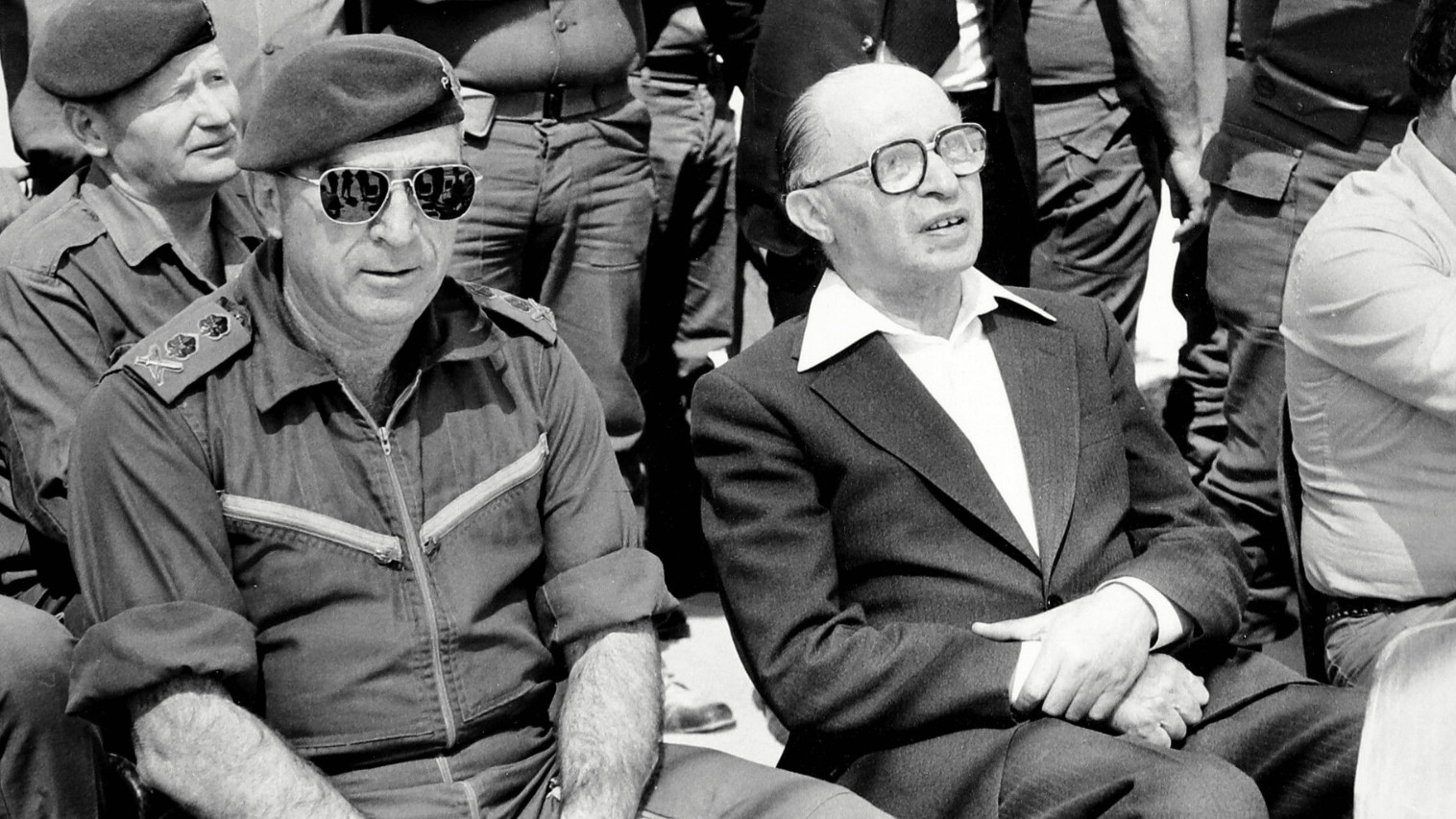
Relations between Israeli Prime Minister Menachem Begin and British Prime Minister Margaret Thatcher were strained long before the Falklands War. Begin, as a young guerrilla leader fighting British rule in Mandatory Palestine, commanded the Irgun Zvai Leumi, which carried out two devastating attacks on British targets: the 1946 bombing of Jerusalem’s King David Hotel, the British administrative headquarters, which killed 91 people including 28 Britons, and an earlier bombing of the British Officers Club in Haifa that left dozens dead and injured.
After Israel’s 1982 invasion of Lebanon, Thatcher pushed back against unlimited U.S. support for Israel, telling President Ronald Reagan that “unlimited support for Israel can only lead to growing polarisation and despair in the Arab world.” Britain imposed a full arms embargo on Israel that remained in place until 1994, and Thatcher publicly denounced the Sabra and Shatila massacres carried out by Lebanese Christian Phalangists with Israeli army complicity as “pure barbarism.”
For Begin’s government, arming Argentina during the Falklands War was a deliberate tactic to pressure the UK into lifting the arms embargo and ending British arms sales to Arab states hostile to Israel. The gambit failed. Thatcher’s government went on to sign the 1980 Venice Declaration, where nine European nations formally expressed their shared concern over Israeli settlements in occupied Palestinian territories, and oversaw the founding of the Conservative Middle East Council, a group focused on promoting a balanced policy in the region.
Decades later, the same fault lines that drove the 1980s rift have reopened, pushing UK-Israel relations to their lowest point in modern history. In 2024, the UK imposed a partial arms embargo on Israel over its conduct in the Gaza war, and is now preparing to expand that with new sanctions targeting illegal Israeli settlements in the West Bank. On Tuesday, UK Foreign Secretary Ed Miliband told Parliament that the government would roll out a “comprehensive” sanctions package in the coming weeks, warning that Israel’s planned expansion of settlements in the E1 area of the West Bank “risks making a Palestinian state unviable.”
Israeli leaders have already made clear they will not accept the new measures quietly. Sa’ar retorted that “Israel will not be a passive victim of this policy” and will defend “its rights, its interests and its people.” Israeli media reports indicate that the government is actively weighing multiple retaliatory options, while the U.S. has reportedly mounted intense private pressure on the UK to abandon the sanctions plan entirely. A leaked April Pentagon memo even suggested Washington could use the Falklands sovereignty dispute as leverage to force the UK to back down.
The decisions made by all three sides in the coming weeks are likely to shape the future of UK-Israel relations, and even UK-U.S. relations, for decades to come.