In a sobering update on the escalating Ebola crisis ravaging eastern Democratic Republic of the Congo, the Africa Centers for Disease Control and Prevention (Africa CDC) announced Thursday that local health authorities are pivoting to a new village-centered strategy to curb transmission, after the virus outpaced existing containment and tracking efforts.
According to the continental public health agency, the current outbreak has not yet reached its peak, marking a far more severe public health emergency than the devastating 2014–2016 West African Ebola epidemic, which remains the deadliest on record with more than 11,000 fatalities. Africa CDC data confirms the current outbreak has already recorded six times as many confirmed cases and five times as many deaths as that prior crisis.
Since the outbreak was declared in mid-May, the virus has jumped from just three initial health zones to 60 across the country, with 6,250 total confirmed cases and 3,039 deaths as of the latest government count. Ongoing insecurity, mass population displacement, and frequent large-scale population movements have been the primary drivers of the virus’s rapid spread. The outbreak is concentrated in Ituri province, which is also the epicenter of a persistent rebel conflict in eastern Congo – a dual crisis that has complicated nearly every aspect of outbreak response.
A new analysis this week from the U.S. Centers for Disease Control and Prevention (U.S. CDC) identifies five critical gaps that continue to undermine Congo’s Ebola response, even as authorities adjust their strategy.
First, community-based surveillance systems remain drastically underdeveloped. Rapid investigation of potential cases, early detection, contact tracking, and transmission slowdown are all hampered by this gap. Delayed case detection, widespread community reluctance to report suspected infections, and insufficient engagement with local populations have all led to entirely preventable deaths. Recent Africa CDC data underscores this failure: at least 63% of all fatalities recorded in the past week occurred outside of dedicated Ebola treatment centers, meaning most infected people never accessed life-saving care.
To address this foundational gap, authorities are now rolling out the new village-centered approach, which centers on partnering directly with local community leaders to build trust and improve collaborative work with residents. But Yap Boum, head of emergency preparedness and response at Africa CDC, noted that trust-building in the middle of an active conflict and outbreak is far from simple. “Building that trust in the middle of an outbreak is quite complex,” Boum explained, referencing the ongoing insecurity that leaves residents deeply suspicious of outside actors.
The second critical gap is persistent failure to scale up effective contact tracing, an essential tool for stopping Ebola chains of transmission. While response teams have followed up with 81% of *officially listed* contacts of confirmed cases, this statistic hides a stark reality: thousands of unrecorded contacts have never been reached for monitoring. Africa CDC estimates that confirmed cases recorded in the three weeks prior to the update should have generated approximately 97,600 total contacts, based on an average of 60 contacts per confirmed case. To date, only 19% of these total expected contacts have successfully been traced, leaving hundreds of potential transmission chains unmonitored.
Third, experts warn that existing treatment and isolation capacity remains insufficient to meet projected need. By late August, treatment centers had expanded their total capacity to more than 1,300 beds, with a current occupancy rate of 67% (holding 869 patients). However, public health teams are calling for additional treatment and isolation centers and beds across affected health zones to prepare for the wave of undetected cases that experts expect to emerge. Many high-risk health zones are located in areas inaccessible to response teams, while widespread community distrust of health authorities leads to many cases going unreported for weeks.
Fourth, limited laboratory testing capacity continues to delay case confirmation and timely treatment. The World Health Organization reported last month that many treatment and transit centers in Ituri, the outbreak’s epicenter, are already operating at full saturation, while North Kivu – the second-most affected province – lacks enough specialized referral facilities for severe cases. Frontline health workers at existing treatment centers are also suffering from extreme burnout. Jeannot Krikeija, who works at an Ebola treatment center in Bunia, Ituri’s capital, described the relentless toll of the crisis: “Ebola is tiring us all the more because we don’t know when this scourge will end. This ordeal is unbearable for me.”
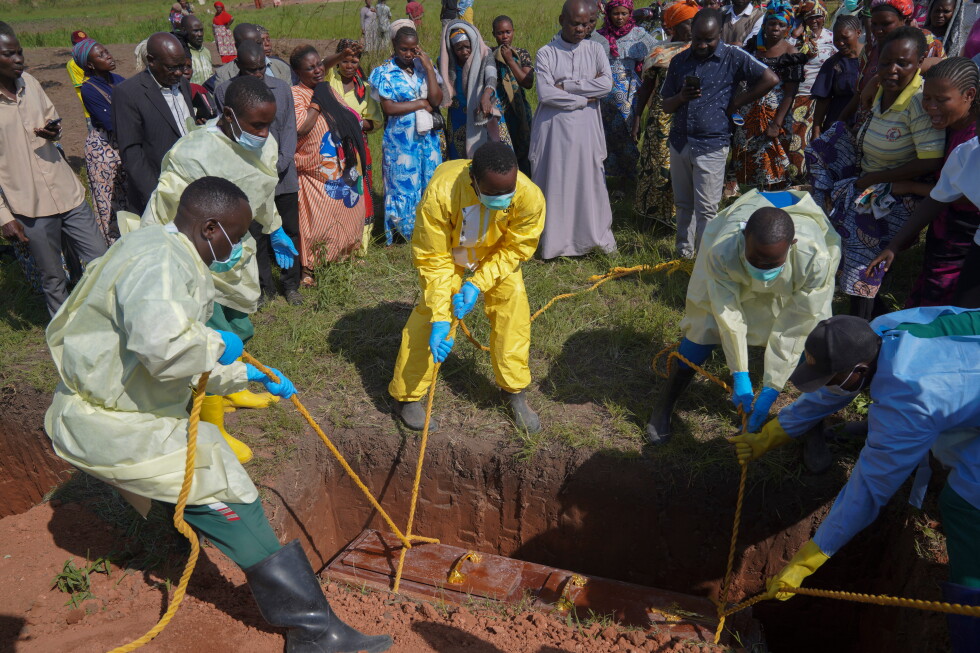
The fifth and final gap identified by the U.S. CDC lies in safe burial practices, a critical intervention given that Ebola spreads through direct contact with bodily fluids, and the bodies of deceased victims remain highly infectious. While authorities have deployed safe burial teams to respond to the more than 3,000 Ebola deaths to date, major gaps remain in execution across affected health zones. In Ituri and other high-risk areas, burial teams have been attacked multiple times, often by grieving family members who wish to carry out traditional burial customs for their loved ones. It remains common for community members to gather within meters of Ebola victim coffins during burials, putting hundreds of people at risk of new infections.
As the new village-centered strategy rolls out, public health agencies across the continent continue to warn that the outbreak’s trajectory remains unpredictable, with sustained transmission expected for the foreseeable future without targeted investment to close the remaining response gaps.
AP writers Constant Same Bagalwa in Bunia, Congo and Mike Stobbe in New York contributed reporting to this article.