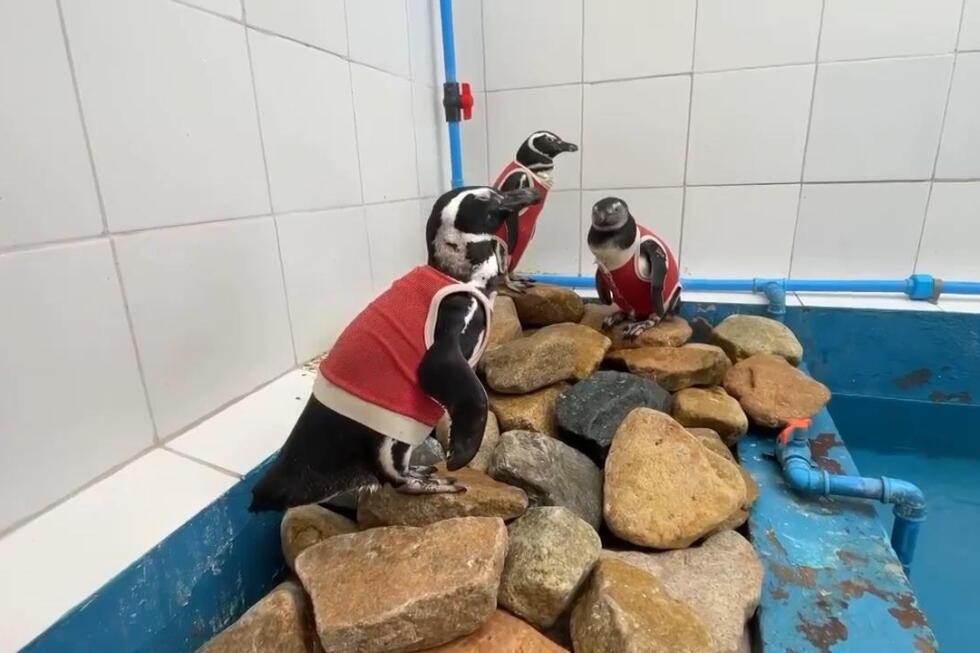
SANTIAGO, Chile — As one of the world’s most vulnerable penguin species faces rapid population decline across Chile, local wildlife researchers and veterinarians have launched an innovative new trial to improve rescue outcomes: custom-fitted red vests woven with healing copper and zinc fibers designed to accelerate wound recovery for injured aquatic birds.
The experimental treatment draws on a proven approach already used in veterinary care for domestic pets. For years, veterinarians have successfully leveraged microfiber garments embedded with copper and zinc to treat skin wounds in domestic dogs and cats. Now, researchers are adapting this technology for Humboldt penguins, a cold-water species that counts Chile as home to its largest global concentration, where it is currently listed as vulnerable by international conservation standards.
The first round of custom vests was developed at Buin Zoo, a wildlife sanctuary located on the outskirts of Santiago, where research teams took precise body measurements of penguins to craft well-fitted garments. “For years, vests with microfibers containing elements like copper and zinc have been tested on pets, particularly dogs and cats, and have greatly helped in the recovery of skin wounds,” explained Ignacio Idalsoaga, director of Buin Zoo, in an interview with the Associated Press Wednesday. “We began to wonder — why can’t this be used on penguins?”
The timing of the trial could not be more urgent. Recent surveys of major Humboldt penguin breeding colonies conducted by Chilean and international research teams between 2024 and 2025 reveal a devastating 63% drop in active nests compared to counts at the same sites just three years prior. The species is confronting a growing cascade of threats: widespread entanglement in commercial fishing nets, rampant plastic pollution, periodic disease outbreaks, and intensified competition with industrial fishing operations for the small fish that make up their core diet.
Compounding these existing pressures, the species is now facing extreme disruption from El Niño, one of the most impactful global weather patterns. El Niño pushes unusually warm water into large swathes of the eastern Pacific Ocean, pushing the cold-water fish Humboldt penguins depend on further south or to deeper depths, making prey far harder to access. As hungry adult penguins are forced to travel longer distances in search of food, they often leave their chicks unprotected and abandoned at nesting sites.
“Especially now, with all the problems caused by El Niño, we’re likely to see many abandoned chicks in the coming weeks, with injuries they suffer in the environment,” Idalsoaga noted.
Wildlife rehabilitation clinics across Chile already treat dozens of distressed penguins stranded along the country’s extended coastline every year. Many arrive with deep gashes from fishing nets or boat propellers, while others are severely weakened by prolonged hunger, according to Tomás Pino, a veterinarian who leads Conservación Humboldt, a northern Chile-based nonprofit dedicated to rescuing and rehabilitating injured marine wildlife.
Treating these wounds has long posed unique challenges for veterinarians. Penguins’ flexible long necks allow them to reach their own body wounds, and they frequently peck at gashes and pull out surgical stitches before injuries can fully heal, Pino explained. The custom vests solve this problem by creating a protective barrier that prevents pecking, while also putting Chile’s most abundant natural resource to work for conservation: Chile is the world’s top producer of copper, which acts as an natural antimicrobial agent when woven into the garment fabric.
Both copper and zinc woven into the vest fabric actively inhibit the growth of harmful bacteria and fungi that can cause wound infections. Zinc also offers an extra healing benefit, stimulating the growth of new blood vessels that speed regeneration of damaged tissue and cut overall recovery time.
Early results from the trial are promising. “We’ve seen that the penguins tolerate it quite well,” Pino said. “We noticed that from one day to the next, the wounds were in better condition with the vest.”